


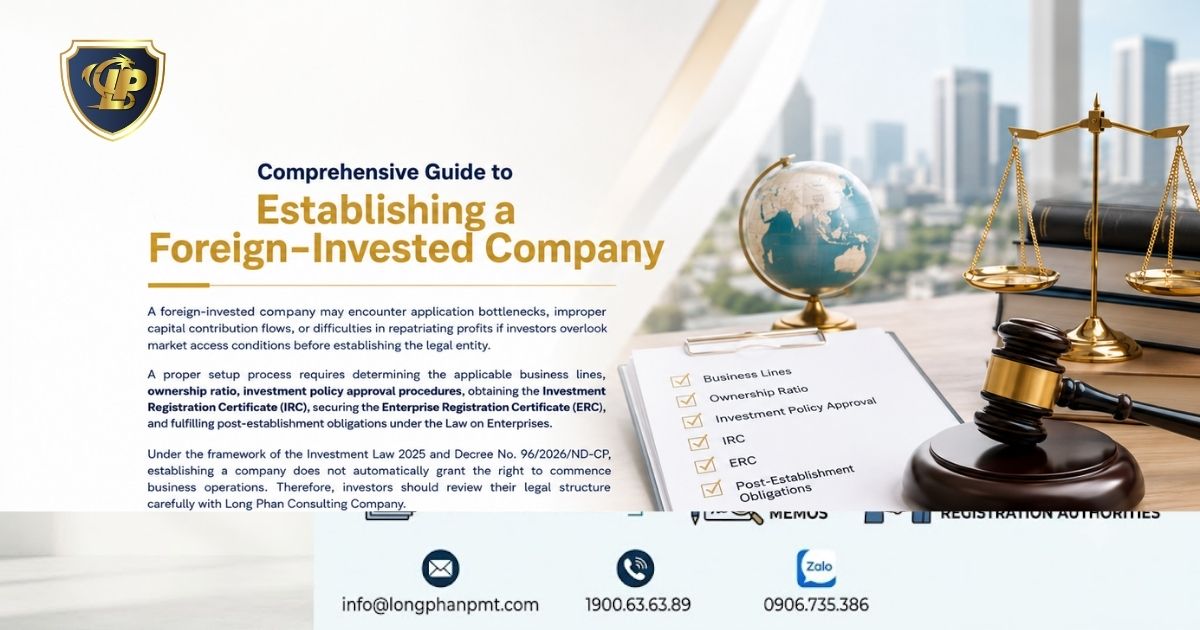
A foreign-invested company may face prolonged licensing procedures, non-compliant capital transfers, or obstacles to profit remittance when market access requirements are not assessed before incorporation. An effective establishment strategy should identify permitted business activities, foreign ownership limits, investment policy approval requirements, and the procedures for obtaining the Investment Registration Certificate and Enterprise Registration Certificate, together with post-incorporation compliance duties. Under the Law on Investment and relevant enterprise regulations, company registration alone does not authorize immediate commercial operations.
Long Phan Consulting assists investors in reviewing ownership structures, licensing conditions, and capital arrangements before commencing business activities.
Key legal notes:
Foreign investors need to choose the right investment form before establishing a legal entity in Vietnam. This decision directly affects capital control rights, the procedures for obtaining an Investment Registration Certificate (IRC), market entry time, and the ability to expand the project later.
According to Clause 2, Article 19 of the Law on Investment 2025, foreign investors may establish an economic organization to implement a project before proceeding with the issuance or amendment of an IRC. However, this mechanism does not exclude the obligation to meet market access conditions for foreign investors.
| Investment form | Procedure | Estimated time of implementation | Level of legal control | Suitable for the project scale |
| Establishing a new economic organization | Review market access requirements, apply for an IRC if required, then apply for an ERC. | Medium to long term, depending on the industry and project location. | High, because the investor controls the legal structure from the beginning. | Suitable for new projects, wholly foreign-owned enterprises, or joint ventures. |
| Contributing capital, purchasing shares, purchasing equity stakes | Register capital contributions if required, then change members or shareholders. | Faster if Vietnamese businesses already meet the operating requirements. | Average to high, depending on ownership percentage and voting rights. | Suitable for M&A, rapid expansion, or leveraging existing licenses. |
| Implementing a project that requires an IRC (Integrated Receipt). | Please obtain approval for the policy, if any, then request an IRC, and subsequently implement the ERC or adjust the legal entity. | Longer durations depend on jurisdiction and the nature of the project. | High price, but subject to strict control from the investment registration authority. | Suitable for large-scale projects involving land, infrastructure, manufacturing, or sensitive industries. |
For small and medium-sized enterprises (SMEs), establishing a new business or investing in a Vietnamese company often helps optimize market entry costs. For large corporations, projects with clearly defined capital scale, location, technology, or infrastructure should be designed according to the IRC (Investment Contract) model to ensure long-term legal stability.
Establishing a new economic entity is a suitable option when investors want to control the entire governance model, charter capital, business lines, and operational strategy in Vietnam. The legal entity can be a wholly foreign-owned enterprise or a joint venture with a Vietnamese partner.
Before establishing a foreign-invested company in this manner, investors must review the planned business sectors. If the sectors are on the list of restricted market access, investors must meet the conditions regarding capital ownership ratio, investment form, scope of operation, and partner capacity as stipulated in Clause 3, Article 8 of the Law on Investment 2025.
A common risk is that investors establish a legal entity first but choose the wrong industry or ownership structure. This can lead to bottlenecks in the stages of applying for an Investment Regulatory Commission (IRC), opening a Direct Investment Account (DICA), or obtaining specialized licenses.
Capital contribution, share purchase, or equity acquisition are suitable options when investors want to quickly enter the market through an existing Vietnamese business. This structure often appears in M&A transactions, joint ventures, or acquisitions of businesses that already have customers, assets, and licenses.
Investors need to carefully assess the ownership ratio after the transaction. If the capital contribution results in a foreign-controlled enterprise, the capital account obligations may change. An ownership threshold of 51% or more of the charter capital is the threshold that necessitates opening a direct investment capital account in certain cases, as stipulated in Clause 2, Article 13 of Circular No. 06/2019/TT-NHNN.
In terms of risk management, M&A is not just about acquiring capital. Investors need to assess the industry, licenses, tax obligations, labor relations, contracts, and the validity of the cash flow before signing the agreement.
For large-scale direct investment projects, those with specific locations, or those in sectors requiring strict control, the Investment Regulatory Commission (IRC) serves as the legal basis for documenting the project’s objectives, scale, timeline, investment capital, and the investor implementing the project. This is a fundamental step before establishing or operating the project’s legal entity.
Projects by foreign investors or economic organizations with foreign investment capital must follow the procedure for issuing an IRC in cases stipulated by law. This mechanism is stipulated in Clause 2, Article 19 and Point a, Clause 1, Article 26 of the Law on Investment 2025.
For large investors, following the IRC process increases transparency when working with banks, partners, tax authorities, and specialized agencies. Conversely, skipping the project classification step may result in the application being rejected due to incorrect procedures or submission to the wrong authority.
Conducting a pre-entry verification of market access conditions is the most critical regulatory checkpoint before setting up a foreign-owned company in Vietnam. Selecting incorrect business lines, exceeding foreign ownership thresholds, or failing to satisfy statutory investment criteria will result in the immediate rejection of the Investment Registration Certificate (IRC), block the activation of capital accounts, and invalidate subsequent applications for specialized operational permits.
Pursuant to Clause 1 and Clause 2, Article 8 of the Law on Investment 2025, foreign investors are granted market access conditions equivalent to domestic investors, except for business sectors explicitly categorized under the Negative List for Market Access. These regulatory compliance filters restrict the charter capital ownership ratio, the permitted investment forms, the operational scope, and the statutory capacity of domestic partners, as governed by Clause 3, Article 8 of the Law on Investment 2025.
For multi-sector enterprises, regulatory compliance risks increase when navigating overlapping statutory conditions. If an investor registers multiple business lines with varying foreign ownership limits, the enterprise is restricted to the lowest maximum ownership ceiling among those registered sectors, pursuant to Point d, Clause 10, Article 17 of Decree No. 96/2026/NĐ-CP.
Foreign investors cannot assume that 100% equity ownership is permitted across all commercial sectors in Vietnam. Multiple industries mandate the participation of a domestic joint venture partner or enforce strict equity caps based on WTO Commitments, CPTPP, EVFTA, or localized statutory regulations.
When evaluating market access conditions, international enterprises must perform a concurrent validation of the following regulatory elements:
Following this initial compliance review, corporate executives must structure their capital allocations and governance models accordingly. Designing an invalid ownership structure at inception necessitates a total restructuring of the IRC, ERC, and specialized sub-license workflows.
For uncommitted commercial sectors or heavily regulated conditional industries, foreign investors must submit a formal market access justification dossier during the initial investment application. This document serves as a primary evidentiary basis for the investment registration authority’s assessment of the IRC.
The compliance justification must comprehensively demonstrate:
Under the regulatory framework of Decree No. 96/2026/NĐ-CP, effective March 31, 2026, investment registration authorities execute a more rigorous evaluation of project objectives against localized market access conditions. Insufficiently prepared justification dossiers or the incorrect application of Vietnam Standard Industrial Classification (VSIC) codes represent the leading causes of administrative delays and iterative revisions.
For projects intersecting technology, logistics, education, or e-commerce, enterprises should execute an exhaustive legal risk assessment prior to submission. This precautionary measure prevents operational conflicts between international treaties and domestic investment regulations.
Incorrect procedural routing is the leading cause of administrative delays and dossier rejections during foreign direct investment procedures in Vietnam. Investors must establish at the outset whether their project requires an Approval of Investment Policy, a mandatory Investment Registration Certificate (IRC), or if it can proceed directly to corporate registration.
Pursuant to Clause 1, Article 3 of the Law on Investment 2025, “Approval of Investment Policy” means a formal decision by a competent state authority approving the objectives, location, scale, schedule, and duration of an investment project, the selection of investors or investment forms, and special mechanisms or policies to execute the project.
The regulatory framework also establishes a distinct hierarchy of administrative jurisdictions. For projects executed across multiple provinces or located outside areas managed by an Industrial Zone Management Board, the statutory authority to issue, amend, and revoke an IRC rests with the Department of Finance, pursuant to Clause 2, Article 36 of Decree No. 96/2026/NĐ-CP.
Specific investment projects cannot bypass the preliminary policy evaluation to apply directly for an IRC or ERC. These projects typically involve large-scale capital allocations, extensive land usage, significant environmental impacts, or sensitive geopolitical sectors.
Identifying the correct competent authority at the project’s inception mitigates the risk of submitting dossiers to improper agencies and restarting the application process. Depending on the nature of the project, statutory approval authority is vested in the National Assembly, the Prime Minister, or the Provincial People’s Committee.
When executing online applications via the National Foreign Investment Information System, enterprises must perform the following sequential compliance actions:
For projects located within industrial zones, export processing zones, or high-tech parks, the specialized Management Board retains direct jurisdiction to issue the IRC pursuant to Clause 3, Article 36 of Decree No. 96/2026/NĐ-CP. If an enterprise misidentifies the governing administrative territory, the application will undergo lengthy inter-agency routing, severely disrupting the market-entry timeline.
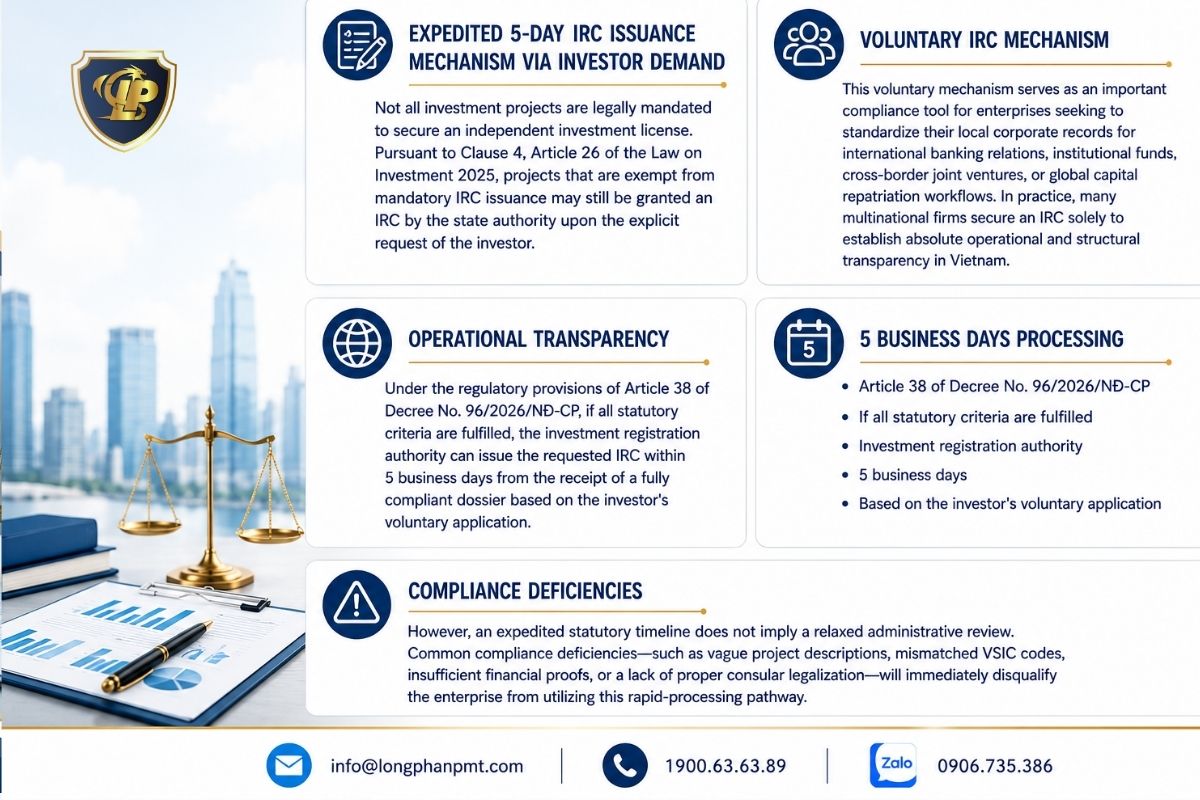
Not all investment projects are legally mandated to secure an independent investment license. Pursuant to Clause 4, Article 26 of the Law on Investment 2025, projects that are exempt from mandatory IRC issuance may still be granted an IRC by the state authority upon the explicit request of the investor.
This voluntary mechanism serves as an important compliance tool for enterprises seeking to standardize their local corporate records for international banking relations, institutional funds, cross-border joint ventures, or global capital repatriation workflows. In practice, many multinational firms secure an IRC solely to establish absolute operational and structural transparency in Vietnam.
Under the regulatory provisions of Article 38 of Decree No. 96/2026/NĐ-CP, if all statutory criteria are fulfilled, the investment registration authority can issue the requested IRC within 5 business days from the receipt of a fully compliant dossier based on the investor’s voluntary application.
However, an expedited statutory timeline does not imply a relaxed administrative review. Common compliance deficiencies—such as vague project descriptions, mismatched VSIC codes, insufficient financial proofs, or a lack of proper consular legalization—will immediately disqualify the enterprise from utilizing this rapid-processing pathway.
Upon verifying market access conditions and securing the appropriate IRC workflow, investors must complete corporate registration procedures to establish a separate legal entity in Vietnam. The Enterprise Registration Certificate (ERC) serves as the definitive statutory instrument establishing the company’s legal persona, corporate identification number, governance framework, and registered business lines.
The incorporation dossier must align with the investment structures established in the preceding regulatory phases. For foreign investors, the registration records must clearly disclose the identities of ultimate beneficial owners, authorized charter capital allocations, legal representatives, operational business lines, and formal commitments to maintain market access compliance.
Pursuant to Article 21 and Article 22 of the Law on Enterprises 2020, a standard incorporation dossier for a limited liability company or a joint-stock company comprises an application for enterprise registration, the corporate charter, a comprehensive roster of founding members or shareholders, and valid legal identification documents. If a member or shareholder is a foreign corporate entity, its constitutional documents must undergo mandatory consular legalization pursuant to Point b, Clause 4, Article 21 and Point b, Clause 4, Article 22 of the Law on Enterprises 2020.
The selection of the corporate form dictates how foreign investors manage voting control, equity transfers, capital restructuring, and subsequent rounds of corporate financing. For foreign-invested companies, this structural selection shapes both internal governance and long-term capital acquisition strategies.
Enterprises should evaluate the following primary corporate models:
For international corporate groups targeting rapid operational expansion, the joint-stock model provides superior structural flexibility for equity adjustments. Conversely, investors prioritizing tight governance control should opt for a limited liability structure to minimize the risk of fractional voting division.
Corporate names, registered office addresses, charter capital thresholds, and industrial classifications must be meticulously structured prior to submitting the ERC application. Drafting errors during this phase will trigger administrative rejections or restrict the company from securing vital operational permits.
The enterprise registration dossier must satisfy the following statutory compliance clusters:
Dossiers are submitted directly to the Provincial Business Registration Office pursuant to Clause 1, Article 21 of Decree No. 168/2025/NĐ-CP. Incorporators are required to submit only 1 single dossier set, and the registration authority is legally prohibited from demanding supplementary documents outside explicit statutory provisions pursuant to Clause 1 and Clause 2, Article 9 of Decree No. 168/2025/NĐ-CP.
For instances where investors utilize specialized investment procedures prior to corporate incorporation, the ERC application may be exempted from enclosing a physical copy of the IRC. However, the corporate founders assume full personal liability for the lawfulness and accuracy of all declared data points pursuant to Clause 5, Article 24 of Decree No. 168/2025/NĐ-CP.
Many foreign-invested enterprises successfully obtain an IRC and ERC but face severe structural barriers when attempting to repatriate profits or execute commercial transactions due to non-compliant capital injection processes. This represents a critical risk area governed strictly by foreign exchange management laws and capital legitimacy audits.
Pursuant to Clause 1, Article 5 and Clause 1, Article 9 of Circular No. 06/2019/TT-NHNN, a foreign-invested economic organization must utilize a dedicated Direct Investment Capital Account (DICA) to process all capital contributions, equity transfers, and outbound profit remittances. Executing capital flows through unapproved banking channels will cause regulatory bodies and commercial banks to reject subsequent remittance requests.
Upon issuance of the ERC, management must immediately deploy the following sequential compliance workflow:
Pursuant to Clause 2, Article 75 of the Law on Enterprises 2020, members and shareholders must inject their full committed charter capital within 90 days from the issuance date of the ERC. This timeline excludes the physical transit time of assets or the administrative duration required to transfer property ownership titles.
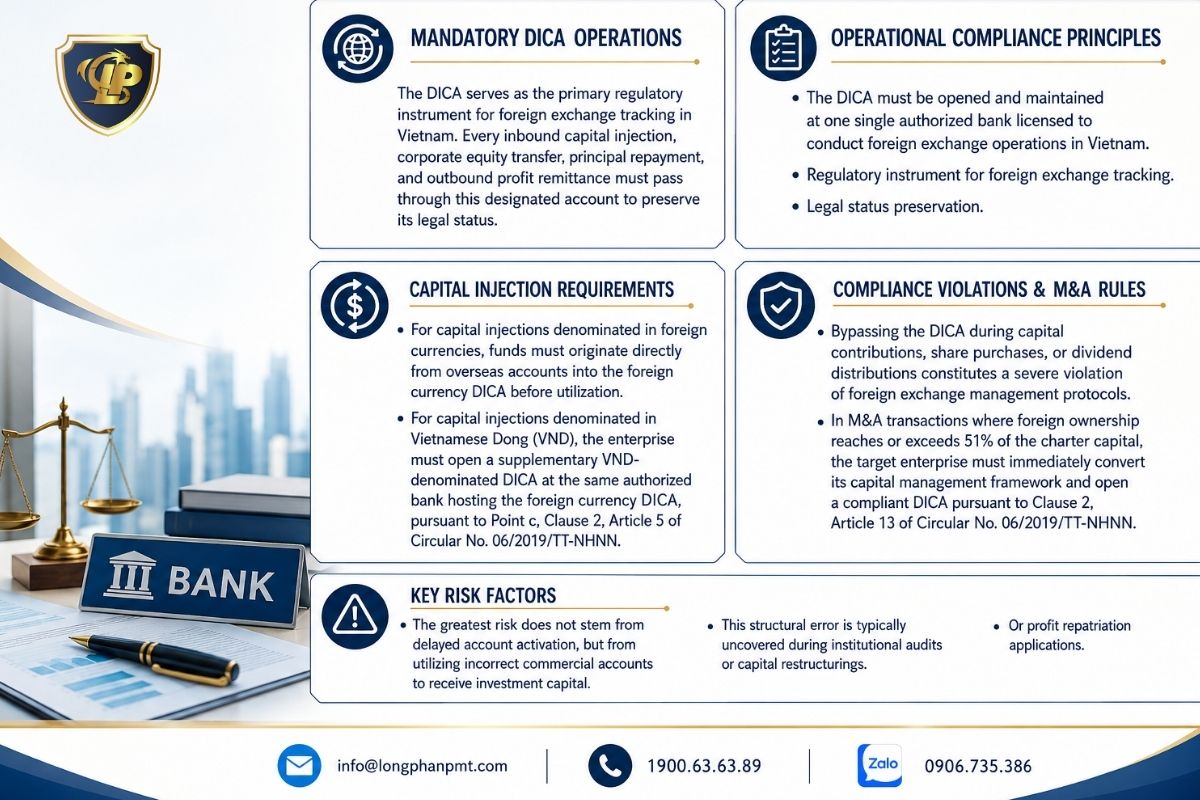
The DICA serves as the primary regulatory instrument for foreign exchange tracking in Vietnam. Every inbound capital injection, corporate equity transfer, principal repayment, and outbound profit remittance must pass through this designated account to preserve its legal status.
Management must adhere to the following operational compliance principles:
Bypassing the DICA during capital contributions, share purchases, or dividend distributions constitutes a severe violation of foreign exchange management protocols. In M&A transactions where foreign ownership reaches or exceeds 51% of the charter capital, the target enterprise must immediately convert its capital management framework and open a compliant DICA pursuant to Clause 2, Article 13 of Circular No. 06/2019/TT-NHNN.
The greatest risk does not stem from delayed account activation, but from utilizing incorrect commercial accounts to receive investment capital. This structural error is typically uncovered during institutional audits, capital restructurings, or profit repatriation applications.
Following capital injection and banking setup, the enterprise must immediately activate its operational compliance framework to avoid being flagged as an inactive or shell corporation by local authorities.
Priority deployment must be given to the following compliance clusters:
Pursuant to Clause 1 and Clause 10, Article 8 of Decree No. 168/2025/NĐ-CP, the unique enterprise identification number functions concurrently as the corporate tax code and the social insurance registration code. This integrated data model streamlines administrative tracking but ensures that compliance failures in one sector are immediately visible across all regulatory agencies.
If an enterprise delays capital injections, makes fraudulent charter capital declarations, or commences commercial operations without fulfilling mandatory legal prerequisites, administrative fines may reach 100,000,000 VND pursuant to Clause 5 and Clause 6, Article 47 of Decree No. 122/2021/NĐ-CP.
Securing an ERC or IRC does not grant an immediate, unrestricted right to launch commercial operations. For a foreign-invested enterprise, specialized sub-licensing represents the final regulatory tier, functioning as validation that the entity satisfies specific statutory criteria regarding professional personnel, capital adequacy, operational facilities, and environmental safety.
Pursuant to Clause 1 and Clause 5, Article 7 of the Law on Investment 2025, enterprises may only initiate operations in conditional business sectors after satisfying all prescribed legal criteria and obtaining the corresponding specialized license, certificate, or formal written approval. Furthermore, the company must maintain continuous compliance with these operational conditions throughout its entire life cycle, pursuant to Clause 1, Article 8 of the Law on Enterprises 2020.
| Industry Cluster | Standard Compliance Prerequisites | Mandatory Specialized Licenses to Review | Non-Compliance Risks (Premature Operation) |
| Retail & Distribution | Product scope restrictions, commercial location verifications, Economic Needs Test (ENT) justifications if applicable. | Business License, Retail Establishment Permit . | Immediate operational suspension; inability to issue lawful commercial invoices for restricted goods. |
| Logistics | Statutory foreign equity caps, transport fleet verifications, specialized personnel certifications, defined service scopes. | Specialized operational permits or certificates tailored to specific transit modalities. | Commercial contracts may be declared legally invalid due to non-compliant operational capacity. |
| Education | Fixed facility specifications, standardized curricula, native/local teaching credentials, minimum investment capital thresholds. | Decision Permitting Educational Establishment, Specialized Educational Operation License. | Total prohibition on student recruitment, marketing, or academic certification issuance. |
| Healthcare | Medical practice certificates, facility sterilization standards, advanced equipment tracking, designated chief medical officers. | Medical Operation License | Severe administrative and criminal liability for practicing without certified medical oversight. |
| E-Commerce | Entity operational capacity, secure digital architecture, online marketplace protocols, mandatory reporting or registration. | E-Commerce Website Notification, E-Commerce Trading Portal Registration. | Immediate platform shutdown mandates; mandatory restructuring of digital operational models. |
| Real Estate & Construction | Minimum legal capital, corporate practicing certificates, individual engineering licenses, project localization approvals. | Construction Capability Certificate, Real Estate Development or Project Execution Permits. | Absolute invalidity of commercial leasehold titles, engineering contracts, or project divestments. |
This matrix serves as an initial risk classification framework. Foreign enterprises must verify every registered industrial code, project objective, and regional zoning law prior to launching advertisements, executing commercial contracts, or generating operational revenue.
The education, healthcare, and real estate sectors face strict regulatory scrutiny because they directly impact public welfare, consumer safety, and structural market stability. Investors cannot rely solely on the generic business lines printed on their ERC to initiate services.
Management must validate the following compliance clusters prior to deployment:
If an initial application declares an elevated charter capital structure but the enterprise fails to produce adequate financial backing during verification, the project may be deemed unfeasible by state regulators. Fabricating charter capital declarations at or above 100 billion VND triggers severe administrative penalties, resulting in fines ranging from 80,000,000 VND to 100,000,000 VND pursuant to Clause 5 and Clause 6, Article 47 of Decree No. 122/2021/NĐ-CP.
Logistics, e-commerce, and retail distribution represent high-growth sectors that attract substantial foreign capital but remain surrounded by complex regulatory layers. The primary compliance failure occurs when an enterprise registers broad business lines but operates without securing the specific underlying sub-licenses required for actual commercial execution.
Enterprises must audit the following operational focus areas before launch:
Operating within a prohibited business sector or executing conditional operations without securing formal regulatory approvals results in aggressive state enforcement. Conducting business within prohibited sectors triggers administrative fines ranging from 200,000,000 VND to 300.000.000 VND, accompanied by immediate corporate shutdown mandates and the total confiscation of all illegally derived revenues pursuant to Clause 3 and Clause 4, Article 16 of Decree No. 122/2021/NĐ-CP.
Dossiers for setting up a foreign-owned company in Vietnam must be meticulously cataloged into distinct document sets rather than compiled as a single generic application. This structured classification allows investors to efficiently monitor specific legal prerequisites, verify corporate financial allocations, and audit the regulatory validity of international records before formal administrative submission.
For all documentation generated by overseas authorities, completing formal consular legalization represents an absolute statutory mandate. If a member or shareholder is an international corporate entity, its primary constitutional records must undergo mandatory consular legalization prior to the filing of the enterprise registration dossier, pursuant to Point b, Clause 4, Article 21 and Point b, Clause 4, Article 22 of the Law on Enterprises 2020.
Pursuant to Article 21 and Article 22 of the Law on Enterprises 2020, incorporation records for a limited liability company or a joint-stock company must comprise an application for enterprise registration, the corporate charter, and a comprehensive roster of founding members or shareholders. For investment projects subject to mandatory investment licensing, the ERC application must attach a valid copy of the issued Investment Registration Certificate, pursuant to Point c, Clause 4, Article 21 and Point c, Clause 4, Article 22 of the Law on Enterprises 2020.
In practical administrative workflows, structural application delays rarely result from missing standardized forms. Instead, they are driven by international records lacking proper consular legalization, translation discrepancies across bilingual profiles, or capital declarations that do not match verified financial statements. Management must audit every dossier set against the specific investor profile, targeted project metrics, and registered business lines prior to official filing.
The administrative timeline required to set up a foreign-owned company in Vietnam cannot be defined by a single static estimate. The actual processing duration fluctuates significantly based on whether the underlying project triggers an Approval of Investment Policy, a mandatory IRC issuance, a detailed market access justification, or specialized post-incorporation sub-licensing.
Investors must precisely map the administrative bodies governing each stage of the market-entry workflow to prevent application rejections due to improper jurisdictional filing. Under the current decentralized administrative framework, the Department of Finance exercises direct statutory authority to issue, amend, or revoke an IRC across multiple scenarios, pursuant to Clause 2, Article 36 of Decree No. 96/2026/NĐ-CP.
| Regulatory Procedure | Statutory Processing Timeline | Direct Competent Authority |
| Approval of Investment Policy | Subject to project scale and evaluation complexity. | The National Assembly, the Prime Minister, or the Provincial People’s Committee. |
| Standard Investment Registration Certificate (IRC) | 10 business days from receipt of a fully compliant dossier. | The Department of Finance or the specialized Industrial Zone Management Board. |
| Expedited Investor-Demand IRC | 05 business days upon satisfying fast-track criteria. | The competent investment registration authority possessing regional jurisdiction. |
| Enterprise Registration Certificate (ERC) | 03 business days from receipt of a fully compliant dossier. | The Provincial Business Registration Office. |
| Online Investment Project Declaration | Mandatory prerequisite prior to physical dossier submission. | The National Foreign Investment Information System Electronic Portal. |
Pursuant to Clause 3, Article 39 of Decree No. 96/2026/NĐ-CP, the statutory timeline for issuing an IRC for projects exempt from an initial policy approval is 10 business days from the receipt of a fully compliant dossier. Where investors voluntarily request an IRC under the investor-demand mechanism and satisfy all underlying compliance criteria, the investment registration authority may process and issue the license within an expedited 5-business-day window in accordance with Decree No. 96/2026/NĐ-CP.
Accurately determining the governing administrative body is vital to prevent dossiers from being trapped in protracted inter-agency transfers. For foreign direct investment procedures in Vietnam, licensing authority is no longer concentrated solely within the Department of Planning and Investment as was historically practiced.
The primary administrative authorities are structured as follows:
Pursuant to Clause 2, Article 36 of Decree No. 96/2026/NĐ-CP, the Department of Finance is formally decentralized to execute all statutory powers regarding the issuance, amendment, and revocation of the IRC within its designated legal scope. This represents an important administrative shift that corporate executives must reflect when preparing investment records under modern compliance workflows.
Prior to lodging physical documentation with any administrative body, developers must complete an electronic declaration of project metrics on the National Foreign Investment Information System. Any data mismatch between the online system inputs and the physical hard-copy records will trigger immediate amendment notices or formal justification demands.
Management should execute the digital compliance workflow in the following sequential order:
In daily compliance workflows, application delays are rarely caused by a simple lack of documentation. Instead, they stem from logical inconsistencies between electronic system inputs and physical dossier records. This risk multiplies in complex projects featuring multi-tier corporate investors, diversified business lines, or intricate capital allocation schedules.
Applications to set up a foreign-owned company in Vietnam are routinely delayed or rejected not due to administrative omissions, but because of systemic logical errors connecting business lines, ownership caps, financial proofing, and banking channels. Investors must utilize a preventative risk management review rather than simply compiling documents against a basic checklist.
The following high-risk areas must be systematically audited before submitting any dossier to investment or corporate registration authorities:
If an enterprise utilizes fraudulent or untruthful disclosures to secure an ERC or IRC, regulatory bodies retain the statutory power to revoke the issued licenses and force the entity to revert to its pre-incorporation legal state, pursuant to Clause 1, Article 69 of Decree No. 168/2025/NĐ-CP. Furthermore, conducting commercial activities under an un-incorporated corporate form carries heavy financial penalties, exposing founders to administrative fines ranging from 50,000,000 VND to 100,000,000 VND pursuant to Clause 4, Article 46 of Decree No. 122/2021/NĐ-CP.
This pre-submission checklist should function as the final internal compliance gate. For enterprises managing multi-sector operations, special attention must be paid to validating the lowest applicable foreign ownership limit, particularly when multiple registered business lines enforce distinct equity ceilings.
Foreign investors must not misinterpret the modern mechanism permitting preliminary corporate establishment under the Law on Investment 2025 as an unconditional right to immediately execute commercial operations. This statutory framework introduces a procedural sequence modification; it does not reduce an enterprise’s legal obligation to satisfy market access conditions, obtain specialized sub-licenses, and verify the absolute legitimacy of all inbound capital.
Within the Vietnamese foreign direct investment framework, licensing applications and banking capital records are inextricably linked. A single procedural error during early capital injections, a failure to use the designated receiving account, or an insufficient financial capacity defense will inevitably disrupt downstream corporate restructurings, project expansions, or cross-border profit remittances.
The modern execution of foreign-invested company incorporation has evolved far beyond basic administrative form-filling. International enterprises must concurrently navigate complex market access filters, structured capital allocations, strict foreign exchange compliance rules, multi-tiered post-incorporation licensing, and immediate post-entry tax and labor activations.
Long Phan Consulting Company delivers comprehensive, risk-mitigated legal solutions, ensuring complete structural alignment between your investment objectives, banking frameworks, and operational compliance profiles from the earliest phases of market-entry design.
Navigating the multi-layered corporate regulations of Vietnam demands specialized local expertise and proactive risk mitigation. Foreign investors and corporate executives are invited to submit their preliminary project briefs, corporate structures, or foundational dossiers via Email at info@longphanpmt.com or through Zalo/WhatsApp at +84 906 735 386 to receive a comprehensive preliminary legal evaluation and structural risk review.
Foreign-invested companies often face risks not at the initial application stage, but at “bottlenecks” related to ownership ratios, direct investment accounts (DICA), market access conditions, and operational obligations after licensing. These situations directly impact the right to transfer profits, expand projects, and maintain a legal business license. Reviewing these legal edge cases beforehand significantly reduces the risk of operational disruption or administrative penalties.
Yes, but foreign investors must still fully meet market access requirements before commencing actual business operations. The Law on Investment 2025 allows for the establishment of an economic organization to implement a project before proceeding with the IRC issuance procedure in certain cases, but it does not eliminate obligations regarding ownership ratios, investment forms, and scope of operations as stipulated in Clause 3, Article 8 of the Law on Investment 2025. If a business chooses the wrong industry or exceeds market access limits, its application may be rejected at the IRC or specialized license issuance stage.
Yes. Economic organizations with foreign direct investment are required to use a foreign direct investment capital account to conduct transactions involving capital contributions, share purchases, and profit transfers abroad, as stipulated in Clause 1, Article 5 and Clause 1, Article 9 of Circular No. 06/2019/TT-NHNN. If a foreign investor owns 51% or more of the charter capital, the enterprise must open a Direct Investment Account (DICA) as stipulated in Clause 2, Article 13 of Circular No. 06/2019/TT-NHNN. If the capital contribution flows into the wrong account, the enterprise may face risks when transferring profits or adjusting investment projects.
Yes. The legal documents of a foreign organization used to establish a foreign-invested company in Vietnam must be consular legalized before submitting the business registration application. This requirement applies to the establishment license, business registration certificate, or equivalent legal documents of the foreign organization as stipulated in Point b, Clause 4, Article 21 and Point b, Clause 4, Article 22 of the 2020 Enterprise Law. If the documents are not consular legalized or the notarized translations are inconsistent, the ERC application may be required to be amended or rejected.
Yes. Investors are still entitled to apply for an Investment Registration Certificate even if the project is not subject to mandatory IRC application requirements under Clause 4, Article 26 of the Law on Investment 2025. This mechanism helps businesses increase transparency when working with banks, investment funds, and international partners. For applications that meet the expedited processing criteria, the investment registration authority may issue an IRC within 10 working days as per Clause 3, Article 39 of Decree No. 96/2026/ND-CP, or apply a simplified mechanism as stipulated in specific regulations.
No. Having an Enterprise Registration Certificate (ERC) or Investment Registration Certificate (IRC) does not mean that a business is immediately entitled to operate in conditional business sectors. A business can only operate after meeting all the conditions and obtaining the necessary specialized licenses as stipulated in Clauses 1 and 5 of Article 7 of the Law on Investment 2025. Intentionally engaging in prohibited business sectors can result in fines ranging from VND 200,000,000 to VND 300,000,000, as per Clauses 3 and 4 of Article 16 of Decree No. 122/2021/ND-CP.
Yes. Foreign-invested economic organizations, when adjusting projects, adding business lines, contributing capital, or establishing new legal entities, must apply market access conditions under the new legal framework as stipulated in Clause 2, Article 104 of Decree No. 96/2026/ND-CP. However, if the enterprise is already enjoying more favorable market access conditions under a previously granted IRC, it may continue to apply the old mechanism as stipulated in Clause 9, Article 52 of the Law on Investment 2025. This is particularly important for M&A transactions and the expansion of multi-sector FDI activities.
Setting up a foreign-owned company in Vietnam demands meticulous, multi-tiered alignment across market access conditions, direct investment registration (IRC) channels, corporate incorporation (ERC) records, foreign exchange bank accounts (DICA), and post-incorporation operational licensing. Errors in structuring corporate business lines, miscalculating ownership caps, or executing capital flows outside authorized banking portals will lead to application blocks, prevent profit repatriation, and trigger severe post-incorporation state penalties. To insulate your enterprise against structural regulatory risks during the early phases of project planning, corporate management should contact our central hotline at 1900636389 to secure dedicated advisory support from Long Phan Consulting Company and execute a compliant market-entry strategy.
📚 This article is provided with professional consultation based on the following legal framework:


