
Food safety certificates for coffee shops should be reviewed and prepared before launch to prevent fines, operational suspension, and revenue disruption. Business owners must standardize the Food Safety Certificate dossier, staff health records, water source documentation, beverage preparation area, and ingredient storage procedures before the competent inspection team conducts its on-site assessment. Incomplete documentation may delay opening schedules, particularly for F&B chains, franchise models, or acquisition transactions. The Legal Updates below provide guidance on building a practical compliance roadmap with professional support from Long Phan Consulting.
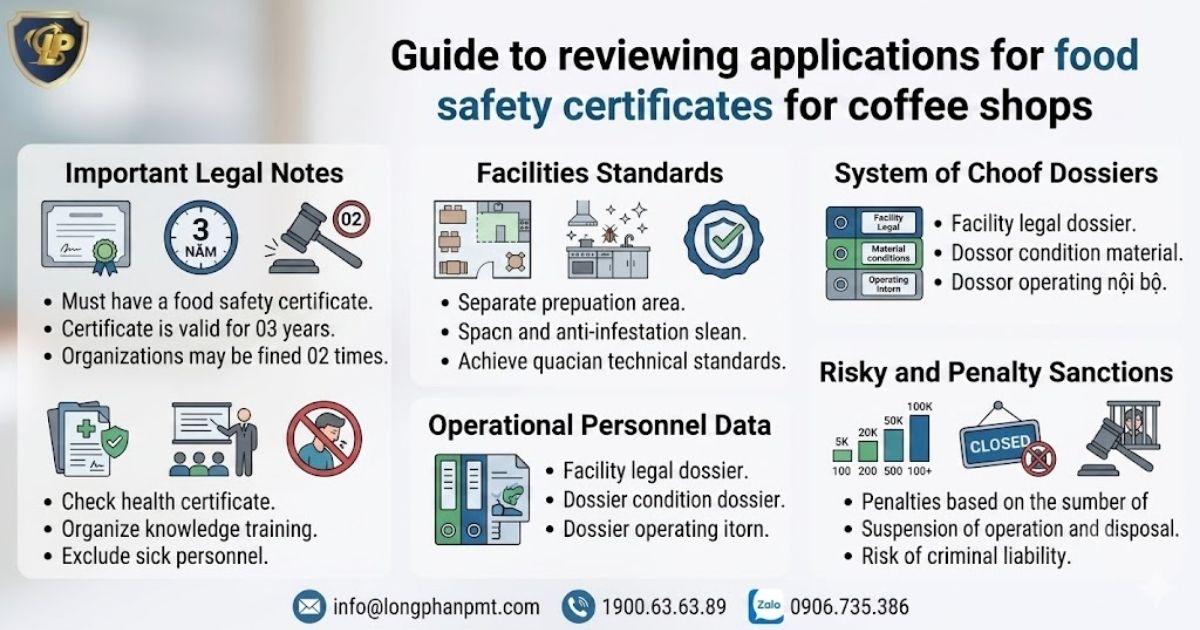
Important legal note:
Coffee shop operators must secure a Certificate of Eligibility for Food Safety prior to initiating commercial operations. Obtaining this permit represents a primary operational milestone directly impacting grand opening schedules, cash flows, and legal standing under Vietnamese law.
The legal obligation to hold a Food Safety Certificate arises because coffee shops, juice bars, and beverage establishments fall under the statutory classification of food service establishments. Serving customers prior to license issuance exposes the enterprise to immediate administrative inspections, heavy fines, and mandatory operational shutdown orders. Food service establishments must satisfy mandatory food safety conditions and obtain an official Certificate of Eligibility for Food Safety prior to commercial launch, pursuant to Clause 10, Article 5 and Clause 1, Article 34 of the 2010 Law on Food Safety.
Corporate managers and investors must integrate licensing procedures into initial setup timelines, specifically under the following business scenarios:
Applicable statutory frameworks recognize no general licensing exemptions for commercial coffee shop operations. Consequently, the safest strategy for F&B operators is to align physical infrastructure, staffing records, and operational dossiers with legal standards prior to serving the public.
Official appraisal delegations perform rigorous on-site evaluations comparing physical floor plans, equipment, water testing records, and staff files against submitted documentation. Discrepancies between operational descriptions and actual store setups result in inspection failures, forcing unexpected renovation expenses and launch delays. F&B investors must treat food safety criteria as fundamental architectural design standards rather than post-construction administrative tasks.
Beverage preparation areas must follow strict spatial separation principles to prevent cross-contamination between raw ingredients, soiled utensils, and finished drinks. Implementing compliant one-way operational flows during initial design is critical to passing physical inspections on the first attempt.
Prior to completing interior fit-outs, management must audit the following critical control points:
A frequent error among foreign operators is signing commercial leases prior to assessing whether the floor plan supports a compliant one-way prep workflow. For F&B chains, repeating layout flaws across multiple outlets exponentially increases retrofitting costs.
Water supply systems and ingredient refrigeration units are frequently overlooked during M&A acquisitions of existing coffee shops. However, these technical components directly affect product quality and statutory corporate liabilities during health inspections.
F&B operators must audit technical specifications and supporting compliance documentation simultaneously:
In practice, water laboratory test results, ingredient supply contracts, and cold storage logs should be centralized within store compliance binders. This evidentiary record serves as primary defense documentation during post-licensing audits or customer food safety complaints.
Baristas and kitchen staff represent a fluid operational risk due to shift rotations, turnover, and cross-store transfers. Multi-location operators must manage staff records as a dedicated F&B HR compliance protocol.
Corporate onboarding workflows should enforce the following verification sequence:
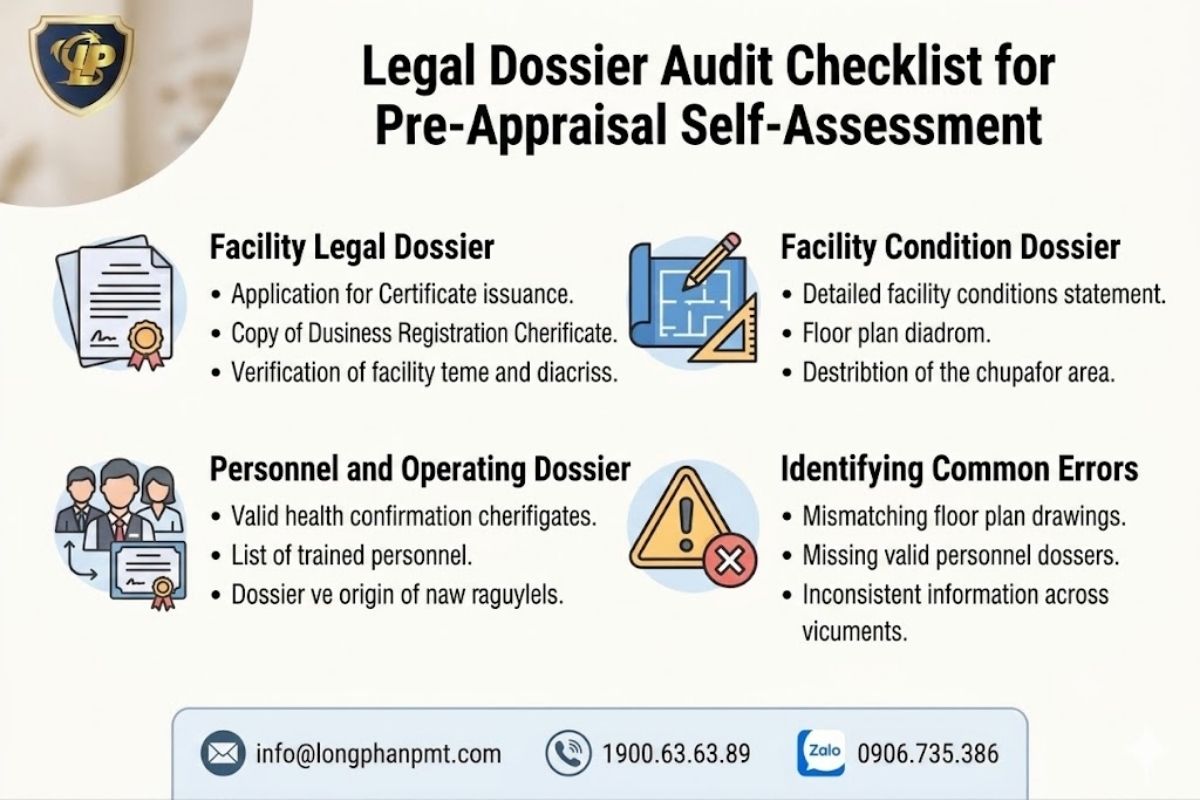
An application dossier for a Food Safety Certificate functions as an organized evidentiary framework proving that physical facilities, staff qualifications, and operational workflows meet statutory safety standards. For F&B operators, the primary compliance objective is ensuring absolute alignment between submitted documentation, physical floor plans, staff rosters, and actual bar operations. Discrepancies between filing materials and store realities inevitably trigger formal rectification demands or immediate appraisal rejections.
Application materials should be organized by functional document groups rather than filed as loose individual forms. Categorizing filing documentation enables multi-outlet chains to maintain operational control across locations and prevents missing document errors during shift turnover.
| Document Group | Detailed Document Itemization | Operational Guidance for Enterprises |
| Legal Status Dossier | Formal Application Form; copy of Enterprise Registration Certificate (ERC) or Household Business Registration with matching F&B business scopes. | Cross-check entity name, store address, legal representative, and business scope before submission. |
| Facility & Equipment Dossier | Explanatory statement of physical facilities, equipment, and utensils; store floor plan diagram; detailed descriptions of bar and storage zones. | Floor plan schematics must match physical store layouts during the state delegation inspection. |
| Personnel Qualification Dossier | Valid medical clearance certificates for owner and direct bar staff; master list of staff trained in food safety knowledge. | High turnover area; update staff files immediately upon onboarding new bar personnel. |
| Internal Operational Dossier | Ingredient origin documentation; commercial waste collection contracts; 3-step food inspection logs and retention samples (if applicable). | Demonstrates active hazard management during post-licensing state inspections and audits. |
The mandatory filing package comprises 05 core document categories: the formal application form, business registration certificate, facility explanatory statement, staff health certificates, and training confirmation lists, pursuant to Clause 1, Article 36 of the 2010 Law on Food Safety.
Filing rejections rarely stem from missing forms alone; they primarily arise when application descriptions fail to mirror actual store setup conditions. Prior to scheduling on-site inspections, store managers must perform cross-audits across architectural drawings, staff files, bar workflows, and supplier invoices.
F&B management teams should audit the following high-risk failure points prior to hosting appraisal delegations:
>> See more: Procedures Must a Business Complete When Expanding Its Business Lines
Application timelines for a Food Safety Certificate must be directly integrated into store launch schedules. Calculating interior fit-out schedules without budgeting for statutory appraisal windows risks pushing back grand opening dates due to mandatory document revisions or facility modifications. Competent licensing authorities vary based on jurisdictional delegation rules governing food service establishments. Consequently, standalone entities, household businesses, and multi-location corporate chains must confirm the correct receiving authority prior to submission.
Securing a Food Safety Certificate involves a two-tiered statutory review: administrative dossier verification followed by a physical on-site facility appraisal. F&B management must align documentation, interior layouts, and staff readiness along a single synchronized timeline to prevent inspection failures.
1.Dossier Submission: Step 1 — Competent Authority Receiving.
Food service entities submit the complete application package to the competent state authority. Licensing authority designations are established under sector-specific regulations issued by the Minister of Health, Minister of Agriculture and Rural Development, or Minister of Industry and Trade, pursuant to Article 35 and Point a, Clause 2, Article 36 of the 2010 Law on Food Safety.
2.On-Site Physical Appraisal: Step 2 — Within 15 Days.
Within 15 days from receiving a complete and valid dossier, competent state authorities conduct an on-site physical appraisal to inspect food safety conditions at the operational facility, pursuant to Point b, Clause 2, Article 36 of the 2010 Law on Food Safety.
3.License Issuance or Written Refusal: Step 3 — Final Administrative Result.
If the physical inspection confirms compliance, the authority issues the official Certificate of Eligibility for Food Safety. In the event of license refusal, the authority must issue a written explanation stating the explicit legal grounds, pursuant to Point b, Clause 2, Article 36 of the 2010 Law on Food Safety.
Investors should finalize public launch dates only after receiving a successful appraisal report or an official grant decision. Commencing commercial operations prior to formal license issuance converts an administrative procedure into heavy fine exposures and shutdown risks.
Monitoring license expiration dates is critical during chain expansion and M&A store acquisitions. Operating under an active certificate does not guarantee that corporate restructuring, facility alterations, or lease transfers remain compliant under existing permits.
F&B operators must audit the following statutory parameters:
For operating F&B outlets, renewal filings should be managed as a routine corporate compliance milestone. Awaiting license expiration creates an illegal operating window, especially during store network expansions or business transfers.
>>> See more: LEGAL DUE DILIGENCE AND M&A TRANSACTION STRUCTURING FOR INVESTORS
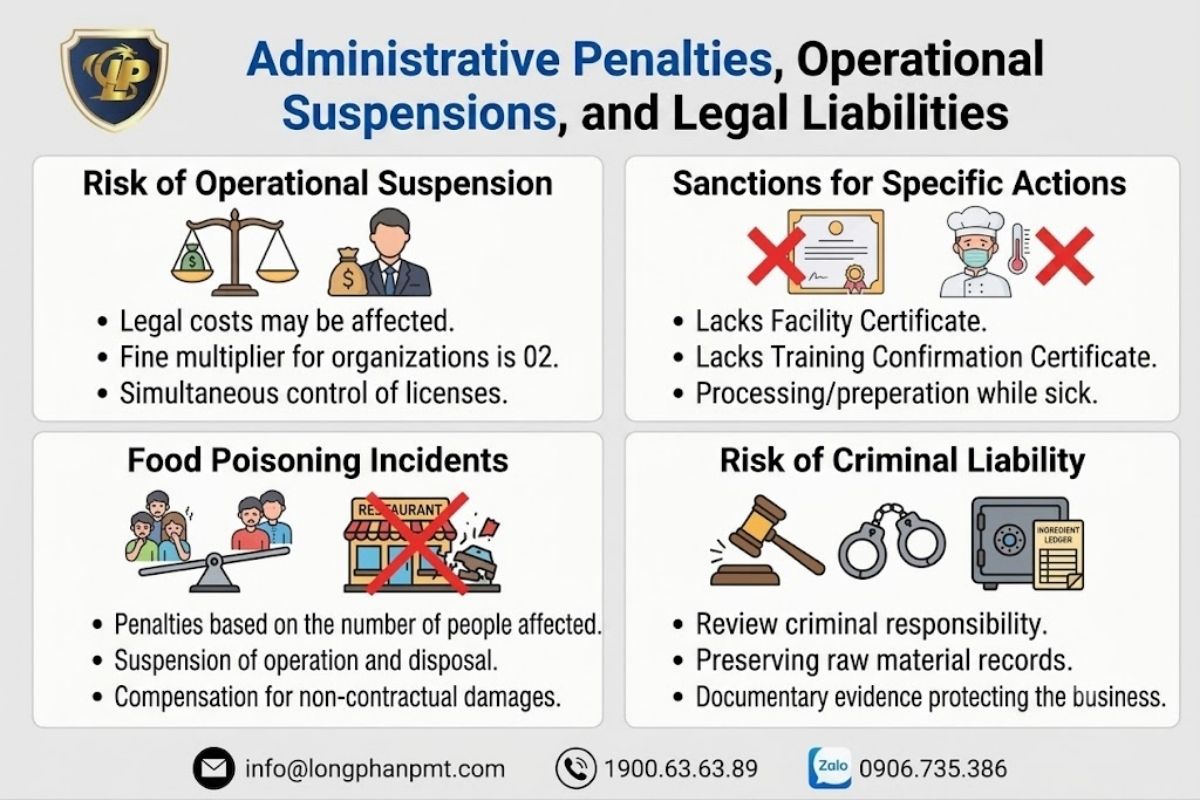
Food safety risks must be quantified as potential corporate legal liabilities directly threatening grand opening dates, operational cash flows, and brand equity. For corporate entities operating coffee chains, statutory fine calculations extend significantly beyond baseline individual penalties. All baseline fines listed in administrative penalty decrees represent amounts applied to individuals; for corporate entities, statutory fine amounts are doubled, pursuant to Clause 2, Article 1 of Decree No. 124/2021/ND-CP.
F&B management must maintain strict compliance across facility setups, water testing, personnel records, and active permits. Minor operational oversights inside the bar area can establish immediate legal grounds for administrative fines during municipal health inspections.
| Non-Compliant Operational Behavior | Statutory Legal Basis | Baseline Individual Fine Range | Mandatory Remedial Actions & Operational Fixes |
| Operating without a valid Food Safety Certificate or operating with an expired certificate. | Clause 1, Article 18 of Decree 115/2018/ND-CP (amended by Clause 8, Article 1 of Decree 124/2021/ND-CP) | VND 10,000,000 to VND 15,000,000 (Corporate: VND 20,000,000 to VND 30,000,000) | Cease operations immediately; complete filing for Food Safety Certificate issuance. |
| Bar staff failing to wear caps or face masks, failing to trim fingernails, or handling ready-to-serve drinks directly without gloves. | Point d, Clause 1, Article 15 of Decree 115/2018/ND-CP | VND 1,000,000 to VND 3,000,000 | Standardize store SOPs, enforce shift checks, and re-train direct bar staff. |
| Blocked, unsealed drainage channels in prep areas, or lacking hygienic, covered waste containers. | Points d & e, Clause 2, Article 15 of Decree 115/2018/ND-CP (amended by Points b & c, Clause 6, Article 1 of Decree 124/2021/ND-CP) | VND 3,000,000 to VND 5,000,000 | Renovate drainage systems, install covered trash bins, and record cleaning logs. |
| Employing direct bar personnel who lack valid food safety knowledge training certificates. | Clause 3, Article 15 of Decree 115/2018/ND-CP (amended by Point d, Clause 6, Article 1 of Decree 124/2021/ND-CP) | VND 5,000,000 to VND 7,000,000 | Complete staff training files and update active employee rosters prior to bar assignment. |
| Business owner lacking food safety training confirmation, or using non-compliant water for brewing or cleaning. | Points a & b, Clause 4, Article 15 of Decree 115/2018/ND-CP (amended by Point đ, Clause 6, Article 1 of Decree 124/2021/ND-CP) | VND 7,000,000 to VND 10,000,000 | Owner completes training; conduct water lab re-testing periodically. |
| Employing staff infected with communicable diseases (cholera, dysentery, typhoid, hepatitis A/E, active TB, acute diarrhea). | Clause 5, Article 15 of Decree 115/2018/ND-CP (amended by Point e, Clause 6, Article 1 of Decree 124/2021/ND-CP) | VND 10,000,000 to VND 15,000,000 | Reassign staff immediately; update medical health checks and HR compliance files. |
Corporate Fine Scale Rule: For corporate entities, statutory fines are calculated at exactly 2x the baseline individual rates, pursuant to Clause 2, Article 1 of Decree No. 124/2021/ND-CP.
Food poisoning outbreaks represent severe legal liabilities expanding beyond routine administrative fines. Corporate entities face medical costs, civil damages, mandatory food destruction, and brand damage.
Management must prepare for the following escalating legal liabilities:
Coffee shop food safety compliance requires seamless integration across legal filings, architectural layouts, staff health records, and store operations. Navigating local administrative procedures, municipal health inspections, and strict F&B licensing conditions in Vietnam can be challenging for foreign investors and corporate operators. Senior Legal Counsel at Long Phan Consulting Company provides end-to-end legal representation to streamline licensing, mitigate fine risks, and protect launch timelines.
Our dedicated F&B legal practice covers the following scope:
F&B investors and corporate managers may transmit existing store documentation, layout schematics, or lease files via Email at info@longphanpmt.com or WhatsApp/Zalo at +84 906 735 386 for an initial legal risk evaluation.
Operating a food and beverage service chain involves numerous legal risks that go beyond basic administrative procedures. Understanding the core regulations regarding “Food Safety Certificates for Coffee Shops” helps investors proactively prevent the risk of having their operations suspended by authorities. Thoroughly resolving compliance issues is the optimal strategy to protect brand reputation and maintain a stable cash flow for the business.
Businesses will be subject to administrative penalties ranging from VND 20,000,000 to VND 30,000,000 for operating food service businesses without a Food Safety Certificate (or with a certificate that has expired). This penalty range is applied directly to the violating organization as stipulated in Clause 8, Article 1 of Decree No. 124/2021/ND-CP, in conjunction with the principle of stipulating penalties for organizations as specified in Point b, Clause 2, Article 1 of Decree No. 124/2021/ND-CP.
Owners of food service establishments are required to use water that meets national technical standards for food processing, business operations, and equipment cleaning. Specifically, according to Official Letter No. 5845/BCT-KHCN of 2013, domestic water at the establishment must comply with the National Technical Standard QCVN 02:2009/BYT. If the owner of a food service establishment uses water that does not meet the technical standards or does not ensure hygiene as prescribed for food processing, beverage preparation, or equipment cleaning, the fine applied to the individual is from VND 7,000,000 to VND 10,000,000 as stipulated in Point a, Clause 4, Article 15 of Decree No. 115/2018/NĐ-CP.
Businesses are strictly prohibited from employing individuals with infectious diseases to prepare beverages. A fine of VND 10,000,000 to VND 15,000,000 will be imposed on individuals who employ food handlers suffering from diseases such as cholera, dysentery, typhoid fever, hepatitis A and E, infectious dermatitis, pulmonary tuberculosis, or acute diarrhea, as stipulated in Clause 5, Article 15 of Decree 115/2018/ND-CP, amended by point e, Clause 6, Article 1 of Decree 124/2021/ND-CP.
A fine of VND 5,000,000 to VND 7,000,000 will be imposed on individuals who employ food handlers without a food safety training certificate, as stipulated in Clause 3, Article 15 of Decree 115/2018/ND-CP, amended by Point d, Clause 6, Article 1 of Decree 124/2021/ND-CP. The fine for businesses (organizations) will be twice the amount imposed on individuals, as stipulated in Clause 2, Article 3 of Decree 115/2018/ND-CP, amended by Point b, Clause 2, Article 1 of Decree 124/2021/ND-CP.
The establishment owner will face severe administrative penalties and be required to pay all treatment costs for those affected by food poisoning. A fine of VND 40,000,000 to VND 50,000,000 will be applied to individuals who provide beverages causing food poisoning affecting 1 to 4 people, but not to the extent of criminal prosecution as stipulated in Point d, Clause 12, Article 1 of Decree No. 124/2021/ND-CP. Regarding civil liability, the coffee shop owner (the organization or individual providing the food) is obligated to compensate for all damages and treatment costs for those affected by food poisoning, as stipulated in Clause 5, Article 53 of the 2010 Food Safety Law.
Within 15 days from the date of receiving a complete and valid application, the competent state agency will conduct an on-site inspection of the food safety conditions at the food production and business establishment; if the conditions are met, a Certificate of Food Safety Compliance must be issued (in case of refusal, a written response stating the reasons must be provided) as stipulated in Point b, Clause 2, Article 36 of the 2010 Food Safety Law.
Securing a coffee shop food safety certificate in Vietnam is an essential operational milestone ensuring full statutory compliance, preventing costly launch delays, and protecting corporate cash flows. F&B investors must conduct a simultaneous audit of business registrations, health certificates, water quality reports, bar schematics, and ingredient sourcing prior to welcoming state appraisal delegations. Addressing licensing requirements early protects brands against administrative fines, operational shutdown orders, and civil liabilities. Contact Hotline 1900636389 for expert legal representation from Senior Legal Counsel at Long Phan Consulting Company.
📚 This article has been professionally reviewed based on the following legal documents: