
A gym operating license must be secured before launching fitness operations to prevent administrative penalties, business suspension, or delays in recovering setup and investment costs. To lawfully operate a gym, enterprises must obtain a Certificate of Eligibility for Sports Business Activities from the specialized physical education and sports authority under the Provincial People’s Committee. The statutory processing period is 7 working days from receipt of a complete and valid dossier. The Legal Updates below help businesses standardize their operating model, facilities, trainers, safety conditions, and application documents before submission, with professional guidance from Long Phan Consulting.
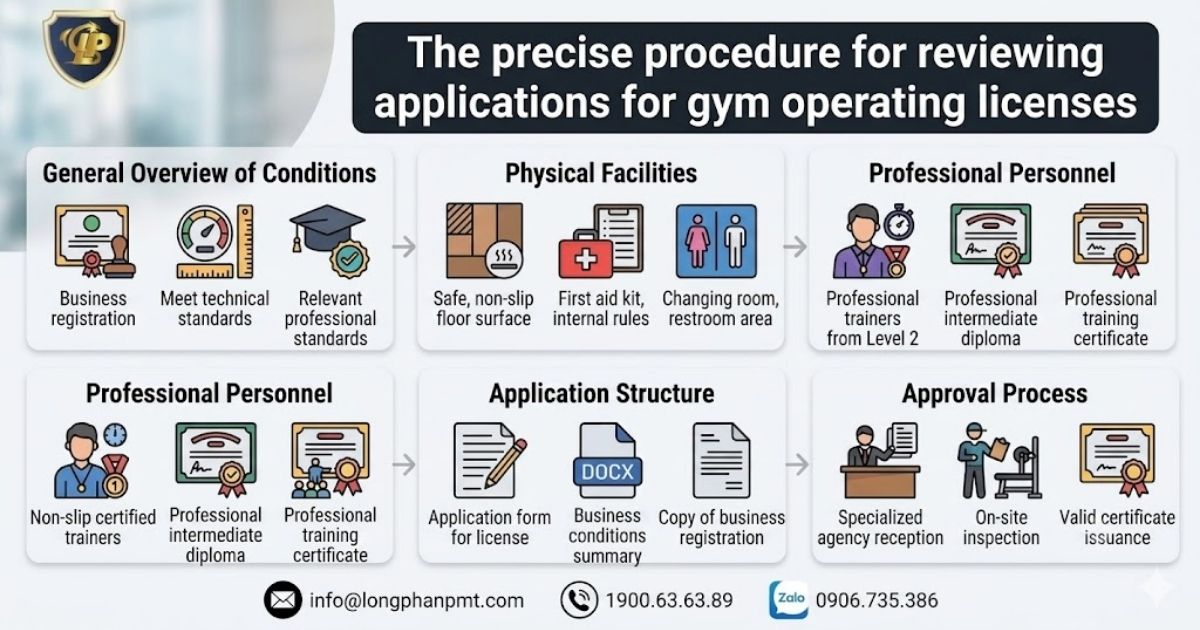
Important legal note:
A gym operating license represents far more than a pre-opening administrative formality. It functions as a structured compliance mechanism to manage athletic safety risks, professional personnel standards, and corporate operational liabilities.
For business models utilizing fitness instructors or personal trainers (PTs), investors must establish the correct corporate legal entity during initial setup. Commercial entities conducting sports activities with instructional staff are statutorily mandated to incorporate as an enterprise, pursuant to Clause 2, Article 56 of the 2006 Law on Physical Activity and Sports (Amended 2018).
Core operational criteria requiring standardization prior to filing include:
For active sole proprietorships and existing entities, the statutory grace period to align with mandatory conditions is 12 months from the effective date of Decree No. 36/2019/ND-CP, pursuant to Clause 1, Article 24 of Decree No. 36/2019/ND-CP. Selecting an incorrect entity model from the outset risks licensing rejections, conversion expenses, and launch schedule disruption.
Commercial gym premises must be designed around legal compliance criteria rather than purely commercial layout logic. Operational risks routinely emerge when corporate investors execute lease agreements prior to verifying whether the floor plan can accommodate workout zones, sanitary facilities, or safe operational clearance.
Applicable legislation does not prescribe a rigid, universal minimum square footage across all gym models within the statutory baseline. Instead, enterprises must ensure that physical facilities and equipment strictly satisfy National Technical Standards promulgated by the Minister of Culture, Sports and Tourism, pursuant to Article 14 of Decree No. 36/2019/ND-CP.
Prior to interior construction, corporate legal teams must review the following infrastructure categories:
Failing to display facility rules, omitting locker rooms or sanitary units, lacking first-aid kits, or failing to maintain adequate workout area space triggers statutory administrative penalties. The fine for organizational entities ranges from VND 2,000,000 to VND 10,000,000 pursuant to Clause 1, Article 17 and Clause 2, Article 5 of Decree No. 46/2019/ND-CP.
Gym equipment selection must prioritize structural safety, inspectability, and compliance with specialized technical standards. Enterprises must avoid arranging exercise machinery based solely on commercial member capacity or maximum floor density.
Pursuant to Article 14 of Decree No. 36/2019/ND-CP, sports equipment must satisfy National Technical Standards. Clause 1, Article 17 of Decree No. 46/2019/ND-CP establishes explicit administrative penalties for facilities lacking basic operational safety equipment.
Enterprises should systematically audit the following equipment categories:
Utilizing exercise equipment that fails to satisfy national technical standards exposes the enterprise to severe enforcement measures beyond mere rectifications. Corporate entities face administrative fines ranging from VND 10,000,000 to VND 20,000,000, alongside operational suspension penalties lasting 03 to 06 months, pursuant to Clause 2 and Clause 3, Article 17, and Clause 2, Article 5 of Decree No. 46/2019/ND-CP.
Qualified professional personnel represent a critical compliance milestone during the appraisal of an application for a Certificate of Eligibility for Sports Business Operations. Employing personal trainers (PTs) who possess practical experience but lack verifiable legal credentials exposes commercial fitness operations to immediate licensing rejections. Fitness facilities are statutorily mandated to appoint qualified instructional staff satisfying recognized professional criteria, pursuant to Clause 1, Article 13 and Clause 1, Article 15 of Decree No. 36/2019/ND-CP.
Qualifying professional credentials recognized under statutory standards include:
Human Resources departments must audit candidate credential files prior to executing employment contracts for personal trainers, fitness directors, or medical personnel. Corporate entities utilizing unqualified instructional personnel face administrative fines ranging from VND 5,000,000 to VND 10,000,000, alongside operational suspension penalties lasting 01 to 03 months, pursuant to Clause 2 and Clause 3, Article 17 of Decree No. 46/2019/ND-CP.
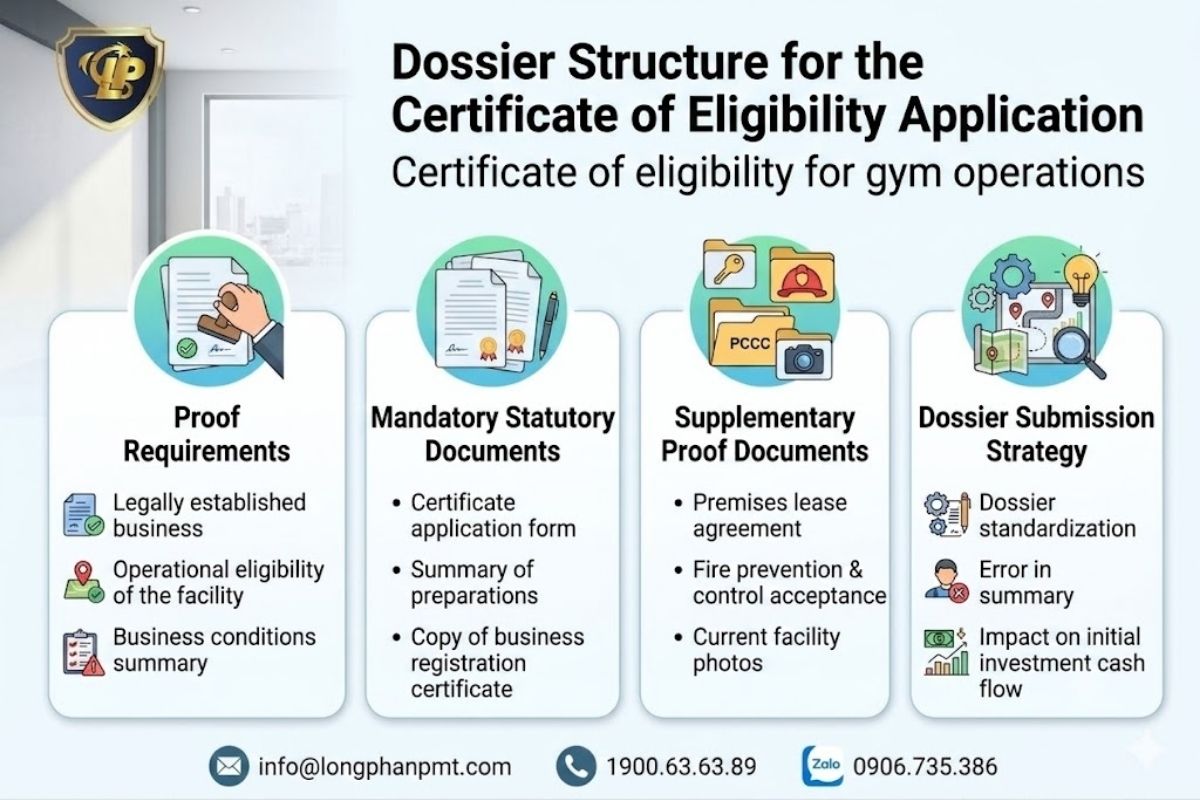
An application for a Certificate of Eligibility for Sports Business Operations must establish two primary facts: the enterprise is lawfully incorporated, and the facility fully meets operational standards for bodybuilding and fitness. Missing personnel credentials or submitting an inaccurate summary report gives appraisal authorities clear grounds to demand amendments or deny authorization.
Statutory dossier components comprise the Application Form for the Certificate of Eligibility, a Summary Report on Operational Readiness and Business Conditions, a copy of the Enterprise Registration Certificate (ERC), and copies of professional qualifications for instructional staff, pursuant to Article 19 of Decree No. 36/2019/ND-CP.
| Document Classification | Required Content & Preparation | Legal Impact & Risk Control |
| Statutory Document | Application Form for Certificate of Eligibility | Establishes the formal corporate licensing request. Inaccurate data creates revocation risks. |
| Statutory Document | Summary Report on Operational Readiness | Proves facilities, equipment, and staff are operational. Primary focus during physical inspections. |
| Statutory Document | Copy of Enterprise Registration Certificate (ERC) | Substantiates corporate legal status. Instructed gym facilities must operate under an enterprise model. |
| Statutory Document | Copies of Trainer Qualifications & Certificates | Validates that PTs, coaches, or instructional personnel meet statutory professional standards. |
| Supplementary Record | Commercial Lease Agreement / Premises Title Proof | Clarifies site occupation rights and mitigates lease disputes during physical inspections. |
| Supplementary Record | Fire Safety Management Records / FPF Approval | Manages pre-opening safety risks, especially within commercial centers or complex buildings. |
| Supplementary Record | Facility Photos, Site Layouts & Equipment Maps | Demonstrates compliant floor plan design, equipment spacing, lockers, restrooms, and first-aid placement. |
Corporate leadership should finalize and verify all filing materials prior to fixing public launch dates or running presale membership campaigns. Errors in the Summary Report can extend processing timelines, trigger unexpected layout modification costs, and jeopardize initial capital projections.
Licensing jurisdiction for a Certificate of Eligibility for Sports Business Operations is directly tied to the commercial location or head office of the enterprise. Submitting to an incorrect receiving authority results in dossier returns, delaying commercial launch schedules and disrupting presale membership strategies.
Specialized physical activity and sports authorities under Provincial People’s Committees are statutorily tasked with receiving dossiers, conducting physical inspections, and granting certificates, pursuant to Article 55 of the 2006 Law on Physical Activity and Sports (Amended 2018).
Enterprises must submit application dossiers to the competent provincial sports authority—typically designated as the provincial Department of Culture and Sports or Department of Culture, Sports and Tourism.
Pursuant to Clause 1 and Clause 3, Article 20 of Decree No. 36/2019/ND-CP (amended by Decree No. 31/2024/ND-CP), corporate entities may submit 01 application dossier via the following authorized methods:
Multi-location fitness chains must evaluate jurisdictional requirements for each individual facility. Standardizing baseline filing documents across branches minimizes branch-level discrepancies and accelerates internal approval timelines.
>>> See more: Yoga Business Eligibility Certificate Procedure
To avoid costly layout adjustments or personnel re-allocations late in the construction phase, licensing procedures must run parallel with interior fit-outs, staff recruitment, and pre-opening operations.
The practical execution workflow should follow 06 sequential stages:
Competent state authorities evaluate physical site conditions against submitted documents pursuant to Clause 2, Article 55 of the 2006 Law on Physical Activity and Sports (Amended 2018). Consequently, physical facilities and documentary submissions must remain completely consistent.
>>> See more: Reissuing Sports Business Certificates in Vietnam
The risks of penalties for gyms often extend beyond fines. For fitness businesses, violations of operating conditions can disrupt membership revenue, damage brand reputation, and provide grounds for terminating lease agreements.
The following penalty levels should be incorporated into the internal compliance review process:
| Violation | The penalty level applies to organizations. | Legal basis |
| Operating a sports business without a Certificate of Eligibility. | 5,000,000 to 10,000,000 VNDand simultaneously ordered to return the illegal profits. | Point a, Clause 2 and Clause 5 of Article 16 of Decree No. 46/2019/ND-CP |
| Businesses operating sports activities are required to have instructors but are not registered as businesses. | 40,000,000 to 60,000,000 VND | Article 15 and Clause 2 of Article 5 of Decree No. 46/2019/ND-CP |
| Lack of rules and regulations, changing rooms, restrooms, first-aid kits, or insufficient training space. | 2,000,000 to 10,000,000 VND | Clause 1 of Article 17 and Clause 2 of Article 5 of Decree No. 46/2019/ND-CP |
| Using personnel who do not meet the required professional qualifications. | 5,000,000 to 10,000,000 VNDand suspend operations1 to 3 months | Paragraphs 2 and 3 of Article 17 of Decree No. 46/2019/ND-CP |
Businesses need to be aware that licenses are not only required at the time of opening. Businesses must also continuously maintain the necessary personnel, equipment, and facilities throughout their operation.
The certificate may be revoked if the business provides false information in its application, ceases operations, has its business registration revoked, is dissolved, goes bankrupt, or fails to maintain the business conditions. This is stipulated in Clause 1, Article 55 of the Law on Physical Education and Sports of 2006, as amended and supplemented in 2018, and Clause 1, Article 23 of Decree No. 36/2019/ND-CP.
Compliance risks extend beyond monetary fines. Operating a commercial fitness center in violation of statutory conditions disrupts member revenue, damages corporate brand equity, and provides legal grounds for landlords to terminate commercial lease agreements.
Internal compliance audit procedures should incorporate the following statutory penalty thresholds:
| Violating Conduct | Administrative Fine (Organisations) | Statutory Basis |
| Operating without a valid Certificate of Eligibility | VND 5,000,000 to VND 10,000,000 & disgorgement of illegally obtained profits | Point a, Clause 2 & Clause 5, Article 16, Decree No. 46/2019/ND-CP |
| Conducting instructed sports activities without enterprise registration | VND 40,000,000 to VND 60,000,000 | Article 15 & Clause 2, Article 5, Decree No. 46/2019/ND-CP |
| Lacking facility rules, lockers, restrooms, first-aid, or adequate floor space | VND 2,000,000 to VND 10,000,000 | Clause 1, Article 17 & Clause 2, Article 5, Decree No. 46/2019/ND-CP |
| Employing unqualified instructional personnel | VND 5,000,000 to VND 10,000,000 & 01-03 month operational suspension | Clause 2 & Clause 3, Article 17, Decree No. 46/2019/ND-CP |
This pre-filing compliance checklist enables corporate management to conduct an internal readiness review prior to official state appraisals, synthesizing statutory criteria under Articles 14, 15, and 19 of Decree No. 36/2019/ND-CP.
>> See more: Procedures Must a Business Complete When Expanding Its Business Lines

Navigating gym operating licenses requires simultaneous control over corporate structures, commercial leases, personnel qualifications, and facility safety standards. Long Phan Consulting Company assists corporate clients in structuring a compliant licensing roadmap that eliminates file rejections, launch delays, and unexpected renovation costs.
Our legal scope includes:
Investors and corporate managers may transmit commercial lease files, corporate certificates, facility layouts, and personnel credentials via Email at info@longphanpmt.com or WhatsApp/Zalo at +84 906 735 386 for a preliminary compliance review.
Compliance risk management is crucial for investors to protect their cash flow when applying for a “Gym Operating License.” Early identification of legal variables regarding organizational structure, approval deadlines, and business suspension penalties will effectively prevent operational disruptions. Management can immediately consult in-depth strategic solutions to directly address the most common legal bottlenecks.
Investors are required to complete the business registration procedures if their sports business provides training instructors. Sports businesses that are required to provide instructors but fail to register will be fined between VND 40,000,000 and VND 60,000,000, as stipulated in Article 15 and Clause 2 of Article 5 of Decree No. 46/2019/ND-CP.
Household businesses are not permitted to continue operating if they regularly employ 10 or more workers. Investors are required to register for conversion to a business enterprise model to meet the legal requirements stipulated in Article 56 of the 2006 Law on Physical Education and Sports, as amended in 2018.
The competent state agency is required to conduct on-site inspections and issue licenses from the date of receiving complete and valid documents. In case of refusal to grant a license, the management agency must notify in writing and clearly state the reasons based on Article 55 of the Law on Physical Education and Sports of 2006, as amended and supplemented in 2018.
Businesses operating without a license will be subject to administrative penalties in the form of fines ranging from VND 5,000,000 to VND 10,000,000. In addition, the authorities will require the violating establishment to return all illegal profits obtained, as stipulated in Point a, Clause 2 and Clause 5 of Article 16 of Decree No. 46/2019/ND-CP.
Businesses will be fined from VND 10,000,000 to VND 20,000,000 for failing to ensure safe distances between exercise equipment. Authorities also have the right to apply additional penalties, such as suspending operations for 1 to 3 months, based on Point d, Clause 2 and Clause 5 of Article 18, and Clause 2 of Article 5 of Decree No. 46/2019/ND-CP.
Businesses are required to return their Certificate of Business Eligibility to the licensing authority within a maximum of 3 working days from the date of official business cessation. The management agency will receive the certificate and issue a revocation decision immediately thereafter, as stipulated in Clause 1, Article 20 of Decree No. 36/2019/ND-CP.
Securing a gym operating license in Vietnam before grand opening is essential to safeguard capital, prevent administrative fines, and avoid operational suspension. Central to this process is obtaining a Certificate of Eligibility for Sports Business Operations, which requires a corporate entity model, compliant facilities, safe equipment spacing, and qualified trainers. For investors, fitness chains, and franchise operators, errors in premises layout or trainer credentials can disrupt cash flow and incur unbudgeted conversion costs. Contact Hotline 1900636389 for comprehensive legal support from the advisory team at Long Phan Consulting Company.
📚 This article has been professionally reviewed based on the following legal documents: