
Operating a dental clinic without a valid Dental Clinic License may lead to service suspension, additional premises expenses, and disrupted investment returns. Under the Law on Enterprises and Businesses, enterprise registration does not replace the separate operating approval required for a dental and maxillofacial specialty clinic. The facility must also meet standards for its professional and technical director, clinical premises, medical equipment, staffing credentials, and authorized service scope.
Before filing with the Department of Health, investors should review the application documents, practitioner qualifications, equipment records, and proposed procedures with support from Long Phan Consulting.

Key legal notes:
Licensing requirements are the first point of control before clinic owners sign long-term leases, purchase dental chairs, or recruit a team of doctors. For specialized dental clinics, the Department of Health not only reviews paperwork but also assesses the compatibility between personnel, premises, equipment, and the planned range of procedures.
The person responsible for technical expertise is the core personnel in the licensing application. Businesses need to avoid the risk of “borrowing licenses” or assigning doctors outside their scope of practice, as this is often scrutinized during the assessment process.
Personnel standards that need to be checked right from the preparation stage include:
If the personnel in charge of professional matters are unsuitable, the clinic may be required to revise its documentation or fail accreditation. This risk slows down the opening plan and prolongs the fixed costs of premises, staff salaries, and equipment.
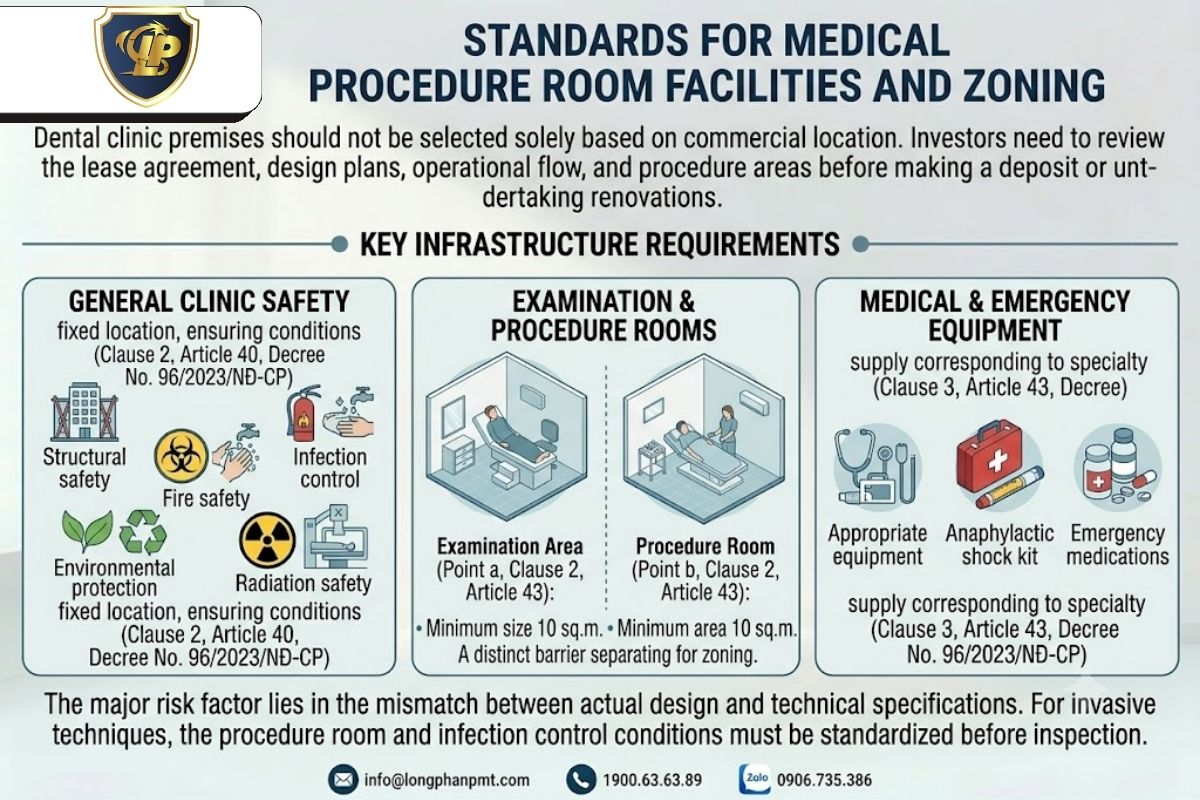
Dental clinic premises should not be selected solely based on commercial location. Investors need to review the lease agreement, design plans, operational flow, and procedure areas before making a deposit or undertaking renovations.
Key infrastructure requirements include:
The major risk factor lies in the mismatch between the actual design and the technical specifications submitted for approval. For invasive techniques, the procedure room and infection control conditions need to be standardized before the assessment team conducts their inspection.
A business registration certificate or household business registration certificate only establishes the business status. To operate a dental clinic for medical examination and treatment, the clinic must be granted a license to operate a specialized dental clinic.
The legal conditions to be aware of include:
Investors should view a dental clinic license as a separate legal component, not a substitute for a regular business license. A safe approach is to design the organizational structure, staffing, premises, and technical procedures to be part of the same licensing application from the outset.
The compilation of the operational licensing dossier dictates the definitive commercial launch schedule of the clinic. For international and domestic healthcare investors, this technical package is far more than an ordinary administrative submission; it serves as the formal legal proof that the facility is fully prepared to operate safely, ethically, and strictly within its approved medical scope.
Enterprises must rigorously standardize all application materials using precise local statutory terminology. While phrases like “dental business license” are common in informal commercial discussions, the foundational document within the formal dossier is the active Enterprise Registration Certificate (ERC) or its equivalent corporate registration.
Pursuant to Section I of the Dossier Components issued under Decision No. 1330/QĐ-BYT (2025), the core application package submitted for regulatory audit must comprise:
In practical application, this dossier should be supplemented with certified technical drawings of the medical layout, authorized medical waste disposal agreements, equipment calibration sheets, and internal zoning maps to minimize the risk of receiving administrative requests for information or material amendments.
The list of professional and technical services is the section most prone to regulatory bottlenecks within the dental licensing process. Investors must never compile this list based purely on commercial marketing desires; instead, they must cross-reference every intended dental procedure against active practitioner credentials, installed equipment specs, and the physical capacity of the procedure rooms.
When engineering the technical scope, corporate boards must monitor the following control metrics:
The statutory boundaries of a physician’s practice are strictly confined to their certified level of professional competence under Clause 1, Article 11 of Circular No. 32/2023/TT-BYT. Consequently, submitting a technical list that lacks a corresponding staff structure or appropriate equipment will halt the entire application, even if the general corporate documentation is flawless.
Integrating the state licensing workflow into the pre-launch schedule is a vital requirement for corporate cash flow management. Clinic owners must allocate sufficient buffer time for on-site inspections, potential document revisions, and real estate maintenance costs during the pending review period.
The administrative workflow follows a standardized statutory sequence:
The statutory authority to receive, audit, and issue new operational licenses to private clinics is vested exclusively in the head of the specialized health organ under the Provincial People’s Committee—specifically, the local Department of Health (DoH), pursuant to Article 14 of Decree No. 148/2025/NĐ-CP.
| Budgetary and Timeline Planning Metrics | Statutory Threshold / Period | Direct Legal Source |
| Statutory On-Site Physical Appraisal Timeline | Max 60 days from the receipt of a complete and valid dossier | Point b, Clause 2, Article 52 of the Law on Medical Examination and Treatment 2023 |
| License Issuance Post-Approval Minutes | Within 10 working days from the execution of a compliant audit report | Point c, Clause 4, Article 52 of the Law on Medical Examination and Treatment 2023 |
| Official State Appraisal Fee | 4,300,000 VND per application | Point b, Clause 1, Section III of the Fee Schedule issued with Circular No. 59/2023/TT-BTC |
| Statutory Window to Complete Dossier Amendments | Within 06 months from the date of official notification | Clause 3, Article 64 of Decree No. 96/2023/NĐ-CP |
| Maximum Validity of an Unamended Application | 12 months from the initial date of dossier submission | Clause 4, Article 64 of Decree No. 96/2023/NĐ-CP |
Investors must pay strict attention to the 06-month amendment window and the 12-month absolute file expiration threshold. Failing to tightly manage these timelines can result in the complete nullification of the application, forcing the enterprise to forfeit paid fees and restart the entire process from scratch while facing mounting retail lease overheads and idle labor costs.
Many dental clinics concentrate heavily on commercial marketing operations after launch but fail to construct a robust post-licensing compliance management system. This systemic oversight is the most common cause of immediate operational suspensions, license revocations, or severe administrative disputes with municipal health regulators.
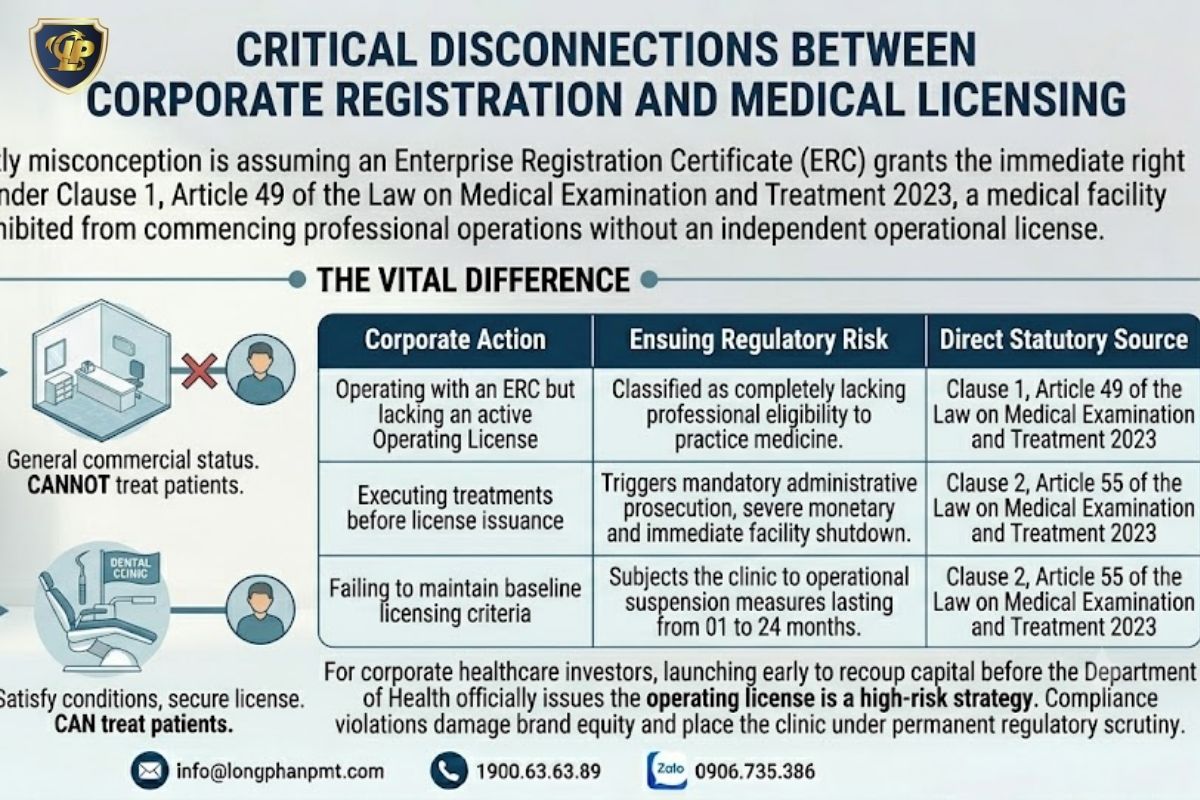
A prevalent and costly misconception among foreign investors is assuming that securing an Enterprise Registration Certificate (ERC) or a household business registration grants the immediate right to treat patients and perform dental procedures. In reality, these two legal instruments serve completely separate statutory functions.
Under Clause 1, Article 49 of the Law on Medical Examination and Treatment 2023, a medical facility is strictly prohibited from commencing any professional operations until it has been formally granted an independent operational license by the competent authority.
| Corporate Action | Ensuing Regulatory Risk | Direct Statutory Source |
| Operating with an ERC but lacking an active Operating License | Classified as completely lacking professional eligibility to practice medicine. | Clause 1, Article 49 of the Law on Medical Examination and Treatment 2023 |
| Executing treatments before license issuance | Triggers mandatory administrative prosecution, severe monetary fines, and immediate facility shutdown. | Clause 2, Article 55 of the Law on Medical Examination and Treatment 2023 |
| Failing to maintain baseline licensing criteria | Subjects the clinic to operational suspension measures lasting from 01 to 24 months. | Clause 2, Article 55 of the Law on Medical Examination and Treatment 2023 |
For corporate healthcare investors, launching early to recoup capital before the Department of Health officially issues the operational license is a high-risk strategy. Beyond the immediate threat of regulatory fines, a documented history of compliance violations severely damages brand equity and places the clinic under permanent regulatory scrutiny during future health inspections.
Once an operational license is secured, the clinic is strictly barred from unilaterally expanding its procedures beyond the explicitly approved list of professional and technical services. This restriction is a foundational pillar of Vietnam’s healthcare management framework.
Pursuant to Clause 1, Article 39 of the Law on Medical Examination and Treatment 2023, a licensed practitioner is authorized to perform only those clinical techniques that directly correspond with their certified scope of practice.
The most common compliance failures identified during state inspections include:
Additionally, investors must carefully monitor the statutory conditions that trigger the mandatory revocation of the clinic’s operating license:
These enforcement criteria are strictly governed under Points e and g, Clause 1 of Article 56, alongside Clause 1 of Article 35 of the Law on Medical Examination and Treatment 2023. For dental chains or long-term medical investment groups, governing the active technical scope must be integrated as a continuous internal audit workflow, rather than a temporary check executed only when a state inspection is announced.
An operational license is not a one-time transaction. Throughout the entire life cycle of the clinic, the operating enterprise is legally mandated to report real-time adjustments regarding its medical personnel and technical environment.
Corporate legal teams must monitor the following mandatory notification windows:
Furthermore, investors must align their strategies with these key transitional rules:
Failing to monitor the validity timelines of the medical staff’s licenses will cause the clinic to fall out of compliance regarding its technically responsible personnel. This breakdown can invalidate the primary operational license and disrupt long-term business continuity.
The procedure for obtaining a dental clinic license requires coordination between business legal aspects, practicing personnel, facilities, and a list of specialized technical services. Long Phan Consulting assists clinic owners and investors in controlling licensing risks right from the site preparation, documentation, and operational planning stages.
Long Phan Consulting conducts pre-licensing reviews to identify legal bottlenecks that could cause applications to be rejected or prolong the assessment time. The focus is on checking the validity of personnel, location, equipment, and documentation proving the operating conditions.
This review process helps investors detect early the costs of repairs, equipment upgrades, or model adjustments before submitting the official application.
The list of technical specialties determines which services a clinic is permitted to provide after obtaining a license. If the declared scope is too broad compared to actual capabilities, the application may be subject to requests for clarification, additional information, or a reduction in the scope of approval.
Establishing the correct service catalog from the outset helps clinics reduce the risk of operating beyond their area of expertise. This also forms the basis for requesting adjustments and expanding services as the facility grows in size.
After the documentation and internal conditions are standardized, Long Phan Consulting represents the client in working with the competent authorities to optimize the processing time. The scope of support focuses on the accuracy of the documentation and the ability to respond promptly when additional requirements arise.
Clinic owners, dentists, or investors can submit existing profiles via email.info@longphanpmt.com or contact Long Phan Consulting Company Zalo at 0906.735.386 for a preliminary assessment of your licensing eligibility.
Dental businesses inherently face compliance risks when balancing commercial objectives with the legal framework of the specialized medical field. Understanding the specific regulations regarding “dental clinic licenses” helps investors prevent the risk of suspension and optimize resource allocation. Complex legal situations from a business perspective will be thoroughly resolved through the application of current legal frameworks.
Businesses are not permitted to use a single license for multiple medical examination and treatment locations. Each dental business location must be granted a separate operating license to ensure independent medical standards. This mandatory regulation is based on Clause 1, Article 50 of the Law on Medical Examination and Treatment 2023. Investors need to submit assessment documents for each branch before officially accepting patients.
Medical examination and treatment facilities will have their licenses revoked if they fail to commence business operations after 24 months or suspend operations for 24 consecutive months or more. This strict penalty for medical facilities is detailed in Points e and g, Clause 1, Article 56 of the 2023 Law on Medical Examination and Treatment. Investors need to develop a proper opening plan and allocate cash flow appropriately to avoid license revocation due to operational delays.
Dental clinics that are operating stably are not required to reapply for a license or change their organizational structure. Medical facilities that have already been granted operating licenses under the Law on Medical Examination and Treatment of 2009 are allowed to continue operating under their old licenses. The transitional rights of businesses are guaranteed based on Clause 11, Article 121 of the Law on Medical Examination and Treatment of 2023 and Clause 1, Article 144 of Decree No. 96/2023/ND-CP. Investors only need to carry out adjustment procedures when a change in scale arises.
Medical examination and treatment facilities are required to report all changes in medical personnel to the state management agency. Specifically, medical examination and treatment facilities must report to the management agency when a practitioner resigns within 3 working days from the date of termination of practice. This notification obligation is mandated in Point a, Clause 12, Article 29 of Decree No. 96/2023/ND-CP. Timely updating of personnel lists helps medical facilities maintain the legitimacy of their professional structure.
Businesses must complete their license application within 6 months from the date the licensing authority issues a notice requesting amendments or additions. If, after 12 months from the date of initial submission, the application still does not meet the requirements, it will no longer be valid. This legal timeframe is determined based on Clauses 3 and 4 of Article 64 of Decree No. 96/2023/ND-CP. Business owners need to cooperate closely with the management board to standardize documents, avoiding the risk of losing fees and having to resubmit from scratch.
When recruiting new medical personnel, medical examination and treatment facilities are required to notify and submit an updated registration list to the Department of Health. In the case of new personnel additions, the clinic must submit an updated list of registered practitioners within 10 days of the addition. This reporting process is based on Form 01, Appendix II, issued with Decree No. 96/2023/ND-CP. This procedure helps investors ensure that new practitioners are legally permitted to perform medical procedures.
Securing a private dental clinic license in Vietnam serves as the definitive statutory pillar required to operate a dental and maxillofacial specialty facility in a legally secure and sustainable manner. Healthcare investors must strictly distinguish between general corporate registration and a specialized Medical Examination and Treatment Operation License, while actively managing their post-licensing compliance duties to eliminate facility shutdowns, license revocations, or commercial launch delays. Properly aligning medical staffing rosters, physical clinical zoning, specialized diagnostic equipment, and the approved technical scope with current health regulations is essential for long-term operational security. Contact our medical licensing desk via the Hotline at 1900636389 to secure specialized transaction structuring and legal risk management under the expert guidance of Long Phan Consulting Company .
📚 This article is provided with professional consultation based on the following legal framework: