
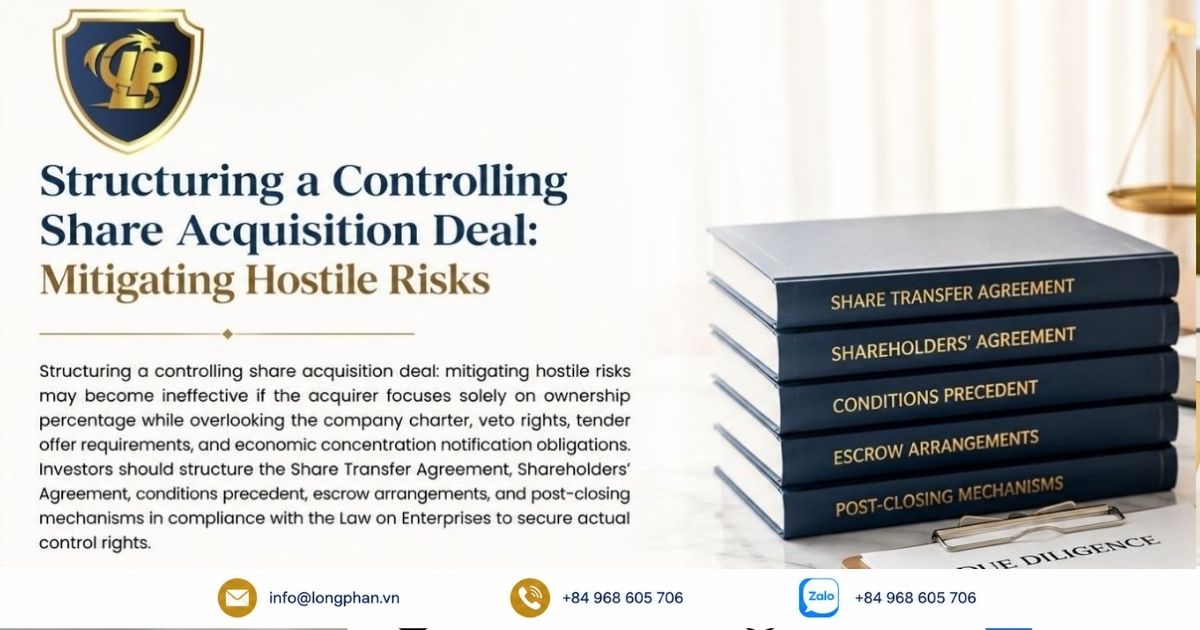
Structuring a controlling share acquisition deal requires more than securing a majority ownership stake. Investors must carefully assess charter provisions, shareholder veto powers, tender offer obligations, and competition filing requirements to obtain effective control. Transaction documents, including the Share Transfer Agreement, Shareholders’ Agreement, closing conditions, escrow mechanisms, and governance arrangements, should be aligned with the Law on Enterprises and Businesses. For acquisitions involving hostile resistance or concentration concerns, Long Phan Consulting provides end-to-end legal structuring from due diligence through post-closing integration.
Important legal notes:
A controlling stake acquisition extends far beyond simply increasing ownership percentages. The core objective is establishing actual management control over voting rights, executive personnel, and the business trajectory of the target company. Failing to audit the corporate charter, veto rights, and resolution approval mechanisms leaves the buyer holding a majority share while remaining entirely locked out of executive power.
A controlling stake acquisition fundamentally differs from standard financial investments. Foreign investors target the ultimate authority to dictate strategic business decisions, rather than merely seeking dividends or capital appreciation.
An acquiring enterprise establishes control when it secures over 50% of the charter capital or over 50% of the voting shares of the target company. Control also arises if the buyer acquires or utilizes over 50% of the target company’s assets across one or all business lines, pursuant to Points a and b, Clause 1, Article 2 of Decree No. 35/2020/ND-CP.
To accurately assess the transaction’s legal nature, investors must scrutinize these specific corporate rights:
While the 2020 Enterprise Law permits share transfers, founding shareholder restrictions or the corporate charter may legally block these transactions. Consequently, the acquisition dossier must be structured as a comprehensive control transaction, not a singular share transfer agreement.
A critical vulnerability arises when buyers confuse share ownership with actual corporate control. The corporate charter or Shareholders’ Agreement (SHA) frequently enforces critical voting thresholds exceeding the buyer’s targeted ownership percentage.
An investor holding 51% of shares can pass ordinary resolutions. However, if the charter demands 65% or higher for material decisions, the buyer cannot unilaterally restructure the enterprise.
| Voting Threshold | Governance Significance | Hostile M&A Risks |
| 36% | Establishes a veto position for decisions requiring high approval thresholds. | Minority shareholders can effectively block strategic corporate resolutions. |
| 51% | Secures a standard majority voting advantage. | Does not guarantee control over material or strategic corporate decisions. |
| 65% | Generally associated with critical corporate decisions under the charter. | Buyers falling below this threshold face severe restructuring deadlocks. |
Evaluating these thresholds requires cross-referencing the charter, the Shareholder Register, and the existing governance framework. The 2020 Enterprise Law strictly governs shareholder rights, GMS authority, and corporate governance structures. Therefore, buyers must prioritize acquiring sufficient shares to control or veto decisions directly impacting personnel, assets, capital, and business strategy.
Public company status enforces rigorous regulatory barriers regarding information disclosure, governance, and mandatory public tender offers. This status serves as a formidable defense layer for target companies facing hostile M&A risks lacking Board of Directors (BOD) approval.
A public company with unlisted or unregistered shares prior to the effective date of the 2019 Securities Law faces the cancellation of public company status if it fails to maintain 30 billion VND in charter capital and a minimum of 10% of shares held by at least 100 non-major investors. This framework is strictly governed by the 2019 Securities Law.
Evaluating this public status holds immense strategic value for structuring the transaction:
Investors must treat this assessment as a mandatory component of Legal Due Diligence (LDD). Executing share purchases or signing a Share Purchase Agreement (SPA) before clarifying public status guarantees severe compliance liabilities.
Transaction structure dictates post-closing control capabilities. An improperly designed controlling stake acquisition can trigger defensive reactions, inflate purchase prices, or leave the buyer without actual governance authority. Investors must select a structure based on the target company’s legal status, shareholder dispersion, and pre-clearance obligations. For public companies, the strategic focus is the mandatory public tender offer; for non-public companies, the focus shifts to the charter, Shareholder Register, and Right of First Refusal (ROFR).
Three common structures include direct purchases from existing shareholders, private placements or capital increases, and multi-phased acquisitions. Each structure generates different consequences regarding control, cash flow, and minority shareholder reactions.
| Transaction Structure | Strategic Advantage | Pre-Signing Risks to Lock |
| Direct purchase from existing shareholders | Buyer can rapidly achieve a controlling threshold. | Blocked by transfer restrictions, ROFR, or share disputes. |
| Private placement or capital increase | Target company receives new capital, improving financial capacity. | Requires internal approvals; avoid illegal dilution or existing shareholder backlash. |
| Multi-phased acquisition | Mitigates hostile reactions and controls the disclosure roadmap. | May trigger a mandatory public tender offer or economic concentration notification. |
For non-public companies, the 2020 Enterprise Law governs share transfer rights, corporate charters, and internal mechanisms. Buyers must rigorously audit the Shareholder Register before selecting a structure, as ownership data forms the foundation for the entire closing process.
For public companies, the share acquisition structure must be controlled from the very first ownership threshold. If an organization, individual, and affiliated persons intend to purchase voting shares leading to direct or indirect ownership of 25% or more, the transaction may require a mandatory public tender offer, pursuant to Point a, Clause 1, Article 35 of the 2019 Securities Law.
Enterprises may structure an exemption if the transfer plan reaching the threshold is formally approved by the target company’s General Meeting of Shareholders (GMS). This exemption is recognized under Point a, Clause 2, Article 35 of the 2019 Securities Law.
The control protocol for mandatory public tender offers should follow this sequence:
If a tender offer must be withdrawn, the State Securities Commission holds the authority to receive the report and issue a written approval, pursuant to Clause 3, Article 92 of Decree 155/2020/ND-CP. This contingency must be drafted into the Share Purchase Agreement (SPA) to prevent the buyer from being trapped in a commercially unviable transaction.
Foreign investors cannot rely solely on ownership percentages to determine the share acquisition structure. Prior to signing the SPA, the buyer must audit business lines, market access conditions, and the legal status of land assets.
Share acquisitions by foreign investors must satisfy national defense and security conditions if the target economic organization holds land use rights in coastal, border, island regions, or areas impacting national defense and security, pursuant to Point c, Clause 2, Article 21 of the 2025 Investment Law.
Pre-transaction structuring audits must address the following points:
Decree 96/2026/ND-CP detailing and guiding the implementation of several articles of the Investment Law serves as the mandatory cross-reference when designing investment dossiers. Bypassing this regulatory layer guarantees the transaction will be blocked during registration or fail to complete the transfer of control.
The Corporate Legal Due Diligence (LDD) Report serves as the primary defense layer prior to signing the Share Purchase Agreement (SPA). The objective is not merely confirming assets, liabilities, and contracts, but uncovering mechanisms that could permanently block the buyer from closing. In transactions exhibiting hostile takeover risks, vulnerabilities typically reside within the corporate charter, Shareholder Register, preemptive rights, credit commitments, and pre-clearance competition obligations. Failing to neutralize these elements in advance ensures that while the purchase price is finalized, actual control remains blocked.
Investors must audit the corporate charter, Shareholder Register, and existing Shareholders’ Agreements prior to negotiating the purchase price. This step determines whether the target shares are freely transferable or locked by a Right of First Refusal (ROFR). The 2020 Enterprise Law strictly places share transfer rights within the boundaries of the corporate charter and regulations applicable to founding shareholders. Consequently, controlling stake acquisitions must be verified against internal corporate records, rather than relying solely on the seller’s representations.
Urgent documentation requiring immediate LDD review includes:
Bypassing the ROFR empowers existing shareholders to formally oppose the transaction or petition to invalidate the share transfer. This direct risk severely delays closing and cripples the buyer’s negotiating leverage.
When a transaction enables the buyer to control or dominate another enterprise, it may be classified as an economic concentration. The paramount risk lies not within the SPA itself, but in executing closing without fulfilling pre-clearance obligations. Enterprises must self-assess their economic concentration notification obligations prior to executing the transaction. The statutory warning thresholds include total assets or total revenue in Vietnam of 3,000 billion VND or more, a transaction value of 1,000 billion VND or more, or a combined market share of 20% or more, pursuant to Points a, b, c, and d, Clause 1, Article 13 of Decree No. 35/2020/ND-CP.
| Target Threshold Group | Warning Level | Risks of Bypassing Clearance |
| Total assets in Vietnam | From 3,000 billion VND | Transaction is subjected to pre-clearance scrutiny. |
| Total revenue in Vietnam | From 3,000 billion VND | Closing procedures may be suspended or severely prolonged. |
| Transaction value | From 1,000 billion VND | SPA requires competition approval as a Condition Precedent. |
| Combined market share | From 20% upwards | Risk of being assessed for competition-restricting impacts. |
The National Competition Commission (NCC) must issue the preliminary appraisal results within 30 days of receiving a complete and valid dossier, pursuant to Clause 1, Article 14 of Decree No. 35/2020/ND-CP. If an official appraisal is mandated, the timeline extends to 90 days from the preliminary result notification, extendable by up to 60 days, pursuant to Clause 1, Article 37 of the 2018 Competition Law.
The maximum administrative fine for violating economic concentration regulations is 5% of the violating enterprise’s total revenue in the relevant market, pursuant to Clause 2, Article 111 of the 2018 Competition Law. Beyond financial penalties, regulatory agencies hold the authority to compel the division, separation, or resale of portions or the entirety of contributed capital and assets, pursuant to Point c, Clause 4, Article 110 of the 2018 Competition Law.
In mature corporate groups, historical cross-ownership acts as a blind spot capable of invalidating the entire acquisition structure. Investors must pinpoint the exact timeline when cross-ownership formed, the current ratios, and identify which transactions could unlawfully increase restricted percentages. Companies devoid of state-owned shares or capital contributions that mutually invested or purchased each other’s shares prior to July 1, 2015, are not compelled to divest under current cross-ownership prohibitions. However, enterprises are strictly prohibited from executing any transaction that increases this existing cross-ownership ratio under the 2020 Enterprise Law.
Critical risks that must be integrated into the Legal Due Diligence Report include:
If a credit agreement mandates bank approval prior to altering control, the SPA must strictly incorporate this requirement into the Conditions Precedent (CPs). Otherwise, the buyer may successfully complete the share transfer but face the catastrophic risk of premature loan recalls.
The Share Purchase Agreement (SPA) should not merely record the price, ownership percentage, and payment schedule. For a controlling stake acquisition, the contract must strictly control closing conditions, breach liabilities, and post-closing governance rights.
The Shareholders’ Agreement (SHA) acts as the primary instrument to lock in actual control. Without a rigorously drafted SHA, the buyer may hold a majority of shares but still face catastrophic deadlocks when altering personnel, budgets, or business strategies.
Conditions Precedent (CPs) ensure the buyer is not obligated to disburse funds before the transaction fulfills all legal prerequisites. This serves as a vital defense mechanism against hostile reactions from existing shareholders, the Board of Directors (BOD), or the incumbent management board.
The SPA must explicitly stipulate the conditions to be fulfilled prior to closing, including internal approvals, regulatory clearances, completion of information disclosure, and the absence of any Material Adverse Change (MAC). These elements must be framed within the context of shareholder rights, General Meeting of Shareholders (GMS) authority, and BOD jurisdiction under the 2020 Enterprise Law.
A secure disbursement sequence should be structured across the following milestones:
The escrow mechanism protects the buyer from the severe risk of releasing payments without securing actual control. Simultaneously, the blocked funds serve as an accessible source of indemnification if the seller breaches warranties post-closing.
The SHA must distinctly establish the specific matters over which the buyer holds decisive authority, veto rights, or the right to prior consultation. This strategy effectively converts raw ownership percentages into enforceable management control.
If the target company retains major shareholders or the legacy management board, the buyer must lock down material decisions directly within the SHA. The 2020 Enterprise Law serves as the governing framework for shareholder rights, GMS authority, BOD jurisdiction, and the validity of the corporate charter.
The mandatory list of rights to be established includes:
Regarding related-party transactions, the contract or transaction price must strictly be the market price at the time of execution, pursuant to Point b, Clause 4, Article 167 of the 2020 Enterprise Law. This provision must be embedded into the SHA to prevent the unlawful dissipation of corporate assets after the buyer assumes control.

Tag-along and drag-along rights serve as dual mechanisms to protect the investment value post-transaction. These clauses empower the buyer to control secondary transfers, limit equity dilution, and prevent the seller from transferring remaining shares to market competitors.
The SHA must explicitly stipulate the activation conditions, applicable thresholds, valuation methodologies, and execution timeframes. Otherwise, the buyer may secure control at closing but subsequently lose their strategic advantage when the shareholder structure inevitably shifts.
| Corporate Mechanism | Primary Protection Objective | Application Context |
| Tag-along Right | Protects minority shareholders when major shareholders sell stakes. | Buyer seeks to avoid disputes with remaining shareholder groups. |
| Drag-along Right | Compels remaining shareholders to sell under pre-agreed conditions. | Buyer must guarantee the ability to divest or sell the entire target company. |
| Transfer Restrictions | Prevents share transfers to competitors or undesirable third parties. | Target holds strategic shareholders or highly sensitive competitive assets. |
| Anti-dilution Rights | Preserves control ratios following capital increases or new issuances. | Target requires capital injections, but the buyer refuses to forfeit control. |
These mechanisms must perfectly align with the corporate charter and the 2020 Enterprise Law. If the SHA contradicts the charter or lacks transparent enforcement mechanisms, post-M&A governance control will fatally collapse during internal disputes.
The pre-closing and post-closing phases dictate whether a transaction successfully translates into actual management control. Buyers must simultaneously control major shareholders, key personnel, shareholder records, and enterprise registration procedures. If the legacy management board reacts hostilely, the risk extends beyond internal disputes. The enterprise may lose critical governance data, suffer severe delays in updating shareholder status, and fail to execute post-M&A integration plans.
Buyers should approach major shareholders prior to public announcements to mitigate the risk of price inflation or defensive alliances. This strategy must strictly avoid coercion, misrepresentation, or the illegal use of insider information. A major shareholder is defined as a shareholder owning 5% or more of the voting shares of an issuing organization, pursuant to Clause 18, Article 4 of the 2019 Securities Law. Therefore, all strategies engaging this group must be strictly controlled under statutory information disclosure obligations.
Actions to execute prior to closing include:
Internal persons and affiliated persons must disclose information regarding their securities transactions within 5 working days from the transaction completion date, pursuant to Point d, Clause 1, Article 33 of Circular No. 96/2020/TT-BTC. This absolute deadline must be hardwired into the closing schedule for public companies.
Upon completing the payment, the buyer must instantly shift focus to legalizing their shareholder status and governance authority. Failing to update the Shareholder Register exposes the new shareholder status to fatal disputes during voting.
The post-closing sequence should be structured to generate irrefutable evidence of handover:
The 2020 Enterprise Law strictly governs the Shareholder Register, shareholder rights, and modifications to enterprise registration content. Consequently, the SPA must anticipate severe punitive measures if the legacy management board refuses to hand over assets or deliberately delays updating corporate records. When obstruction occurs, buyers must trigger breach clauses and secure evidence to aggressively protect their new shareholder rights.
In transactions acquiring a project-owning company, the true value of the shares depends directly on the remaining operational term of the asset. If the project is nearing expiration, the buyer must rigorously evaluate the feasibility of resetting the project term during the pre-transaction phase.
For the transfer of an ongoing project implemented before the 2025 Investment Law takes effect, possessing a Land Use Right Certificate and having fulfilled financial obligations, the buyer may propose the competent authority reset the project term. This mechanism aligns with the procedure for approving adjustments or issuing an Investment Registration Certificate under the 2025 Investment Law.
The Legal Due Diligence Report must assess these strategic benefits:
This represents a critical focal point for foreign investors acquiring entities with massive land banks or stalled projects. Ignoring the project term leaves the buyer with corporate control but a catastrophic failure to achieve projected economic returns.
A controlling stake acquisition requires synchronization between the transaction structure, legal documentation, pre-audit obligations, and post-M&A governance mechanisms. Long Phan Consulting Company We assist investors in managing risk from the due diligence stage to closing, especially in transactions showing signs of hostile reaction.
Long Phan Consulting Company This helps in selecting a transaction structure that aligns with control objectives, shareholder characteristics, and the legal status of the target company. The focus is on reducing the risk of transaction blocking, triggering pre-closing obligations, or post-closing disputes.
The tasks performed by the specialists include:
This approach allows investors not only to “buy shares,” but also to control the process of power transfer within the target company.
A due diligence report helps investors identify potential deal failures before signing a Spam Sale Agreement (SPA). This step is especially important when the target company has a dispersed shareholder base, bank debt, land assets, or articles of incorporation with safeguards.
Long Phan Consulting Company carried out the following review items:
The due diligence results form the basis for adjusting the purchase price, designing the escrow system, and deciding whether to proceed with the transaction.
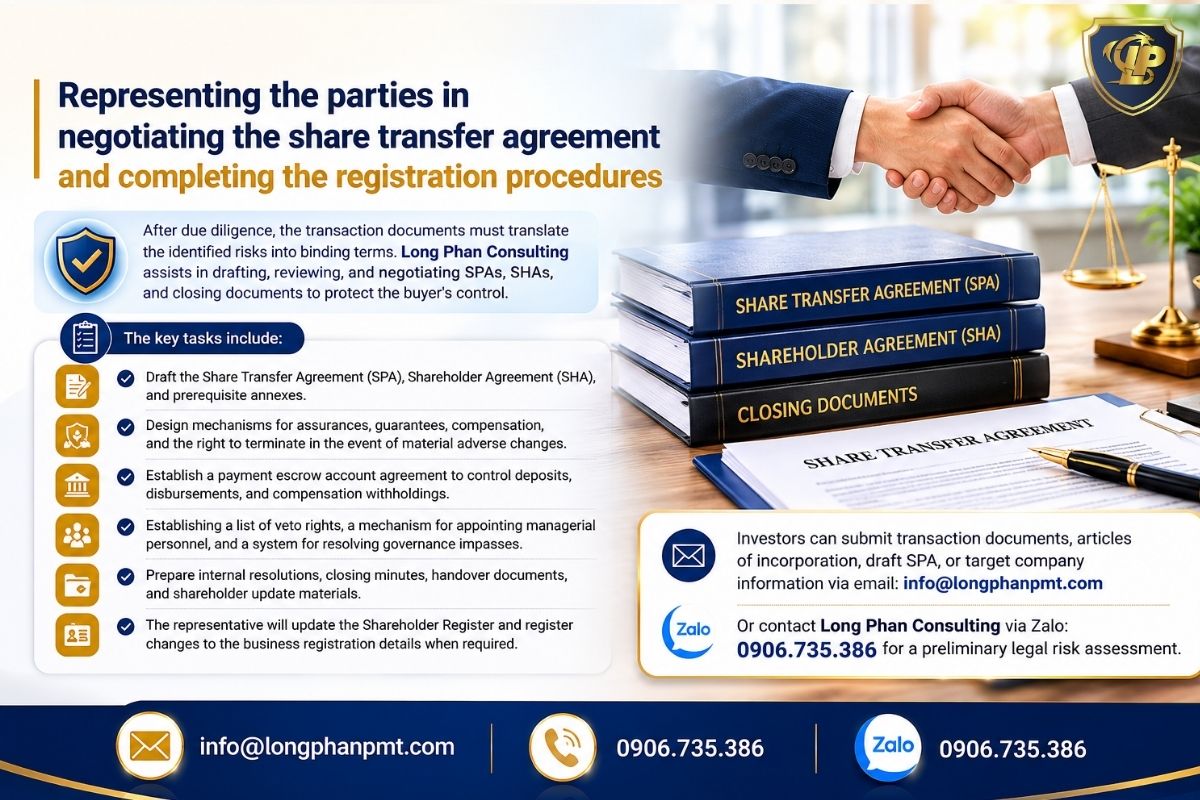
After due diligence, the transaction documents must translate the identified risks into binding terms. Long Phan Consulting Company assists in drafting, reviewing, and negotiating SPAs, SHAs, and closing documents to protect the buyer’s control.
The key tasks include:
Investors can submit transaction documents, articles of incorporation, draft SPA, or target company information via email: info@longphanpmt.com Or contact Long Phan Consulting Company via Zalo: 0906.735.386 for a preliminary legal risk assessment.
The questions below help investors, major shareholders, and management quickly identify potentially contentious legal issues when implementing controlling stake acquisitions, especially in the context of hostile takeover risks, public tender offer obligations, or economic concentration notification requirements.
No. Acquiring a controlling stake only creates a controlling advantage when the ownership percentage is consistent with the company’s charter, voting structure, and shareholder agreement. An investor holding 51% of the shares can still be blocked from making key decisions if the charter requires a higher approval percentage, such as 65%. Therefore, the buyer needs to assess the charter, shareholder register, veto power, and personnel appointment mechanism before signing the SPA.
A public tender offer may be required when the acquisition of voting shares causes an organization, individual, or related party to directly or indirectly own 25% or more of the voting shares of a public company. This requirement is based on Point a, Clause 1, Article 35 of the Securities Law 2019. Investors should assess this threshold before negotiating or completing any transfer transaction.
Yes. Certain transactions are exempt from the public tender offer requirement. These include acquisitions that have been approved by the General Meeting of Shareholders of the target company and transfers conducted pursuant to court judgments, decisions, or arbitration awards. These exemptions are provided under Point a, Clause 2, Article 35 and Point g, Clause 2, Article 35 of the Securities Law 2019.
Transactions requiring notification of economic concentration are necessary if the buyer gains control or dominance over another enterprise. Warning thresholds include total assets or total revenue in Vietnam exceeding VND 3,000 billion, transaction value exceeding VND 1,000 billion, or combined market share of 20% or more. The applicable basis is Points a, b, c, and d of Clause 1, Article 13 of Decree No. 35/2020/ND-CP.
The risks extend beyond administrative penalties. Businesses can be fined up to 5% of their total revenue in the relevant market in the fiscal year immediately preceding the year of violation, according to Clause 2, Article 111 of the 2018 Competition Law. Regulatory authorities may also force the division, separation, or resale of part or all of the capital contributions or assets if competition regulations are violated, according to Point c, Clause 4, Article 110 of the 2018 Competition Law.
The legal due diligence report needs to examine the articles of incorporation, shareholder register, transfer restrictions, preemptive rights, shareholder agreements, credit agreements, non-compete commitments, and control change clauses. These are risk factors that could lead to the buyer signing a Special Offer but failing to close the transaction. For transactions with hostile elements, Legal Due Diligence must clarify both the public tender offer obligation and the economic concentration notification obligation.
Shareholder agreements (SHAs) help translate ownership percentages into de facto control. These documents should stipulate the right to appoint management personnel, veto power categories, transfer restrictions, anti-dilution measures, derivative rights, and mechanisms for resolving impasses. Without a SHA, a buyer may acquire a majority stake but still lack control over the Board of Directors, budget, major asset transactions, or business strategy.
The buyer needs to activate the breach mechanism in the SPA, requiring the target company to update the Shareholder Register and preserve all evidence of the handover. If the delay affects voting or governance rights, the buyer must simultaneously address the issue according to the closing clause, handover minutes, internal resolutions, and business registration documents. This is why SPAs must clearly define the handover obligations, penalties, and retention amounts in the escrow.
A controlling stake acquisition in Vietnam is only secure when the buyer simultaneously dictates critical voting thresholds, the corporate charter, mandatory public tender offers, economic concentration notifications, and post-M&A governance agreements. Merely finalizing the purchase price and signing the SPA without strictly locking in Conditions Precedent, escrow mechanisms, absolute veto rights, personnel appointment protocols, and Shareholder Register updates leaves the investor holding a majority stake but entirely stripped of actual corporate control. To aggressively mitigate hostile takeover risks, legally structure a bulletproof transaction, and execute a flawless commercial closing, contact the senior corporate attorneys at Long Phan Consulting Company Company immediately via Hotline 1900636389 .
📚 This article is provided with professional consultation based on the following legal framework: