


Long Phan Consulting advises that withdrawal of Capital Using Land Use Rights does not entitle a member to reclaim contributed assets at will. Once the Land Use Rights Certificate (LURC) is registered under the company’s name, business returning the asset must rest on a lawful basis such as charter capital reduction, transfer, or lawful asset division. Enterprises must review the Law On Land, debt repayment capacity, internal authority, tax obligations, and the land registration dossier. An incorrect transaction structure can cause dossier rejection, tax arrears, or an obligation to return the asset already received. Long Phan Consulting supports enterprises in building a compliant roadmap and controlling these risks.
Legal Notes:
Before returning any asset, the enterprise must move through five stages: classifying the land’s legal status, meeting the conditions for disposal, selecting a transaction structure, completing the land and enterprise registration dossiers, and managing tax exposure. Each stage depends on the outcome of the one before it.
The enterprise must determine whether the land use rights still belong to the contributing member or have already become an asset of the legal entity. Misclassification can lead to the wrong procedure being applied — capital reduction, transfer, or contract liquidation. Reclaiming the Certificate cannot be processed solely based on a member’s or shareholder’s request.
Land with completed registration under the company’s name. Once the Certificate is registered under the company, the land use rights become an independent asset of the legal entity. The original contributing member no longer has the right to unilaterally decide on the asset or request the land authority to re-register it.
Transferring the land back to a member must rest on a lawful basis, such as returning a capital contribution, transferring the asset, or dividing assets upon dissolution. Land use rights are transferred to the company through the procedure for transferring contributed property under Clause 1, Article 35 of the Law on Enterprises 2020.
For a joint stock company, shareholders own shares only, not the company’s individual assets directly. A request to return land must therefore be processed through a valid resolution of the management body and a separate transfer transaction.
Capital contribution agreement signed but ownership not yet transferred. If the agreement has been signed but the land has not been registered under the company, the capital contribution obligation is not yet complete. The enterprise must check the establishment date, the registered capital portion, and the status of the land procedure.
Members of a multi-member limited liability company must fully contribute capital within 90 days from the date the Enterprise Registration Certificate is issued, under Clause 2, Article 47 of the Law on Enterprises 2020. If the deadline passes without full contribution, the company must register the adjusted charter capital within 30 days from the final contribution deadline, under Clause 4, Article 47 of the Law on Enterprises 2020.
The parties may agree to terminate the capital contribution agreement, adjust the uncontributed portion, and determine any resulting liability. Capital contribution using an asset subject to registration is only complete once the lawful right has been transferred to the company, under Clause 3, Article 35 of the Law on Enterprises 2020.
Transactions under a BCC or involving only exploitation rights. This group should not apply the enterprise’s capital return procedure if the land use rights have not yet been transferred to the legal entity. The contract must be reviewed to identify the exact rights granted and the termination mechanism.
If only exploitation or usage rights were granted, the relationship may in substance be a lease, a loan for use, or a cooperation over asset use. Land recovery follows the termination and handover conditions in the contract. If capital was contributed under a Business Cooperation Contract (BCC) that does not create a new legal entity, the parties must liquidate the contract and settle investment costs on the land, obligations to third parties, and the registration change dossier if already filed.
A lawfully concluded contract is binding on the parties and must be performed as agreed, under Clause 1, Article 401 of the Civil Code 2015. The enterprise should prepare a clear liquidation and handover record to limit disputes over assets attached to the land.
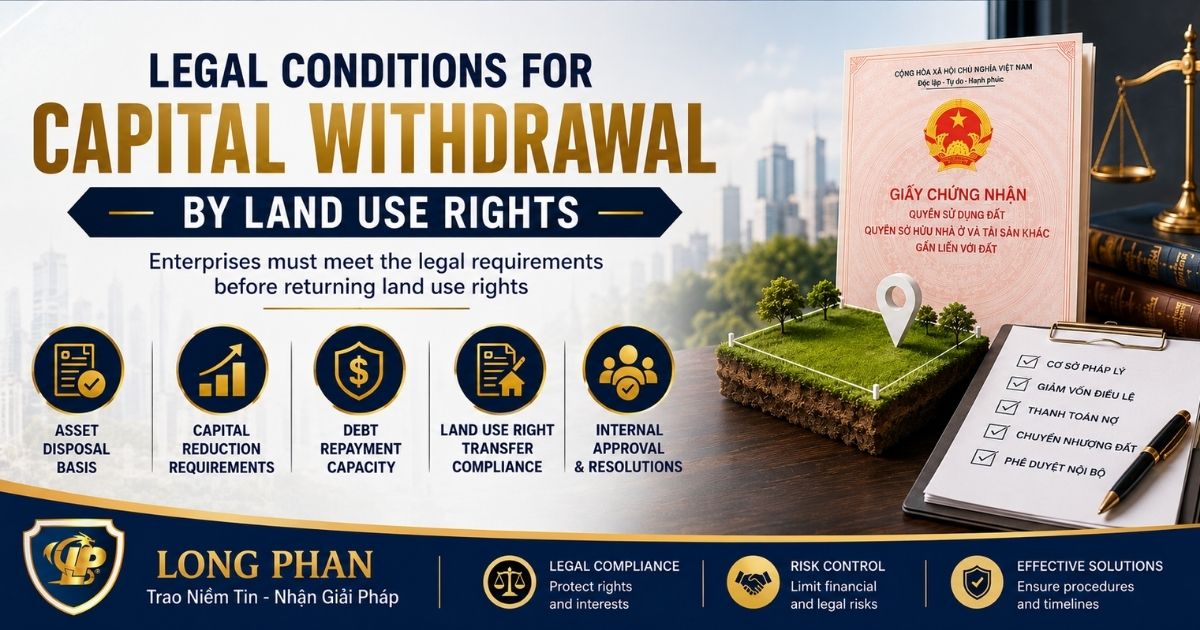
A company may only return land use rights when it simultaneously satisfies the conditions on assets, capital reduction, debt payment, and internal authority. Missing one condition can prevent the transfer from being registered or trigger an obligation to return the asset to the enterprise.
Lawful basis for the company to dispose of the land use rights. Once the land is registered under the enterprise, transferring it back to a member must rest on a lawful transaction, such as returning a capital contribution, transferring the asset, or dividing assets upon dissolution. The enterprise may not use an internal resolution to replace a contract or transfer document. An economic organization may dispose of land use rights that belong to its own assets under Clause 1, Article 27 of the Law on Land 2024.
Full compliance with charter capital reduction conditions. Returning land through capital reduction is only feasible where the company is eligible to reduce capital. The company must have operated continuously for at least two years and must still be able to pay its debts in full after the return. This condition applies to returning a portion of capital corresponding to a member’s ownership ratio, under Point a, Clause 3, Article 68 and Point a, Clause 3, Article 87 of the Law on Enterprises 2020.
Land use rights eligible for the transaction. The parcel must have a clear legal dossier and no restriction on the right of disposal. The enterprise must verify the Certificate directly, together with dispute status, distraint status, and the land use term. Land use rights may only be transferred where a Certificate exists, there is no dispute, no distraint, no provisional urgent measure applied, and the use term remains valid, under Point a, b, c, d, Clause 1, Article 45 of the Law on Land 2024.
Completed financial obligations and eligibility to receive the rights. The enterprise must check land use levies, land rent, tax, and any outstanding obligations before transferring the rights. Unfulfilled obligations may delay or block registration of the change. An economic organization must complete its land-related financial obligations before exercising the right to transfer, under Clause 5, Article 45 of the Law on Land 2024. The recipient must also meet the eligibility conditions for the relevant land type and use purpose.
Valid decision from the enterprise’s internal authority. The land return plan must be approved by the competent body, at the correct voting ratio, and consistent with the Charter. The dossier must clearly reflect the asset value, the return method, and the impact on charter capital. Where a valuation organization is engaged to determine the land value, the result must be approved by more than 50% of the members or founding shareholders, under Clause 2, Article 36 of the Law on Enterprises 2020. Non-transparent valuation or approval may lead to joint liability for compensation.
An enterprise should not assume that land must automatically be transferred back to the contributing party. The right structure must be chosen based on the divestment goal, debt repayment capacity, tax cost, and the legal status of the parcel.
Transfer of the capital contribution while the asset stays with the legal entity. The contributing member transfers the capital portion to another member or a transferee, while the land use rights remain with the company. This option does not change the land user, which can reduce the registration procedure and avoid disruption to the asset’s use. Transferring a capital contribution in a limited liability company follows Article 52 of the Law on Enterprises 2020. However, the transferring party does not receive the land back but instead receives the value of the transferred capital. The enterprise must value the capital portion based on the land value, outstanding debts, and actual financial obligations.
Charter capital reduction with in-kind return of the land use rights. The company reduces its charter capital correspondingly and uses the land use rights to return capital to the member in proportion to their contribution. The company must have operated continuously for at least two years and must still be able to pay its debts in full after the return, under Point a, Clause 3, Article 68 and Point a, Clause 3, Article 87 of the Law on Enterprises 2020. The land use rights must be revalued at the time of return. If the land value exceeds the capital portion returned, the parties must settle the difference through payment records and appropriate accounting entries.
Economic organization transfers the land use rights to a member. Where capital reduction is not available, the company may transfer the land to the member as an independent commercial transaction. This option separates the capital withdrawal from the enterprise’s disposal of its asset. An economic organization may transfer land use rights forming part of its lawful assets under Clause 1, Article 27 of the Law on Land 2024. The contract must be notarized or authenticated, except where a statutory exception applies, under Point a, Clause 3, Article 27 of the Law on Land 2024. The enterprise must control the transfer price, tax, registration fee, and any related-party transaction. A transfer price lacking a proper basis may trigger tax arrears or internal disputes.
Division of real estate assets upon dissolution. Dividing the land use rights may only occur after the enterprise has settled its priority obligations. Members or shareholders may not receive land ahead of creditors, employees, and the tax authority. The remaining assets are divided after paying dissolution costs, unpaid wages, tax, and other debts, under Clause 5, Article 208 of the Law on Enterprises 2020. This option applies when the enterprise ceases operations, not as an ordinary divestment solution. The dissolution, valuation, asset division, and registration change dossiers must be completed in a coordinated manner.
The withdrawal process must connect the corporate governance dossier, business registration, tax, and land records. The enterprise should only sign the transfer document once the transaction structure and internal approval authority are clear.
The withdrawal is only relatively complete once the capital change is recorded, the tax obligation has been declared, and the land use rights change has been registered.
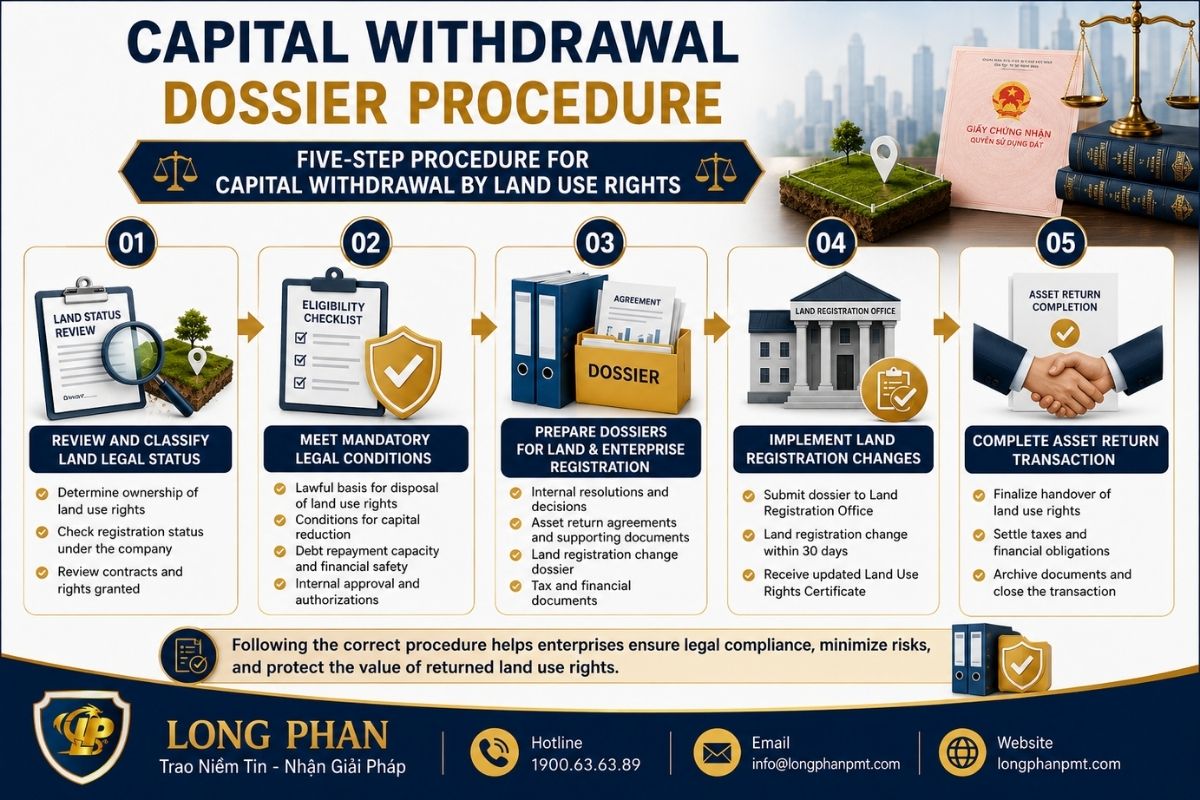
The enterprise must complete the capital reduction procedure before or together with the rights transfer, depending on the transaction structure. The governance dossier must clearly show the reduced capital value, the asset recipient, and the ability to pay debts.
The dossier set typically includes:
The provincial business registration authority receives applications for changes to charter capital and member information, under Clause 1, Article 44 and Clause 1, Article 45 of Decree No. 168/2025/ND-CP. Dossiers received before the decree took effect but not yet resolved will follow the transitional mechanism under Article 117 of Decree No. 168/2025/ND-CP.
The re-registration dossier must simultaneously prove the company’s right of disposal and the member’s basis for receiving the rights. Missing documentation on the transaction’s origin may trigger requests to explain the asset, the capital, and the tax obligation.
| Dossier Group | Core Components |
| Land use rights | Change registration application, Certificate, transfer document, records of assets attached to the land, cadastral extract, and mortgage release document |
| Enterprise | Enterprise Registration Certificate, Charter, resolution, meeting minutes, capital reduction dossier, and power of attorney |
| Transaction origin | Contribution agreement, valuation minutes, accounting records, the initial re-registration dossier, and documents identifying the remaining capital portion |
| Tax and finance | Tax declaration, valuation certificate, debt reconciliation, payment records, and registration fee documents |
The dossier is submitted at the One-Stop Department, the Land Registration Office, or its branch. The land registration organization has the authority to confirm changes for economic organizations, under Point a, Clause 2, Article 136 of the Law on Land 2024.
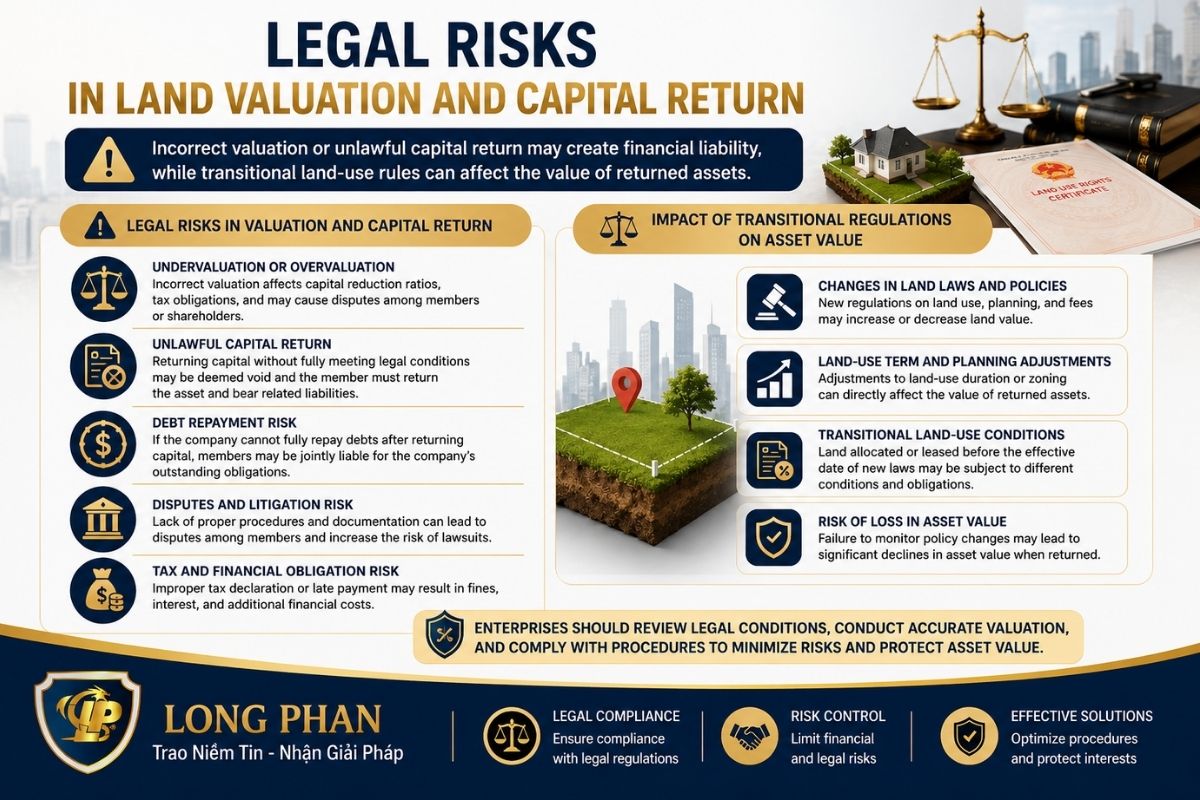
Errors in valuation or capital return can create asset liability for members, shareholders, and the person who approved the transaction. The enterprise must also review transitional regulations, since the land use term can significantly change the value of the capital portion returned.
The value of the land use rights must accurately reflect its legal status, use term, and outstanding financial obligations. Inflating the asset’s value to increase the capital returned can harm the company and its creditors.
Where a valuation organization is engaged, the result must be approved by more than 50% of the members or founding shareholders, under Clause 2, Article 36 of the Law on Enterprises 2020. The enterprise must still retain records proving the valuation method and comparative data.
Agricultural land whose Certificate states “long-term” or shows no use term may be adjusted upon registration of the change. This adjustment directly affects the asset’s value and the proportion of capital returned.
For Certificates issued before 1 August 2024, the agricultural land use term is redetermined as 50 years when the registration change is carried out. The term is calculated from the date the change is confirmed or the new Certificate is issued, under Clause 1, Article 20 of Decree No. 49/2026/ND-CP.
Long Phan Consulting supports enterprises, members, shareholders, and investors in structuring capital withdrawal transactions involving land use rights, while coordinating corporate, land, tax, accounting, and creditor-related issues. Our services include:
Enterprises, clients, or investors seeking a preliminary assessment of a capital withdrawal transaction involving land use rights may send their documents via email at info@longphanpmt.com or Zalo/WhatsApp at +84 906 735 386.
Handling a corporate asset always carries complex legal risk that can go beyond the standard procedure, especially when land policy changes. Understanding exceptional scenarios in capital withdrawal by land use rights helps management control tax cost and protect core assets. The answers below address the practical issues investors most often face..
The investor cannot unilaterally cancel the transaction and must instead reach an agreement with the enterprise to terminate the capital contribution agreement. A capital contribution made with assets is considered fully paid only when lawful ownership of those assets has been transferred to the company under Clause 3 Article 35 of the Law on Enterprises 2020. If the transfer has not been completed, the parties should agree on an adjustment to the charter capital within 30 days from the final deadline for fully contributing the committed capital under Clause 4 Article 47 of the Law on Enterprises 2020.
The enterprise is not permitted to reduce its charter capital by returning contributed assets in this case. A company may reduce its charter capital by returning part of the contributed capital to members only if it has continuously conducted business operations for at least two years from the date of enterprise registration, pursuant to Point a Clause 3 Article 68 and Point a Clause 3 Article 87 of the Law on Enterprises 2020. As an alternative, the investor may consider transferring the capital contribution associated with the asset to another party.
An agreement for the transfer of land use rights between an enterprise and its member must generally be lawfully notarized or authenticated under Point a Clause 3 Article 27 of the Land Law 2024. However, the law provides a specific exception to this requirement. Notarization or authentication is not mandatory if one of the parties to the transaction is an organization engaged in real estate business activities, pursuant to Point b Clause 3 Article 27 of the Land Law 2024.
The capital contributor and the members participating in the incorrect valuation may be jointly liable to the enterprise. Specifically, they must jointly contribute an additional amount equal to the difference between the assessed value and the actual value of the asset and may also be jointly liable for any resulting damage under Clauses 2 and 3 Article 36 of the Law on Enterprises 2020. In addition, where the valuation is conducted by a price appraisal organization, the assessed value must be approved by more than 50% of the members or founding shareholders under Clause 2 Article 36 of the Law on Enterprises 2020.
Members who have received the returned assets may be required to return the assets in kind or an equivalent value to the company. Where capital is returned contrary to law, the members must return the received assets to the company and may be jointly liable for the company’s debts corresponding to the amount that has not been fully returned, pursuant to Article 70 of the Law on Enterprises 2020. A key condition for a lawful capital reduction is that the enterprise must remain capable of fully paying its debts and other property obligations after the capital has been returned, pursuant to Point a Clause 3 Article 68 of the Law on Enterprises 2020.
Withdrawal of Capital Using Land Use Rights can only be carried out safely when the enterprise correctly determines the legal status of the asset, selects an appropriate capital reduction or transfer structure, and completes the required land registration changes. Any decision to return contributed capital must take into account the company’s ability to pay debts, transparent asset valuation, tax obligations, and valid internal corporate authority. Errors at any stage may result in rejection of the application, tax reassessment, or joint liability toward creditors. Contact the Hotline 1900636389 for Long Phan Consulting to develop an appropriate roadmap for asset restructuring and capital withdrawal.
📚 This article has been professionally reviewed based on the following legal documents:
Capital withdrawal by land use rights is only safe when the enterprise correctly determines the asset’s status, selects an appropriate capital reduction or transfer structure, and completes the land registration change. Every decision to return a capital contribution must be tied to debt repayment capacity, transparent valuation, tax obligations, and valid internal authority. An error at any stage can cause the dossier to be rejected, trigger tax arrears, or create joint liability toward creditors. Contact Hotline 1900636389 for Long Phan Consulting to build a suitable roadmap for asset handling and capital divestment.


