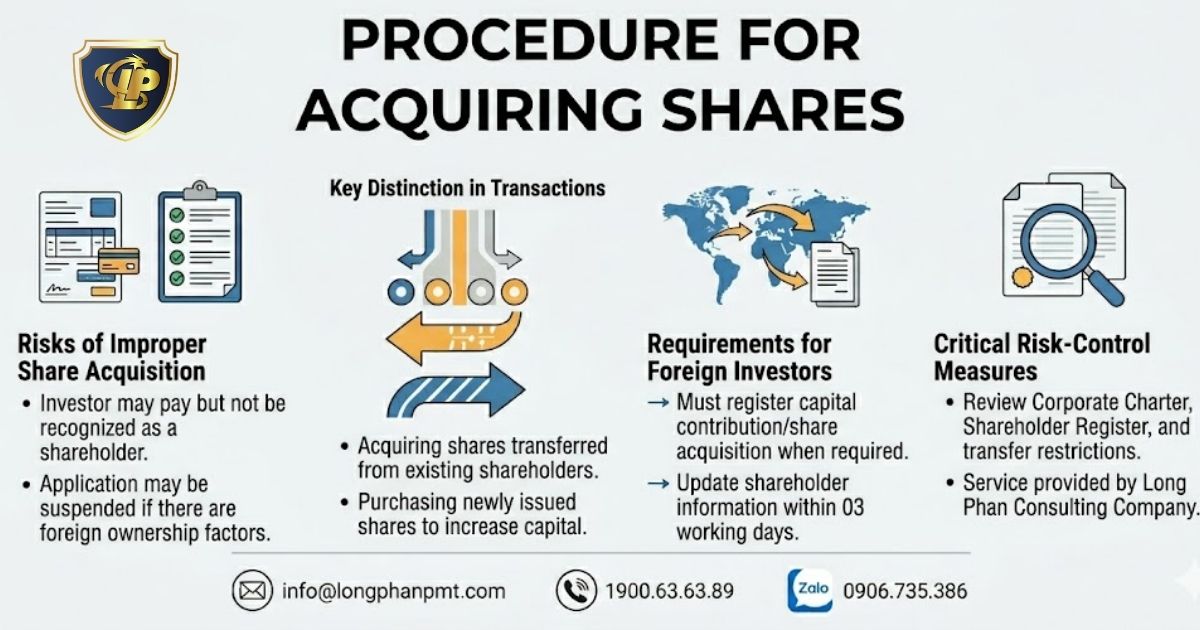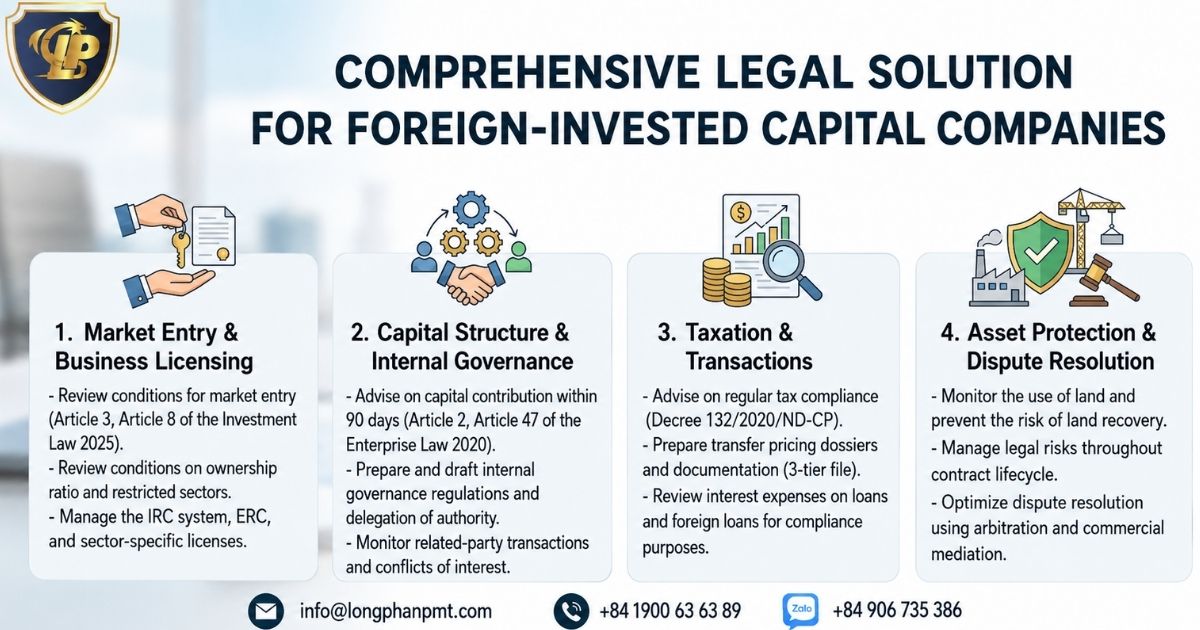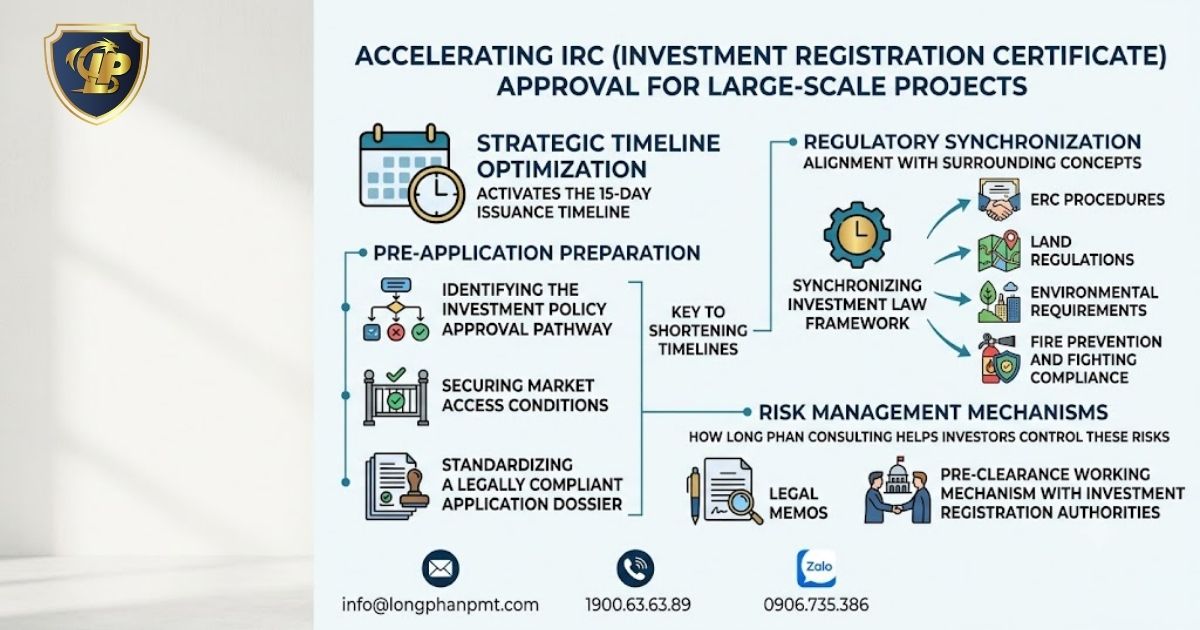

Foreign Capital Contributions may be delayed, rejected, or blocked by banks when investors fail to verify market access rules, foreign ownership caps, and the correct investment account structure. Under the Law on Investment, capital injections, share acquisitions, and equity purchases require proper identification of conditional business sectors, completion of registration procedures with the Investment Registration Authority when applicable, updates with the Business Registration Authority, and payment through the appropriate DICA or IICA.
Long Phan Consulting supports investors in controlling transaction, licensing, and capital-flow risks.

Key legal notes:
Foreign investors must rigorously evaluate business lines, ownership caps, and capital injection mechanisms before executing commercial terms. Pursuant to Clause 19, Article 3 of the Law on Investment 2025, a “foreign investor” is defined as any individual holding foreign nationality or any organization established under foreign laws conducting business investment activities within Vietnam.
For standard industries, foreign entities enjoy market access conditions identical to those applicable to domestic investors. However, if the target company operates within the Directory of Sectors Restricted from Market Access, the transaction must satisfy stricter regulatory thresholds regarding charter capital ownership ratios, investment methods, scopes of activity, and professional capacity, in accordance with Clauses 1, 2, and 3, Article 8 of the Law on Investment 2025.
| Business Sector Classification | Statutory Significance for Foreign Blocks | Direct Impact on Capital Transaction Structure |
| Sectors Unmapped for Market Access | Foreign investors are strictly prohibited from investing. | Parties should not execute MOUs, deposit funds, or transfer capital before legally removing these restricted sectors. |
| Conditional Market Access Sectors | Must satisfy rigid conditions regarding ownership caps, investment forms, and operational scopes. | Legal due diligence is mandatory to verify conditional compliance before determining the final equity purchase ratio. |
| Unrestricted Sectors | Subject to equal market access treatment as domestic investors. | Transaction timelines can be optimized provided no sensitive land-use elements are triggered. |
An investor’s nationality can substantially alter the legal reasoning required within a capital contribution dossier. Investors originating from WTO member states or nations party to relevant international treaties generally possess a clearer baseline for comparison when justifying market access conditions.
Conversely, for investors from non-WTO countries or jurisdictions lacking specific bilateral treaties, the application dossier must proactively prove the capacity to satisfy local investment conditions. These criteria encompass explicit limits on charter capital ownership ratios, permitted investment structures, business scopes, and corporate capability thresholds under Clause 3, Article 8 of the Law on Investment 2025.
Evaluating nationality is far more than a mere administrative step. It establishes the critical baseline for determining whether an investor should execute a direct capital contribution, a share purchase, an acquisition of capital contribution, or utilize a legally compliant intermediary entity.
The concept of “foreign room” must be accurately interpreted as a structural condition governing the maximum charter capital ownership ratio held by foreign investors. In multi-sector enterprises, the most severe strategic risk involves a single, restricted secondary business line dragging down the allowable ownership cap of the entire corporate vehicle.
Enterprises must perform a comprehensive audit comparing currently registered business lines against actual operations. Under Clause 10, Article 17 of Decree No. 96/2026/NĐ-CP, if a target company operates multiple business sectors, the maximum foreign ownership limit may be dictated by the single industry subject to the most restrictive threshold.
Prior to receiving inbound foreign capital, Vietnamese target companies should legally divest from obsolete business lines that no longer generate revenue but introduce severe regulatory barriers. This structural cleanup mitigates transactional risk prior to asset valuation, Share Purchase Agreement (SPA) signing, and final equity allocation.

Businesses need to clearly distinguish between M&A procedures and procedures for establishing new investment projects. Transactions involving the purchase of shares or capital contributions usually require. Document approving capital contribution, share purchase, or equity purchase. However, it is not automatically required to apply for an Investment Registration Certificate (IRC).
The investment registration authority is the focal point for assessing market access conditions and national defense and security factors. After this step, the provincial business registration authority will record the status of foreign members or shareholders in the company’s records.
Not all foreign capital transactions require prior approval. Businesses need to check 3 control boundaries. This includes conditional business sectors, foreign ownership limits, and land use rights in sensitive areas.
| Comparison criteria | Cases where investment approval registration is mandatory. | Exceptions are referred directly to the Business Registration Authority. |
| Business lines | Transactions that increase the foreign ownership ratio in businesses operating in sectors with conditional market access. | Businesses that do not belong to industries or professions subject to conditional market access. |
| Equity ownership ratio | The transaction increased the foreign ownership percentage from below. 51% go up 51% or more, or word51% or more up to a higher rate | The transaction does not alter the capital control threshold as stipulated by regulations. |
| Land factor | The target enterprise must possess a Certificate of Land Use Rights located on an island, in a border commune, ward, or town, in a coastal area, or in an area affected by national defense and security. | The target business will not use land in the sensitive area. |
Registration of capital contributions, share purchases, and equity investments at the Investment Registration Authority is mandatory when the target economic organization falls into the above situations, according to Clause 3, Article 76 of Decree No. 96/2026/ND-CP. If it does not fall into this group, the enterprise can proceed directly to the information update procedure at the Business Registration Authority.
The registration step at the Investment Registration Authority determines the validity of the transaction before closing. The documentation needs to demonstrate that the investor meets the market access requirements, while also eliminating the risk of being required to provide additional explanations.
Businesses should factor these milestones into their SPA signing, payment, and closing schedules. If documents lack consular legalization or do not clearly demonstrate legal standing, the transaction process may be delayed beyond the planned commercial timeline.
After receiving written approval, the target enterprise must carry out the procedure to amend its business registration details. This is the step to officially record the foreign investor’s status as a shareholder or member.
The process of updating business registration should not be viewed as a mere formality. Failure to complete this step may put investors at risk when exercising voting rights, further transferring ownership, or proving ownership in disputes.
Corporate capital contribution procedures are inextricably linked to strict banking compliance. Even if a transaction clears all local investment registration hurdles, utilizing an incorrect bank account type can permanently freeze corporate capital, obstruct future equity divestments, or block the outbound repatriation of legitimate dividends.
Enterprises with foreign direct investment must open a specialized Direct Investment Capital Account (DICA) in either foreign currency or Vietnamese Dong at an authorized bank. This statutory obligation applies directly to any enterprise established by a foreign investor that requires an IRC, as well as any operational enterprise where foreign investors acquire a charter capital ownership ratio of 51% or higher, pursuant to Clauses 1 and 2, Article 5 of Circular No. 06/2019/TT-NHNN.
Every single transaction relating to inbound capital contributions, payments for share acquisitions, outbound dividend remittances, or the repatriation of legitimate corporate revenues must route exclusively through this designated Direct Investment Capital Account. This rigid operational principle is strictly mandated under Articles 6 and 7 of Circular No. 06/2019/TT–NHNN.
Payment clauses within a Capital Contribution Transfer Agreement or Share Purchase Agreement (SPA) must be engineered around the explicit residency status of the contracting counterparties. Designating an unapproved settlement currency or misrouting funds across banking streams will prompt authorized credit institutions to block the transaction during post-closing audits.
| Transaction Scenarios | Valid Settlement Currency & Capital Routing | Statutory Legal Basis |
| Between Non-Resident Foreign Investors | Parties are legally permitted to value the transaction and execute payments in freely convertible foreign currencies. | Clause 3, Article 10 of Circular No. 06/2019/TT-NHNN |
| Between a Resident and a Non-Resident | The transaction valuation and final payment settlement must be executed exclusively in Vietnamese Dong (VND). | Clause 3, Article 10 of Circular No. 06/2019/TT-NHNN |
| Equity Settlements within an FDI Project | All capital transfers and acquisition payments must be routed through a specialized investment capital account. | Clause 2, Article 10 of Circular No. 06/2019/TT-NHNN |
Chief Financial Officers (CFOs) and internal legal counsels must systematically review payment terms before executing any binding equity transfer contracts. Accepting direct cash settlements, utilizing personal bank accounts, or routing funds into ordinary corporate operating accounts will destroy the investor’s ability to prove the legal origin of their investment capital.
Enterprises must definitively classify their financial routing model into either a DICA or an IICA framework before any cross-border funds are remitted. Ownership thresholds, ultimate corporate control, and the core legal nature of the investment serve as the sole criteria determining banking compliance.
Whenever a foreign investor transitions from an indirect investment position to a dominant, controlling stake, the underlying corporate account architecture must be restructured immediately. Once equity ratios breach the 51% threshold, corporate banking streams must be systematically migrated to a compliant DICA framework.
Account structuring errors rarely manifest during the initial capital injection phase. Instead, these hidden compliance landmines explode during retrospective tax audits, state foreign exchange inspections, corporate dividend distributions, or when executing an exit transaction to a subsequent foreign buyer.
Foreign investors must never treat capital contribution procedures as minor administrative chores that can be cleaned up post-closing. The two risk categories that historically inflict the most severe financial damage are unapproved proxy ownership structures and misrouted capital banking flows.
These transactional risks share a dangerous trait: they remain completely invisible until a corporate dispute occurs, a regulatory audit is initiated, or an exit is attempted. Consequently, foreign enterprises must execute exhaustive legal due diligence before signing any binding assignment contracts, power of attorney documents, or capital contribution agreements.
Utilizing a local Vietnamese citizen as a proxy owner may accelerate initial market entry on the surface, but it strips the foreign investor of genuine asset protection. When operational control and beneficial ownership reside with a foreign individual, regulators will classify the proxy arrangement as an illegal transaction engineered to circumvent market access conditions.
The Investment Registration Authority possesses the explicit statutory power to terminate an investment project, either in whole or in part, if the underlying business activity was established via a fictitious civil transaction, pursuant to a binding court judgment or ruling. This severe administrative sanction is enforced under Clause 1, Article 68 of Decree No. 96/2026/NĐ-CP.
This operational hazard is exceptionally acute in real estate, logistics, education, e-commerce, and any industry imposing strict caps on the charter capital ownership ratio of foreign investors. Investors must proactively restructure these proxy models into direct, legally compliant equity holdings before internal commercial disputes erupt.
Executing transactions via unapproved payment channels can completely destroy the commercial value of an M&A deal. Prevalent banking compliance errors include settling equity values via personal bank accounts, delivering physical cash, remitting funds directly into standard operational accounts, or utilizing the incorrect investment capital account framework.
Foreign investors are legally obligated to strictly conform to foreign exchange control regulations when injecting capital into Vietnam, remitting corporate profits, or repatriating legitimate revenues out of the country. This fundamental compliance duty is anchored to Clause 2, Article 11 of the Ordinance on Foreign Exchange 2005, as amended and supplemented by the 2013 Ordinance.
While current statutory sources do not dictate a fixed monetary fine for every specific misrouted capital stream, the true commercial damage lies elsewhere. The primary financial threat remains the permanent freeze on dividend repatriation, extensive exit delays, and the absolute inability to prove the legitimacy of international capital under retrospective state inspections.
Foreign capital acquisitions and corporate share purchases must be strictly managed around transitional legal milestones. Filing an application at the wrong time can fundamentally alter applicable market access conditions, invalidate active registration forms, and disrupt capital account structures.
Executive boards, internal legal teams, and CFOs must integrate the statutory milestones of 2025 and 2026 into their pre-closing schedules. This proactive planning prevents the unexpected application of restrictive new laws and avoids administrative lockouts when utilizing online business registration portals.
| Transitional Regulatory Category | Statutory Milestone Date | Direct Operational Impact on Enterprises |
| Dossiers Submitted Prior to New Legislation | Before March 01, 2026 | Applications may continue processing under the Law on Investment 2020, provided the dossier was officially accepted as valid. |
| Registrations Overlapping New Regulations | From July 01, 2025 | The Business Registration Authority strictly applies updated corporate compliance workflows and modernized registration forms. |
| Legacy Foreign-Invested Enterprises | From March 01, 2026 | Capital expansions or subsequent M&A deals will trigger regulatory scrutiny identical to newly entering foreign entities. |
| Standard Business Registration Accounts | Until December 31, 2025 | Corporate entities must transition to approved electronic identification methods to secure access for online document filings. |
| Investment Capital Account Re-Structuring | Upon breaching the 51% ownership threshold | Corporate banking mechanisms must be migrated from an indirect investment model to a Direct Investment Capital Account. |
Enterprises with applications pending during legislative transitions must verify whether their files qualify for grandfathering protection. This determination directly influences approval timelines, applicable market access rules, and commercial closing guarantees.
The Law on Investment 2025 entered into full effect on March 01, 2026. Pursuant to Clause 14, Article 52 of the Law on Investment 2025, valid applications for M&A approval or investment registration officially received by authorities prior to this date but still awaiting final results will continue to be reviewed and processed under the statutory frameworks of the Law on Investment 2020.
Conversely, the corporate registration framework operates on a distinct transitional timeline. Under Article 117 of Decree No. 168/2025/NĐ-CP, if an application to update member registries following a capital transaction was submitted but not yet approved prior to July 01, 2025, the Business Registration Authority will resolve the filing strictly under the modernized regulatory procedures.
From a transaction management perspective, executives must not rely on the execution date of the contract. The official date of issuance on the administrative receipt of a valid dossier is the sole legal trigger determining whether a deal is protected by grandfathering rules or pushed into new compliance frameworks.
Legacy foreign-invested enterprises (FIEs) are no longer treated as absolute safe-harbor corporate vehicles for executing domestic acquisitions. Once an established FIE holds a dominant, controlling equity stake, its downstream expansion activities are scrutinized as direct foreign inbound capital.
Effective March 01, 2026, economic organizations where foreign investors hold a charter capital ownership ratio exceeding 50% must fully satisfy local market access conditions and clear identical administrative hurdles as a brand-new foreign investor when adjusting investment projects, adding business lines, incorporating subsidiaries, purchasing equity in domestic targets, or investing via BCC structures. This strict enforcement is anchored to Clause 2, Article 104 of Decree No. 96/2026/NĐ-CP.
This provision eliminates the structural advantage of utilizing an early-stage, legacy FIE as a proxy vehicle to absorb domestic companies. Prior to deploying an intermediary corporate entity for M&A, investors must perform a comprehensive evaluation of the actual control structures, target business lines, and resultant charter capital ownership ratios.
For multinational conglomerates managing complex corporate webs in Vietnam, each individual equity transaction must be audited as an independent cross-border deal. Assuming an acquisition is exempt from foreign ownership limits simply because it is executed by an existing local corporate entity introduces critical regulatory exposure.
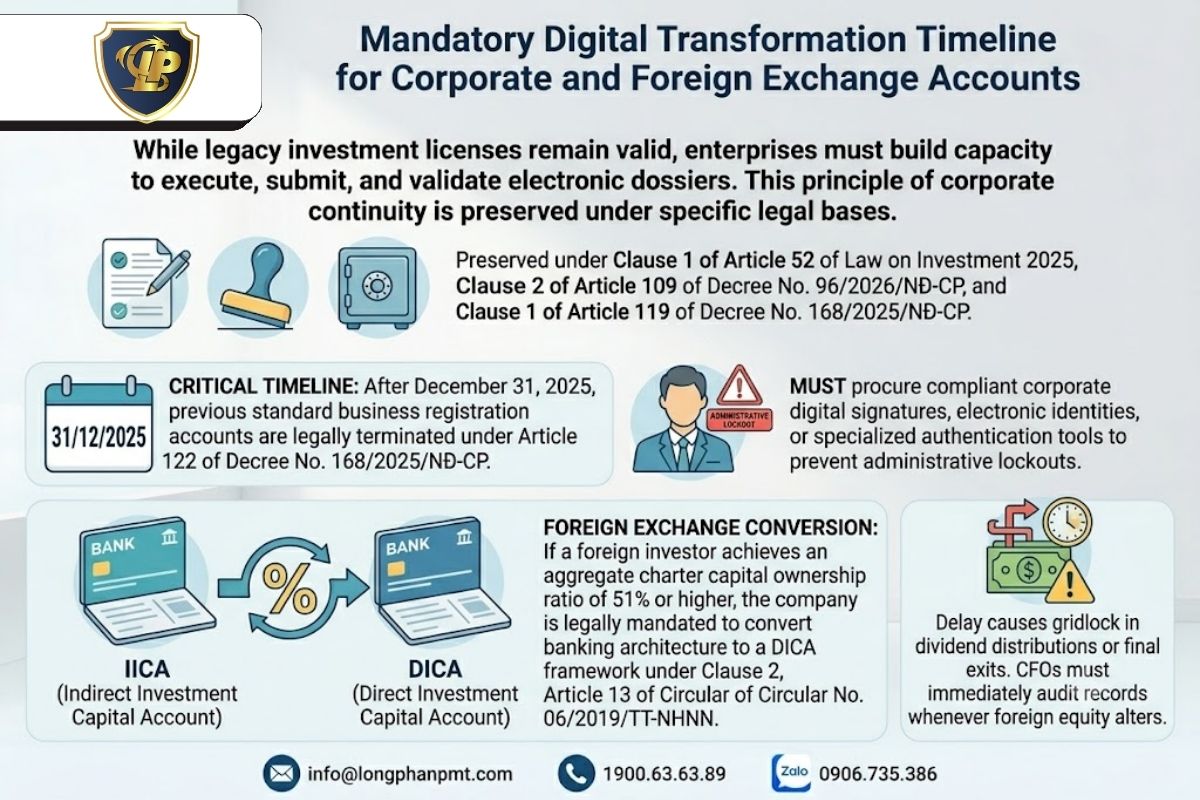
While legacy investment licenses remain legally valid, enterprises must develop the institutional capacity to navigate completely digital administrative environments. The primary operational risk does not stem from a requirement to exchange physical certificates, but from the technical ability to execute, submit, and validate electronic corporate dossiers.
Enterprises currently operating under older Investment Licenses or Investment Certificates that double as corporate business licenses are fully authorized to maintain active operations without a mandatory obligation to convert to modern forms, unless a specific modification is requested. This principle of corporate continuity is preserved under Clause 1 of Article 52 of the Law on Investment 2025, Clause 2 of Article 109 of Decree No. 96/2026/NĐ-CP, and Clause 1 of Article 119 of Decree No. 168/2025/NĐ-CP.
However, standard business registration accounts previously used to authenticate online corporate filings are legally terminated after December 31, 2025, pursuant to Article 122 of Decree No. 168/2025/NĐ-CP. Foreign legal representatives must immediately procure compliant corporate digital signatures, electronic identities, or specialized authentication tools to prevent administrative lockouts.
Simultaneously, the underlying foreign exchange account structures must be audited whenever corporate ownership balances shift. If a foreign investor previously utilized an Indirect Investment Capital Account (IICA) to purchase shares and subsequently achieves an aggregate charter capital ownership ratio of 51% or higher, the company is legally mandated to convert its banking architecture to a Direct Investment Capital Account (DICA) framework under Clause 2, Article 13 of Circular No. 06/2019/TT-NHNN.
Delaying this bank account migration causes catastrophic gridlock in corporate cash flows during subsequent dividend distributions or final exits. Corporate financial officers must systematically audit banking records, historical capital contributions, and account classifications the moment any transaction alters the foreign equity ratio.
Foreign capital transactions frequently collapse post-closing not due to commercial valuation disagreements, but because of unmapped market access restrictions, misrouted banking streams, or deficient due diligence on the target asset. Long Phan Consulting Company equips foreign enterprises with comprehensive risk mitigation from the initial transaction structuring phase through to final state registration.
Legal Support from Long Phan Consulting Company
Foreign corporate executives, investors, and CFOs can securely transmit transaction files, corporate licenses, and banking records via Email at info@longphanpmt.com or through Zalo/WhatsApp at +84 906 735 386 for a preliminary legal evaluation.
The process of structuring transactions for “foreign capital contributions” to economic organizations in Vietnam requires absolute precision in both administrative procedures and investment cash flow risk management. Small changes in the ownership structure or geographical location of the target enterprise can trigger stringent security assessment conditions. Proactively identifying specific legal situations helps the board of directors protect commercial interests and international capital flows to the fullest extent.
Yes, this share purchase transaction is required to undergo registration and obtain written approval from the Investment Registration Authority before updating member information. This regulation applies because the transaction increased the foreign ownership ratio beyond the core control threshold from below 51% to over 50% of the charter capital, as stipulated in Clause 3, Article 76 of Decree No. 96/2026/ND-CP.
The maximum time limit for the Investment Registration Authority to assess market access conditions and issue a notification of transaction approval is 15 working days. The processing time for administrative procedures is longer than for normal transactions because the target economic organization holds a land use right certificate in a sensitive area affecting national security and defense, as stipulated in Point c, Clause 5, Article 76 of Decree No. 96/2026/ND-CP.
Yes, the Investment Registration Authority has the full right to issue an administrative decision to terminate all or part of the investment project’s operations. This severe penalty is triggered when there is sufficient legal basis from a valid judgment or decision of the Court determining that the investor circumvented the law by conducting investment and business activities based on fictitious civil transactions, as stipulated in Clause 1, Article 68 of Decree No. 96/2026/ND-CP.
No, foreign investors are absolutely prohibited from using regular personal accounts to make M&A transaction payments. All payments for the transfer value of investment capital or investment projects between non-residents and residents must be channeled through dedicated accounts as stipulated in Clause 2, Article 10 of the State Bank of Vietnam’s Circular No. 06/2019/TT-NHNN.
Foreign investors are required to manage all payment flows for the transfer of shares and subsequent dividend payments through a single indirect investment capital account opened in Vietnamese Dong at an authorized bank. This indirect investment mechanism applies because the foreign investor’s ownership stake in the charter capital after the transaction falls below the controlling threshold of 51% as stipulated in Clause 2, Article 3 of Circular No. 03/2025/TT-NHNN.
No, acquisition and capital transfer transactions between two non-resident investors are free to choose their own valuation and make payments in freely convertible currencies. This exception is permitted by foreign exchange regulations and applies specifically to investment relationships conducted entirely between non-residents, as stipulated in Point a, Clause 3, Article 10 of Circular No. 06/2019/TT-NHNN.
Executing a foreign investors capital contribution in Vietnam generates lasting commercial value only when the underlying transaction is meticulously structured around local market access restrictions, charter capital thresholds, mandatory M&A approvals, and strict foreign exchange banking disciplines. Vietnamese target entities must comprehensively audit their business registries, land portfolios, conditional operational licenses, and specific bank routing frameworks well in advance of closing. Relying on unapproved proxy structures or utilizing non-compliant banking flows introduces severe operational exposure, including frozen corporate capital, asset disputes, and fatal compliance failures during retrospective state inspections. Contact our corporate desk via the Hotline at 1900636389 to secure specialized transaction structuring and legal risk management under the expert guidance of Long Phan Consulting Company.
📚 This article is provided with professional consultation based on the following legal framework: