


Executive Employment Contracts for senior management can expose businesses to risks involving performance targets, confidential information, equity incentives, and executive departures if not properly structured. Contracts for positions such as CEO, CFO, and COO should clearly define decision-making authority, compensation packages, confidentiality commitments, non-solicitation obligations, non-compete restrictions, transition responsibilities, and conflict-of-interest controls. Enterprises should ensure alignment with governance policies, approval hierarchies, and obligations under the Law on Labor. Long Phan Consulting provides strategic review and drafting support to strengthen executive employment arrangements.

Important legal note:
A senior executive labor contract does not merely record a job description, base remuneration, and standard working hours. For a CEO, CFO, COO, or divisional Vice President, this strategic document must simultaneously regulate legal representation rights, internal budget approval thresholds, data access privileges, and statutory corporate governance duties.
In terms of its legal classification, this instrument must be structurally drafted as a labor contract for an enterprise manager. This specialized approach ensures that a corporation does not conflate general employment relationships with distinct corporate liabilities arising directly under Vietnamese enterprise law.
A senior executive may still be legally classified as an employee if they perform work based on a mutual agreement, receive wages, and operate under the direct administration, leadership, and supervision of the hiring entity. This employment relationship is identified by the actual nature of the work performed rather than the formal corporate title, pursuant to Clause 1, Article 3 of the Labor Code 2019.
However, the critical differentiator lies in the exercise of corporate governance authority. Under Vietnamese law, an enterprise manager explicitly encompasses the Director, General Director, members of the Board of Directors, the Chairman of the Members’ Council, and any other managerial individual holding equivalent titles stipulated directly within the Corporate Charter, pursuant to Clause 24, Article 4 of the Law on Enterprises 2020.
Consequently, boilerplate labor contract templates fail to provide adequate legal protection for C-level positions. Enterprises must integrate dedicated contract appendices detailing internal decision-making matrices, strict budgetary boundaries, corporate signing authorities, objective performance metrics, and comprehensive conflict of interest recusal frameworks.

A senior executive employment agreement must explicitly detail the core corporate title, precise scope of work, financial compensation structures, and the reciprocal rights and obligations of the contracting parties. These elements constitute the mandatory core contents of a valid labor contract, pursuant to Clause 1, Article 21 of the Labor Code 2019.
Furthermore, when an executive is hired to serve as the Director or General Director within a state-owned structure, the underlying employment agreement must incorporate specialized clauses governing operational powers, rigorous performance evaluations, mandatory removal conditions, and dedicated dispute resolution mechanisms, pursuant to Articles 5 and 6 of Decree No. 145/2020/ND-CP.
In international corporate practice, these contractual frameworks should be customized into the following specific operational clauses:
If an employment contract burdens an executive with strict revenue targets but fails to grant them proportional control over corporate budgets, headcount allocation, or market strategy, the enterprise will face immense evidentiary hurdles when attempting to justify a contract termination based on a failure to perform duties.
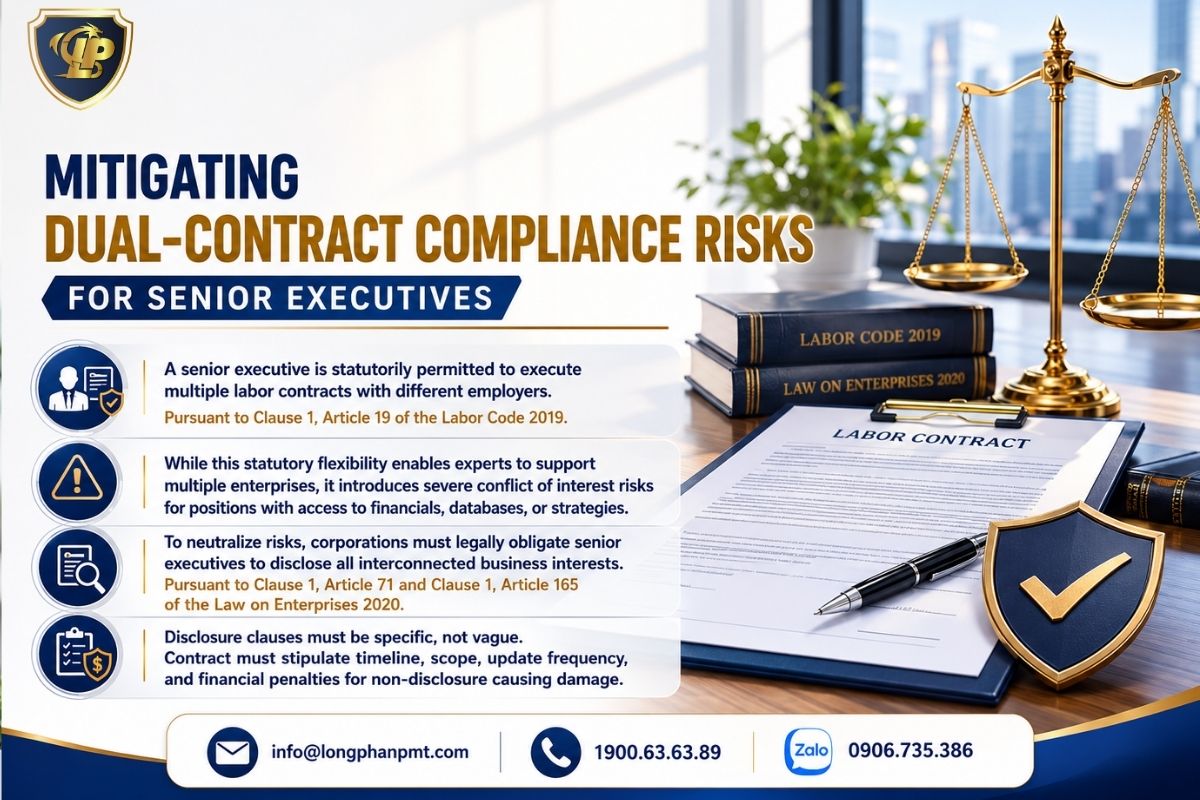
A senior executive is statutorily permitted to execute multiple labor contracts with different employers simultaneously. However, they remain legally obligated to fully perform all terms and operational covenants agreed upon across each contracting entity, pursuant to Clause 1, Article 19 of the Labor Code 2019.
While this statutory flexibility enables corporate governance experts, fractional CFOs, or cross-border executive advisors to support multiple enterprises, it introduces severe conflict of interest risks for positions possessing direct access to financial statements, proprietary customer databases, or core market strategies.
To neutralize these commercial risks, corporations must legally obligate senior executives to comprehensively disclose all interconnected business interests prior to onboarding. The statutory duty to timely notify the enterprise regarding any company in which the manager or their related parties hold sole ownership, joint ownership, or a controlling equity stake is strictly mandated pursuant to Clause 1, Article 71 and Clause 1, Article 165 of the Law on Enterprises 2020.
These material disclosure clauses must not be drafted in vague, non-specific terms. Instead, the contract must explicitly stipulate the exact timeline for declarations, the precise scope of reportable business entities, the mandatory frequency of updates, and clear financial penalties if a failure to disclose causes commercial damage to the corporation.
The financial mechanisms embedded within a senior executive labor contract must be engineered as active corporate governance tools rather than static payroll listings. For a CEO, CFO, or COO, base remuneration, performance bonuses, Employee Stock Ownership Plans (ESOPs), and severance packages must be linked directly to audited business outcomes, verified operational boundaries, and statutory fiduciary duties.
If an enterprise merely commits to an absolute gross compensation package without specifying the exact triggers for performance rewards, the timeline for disbursements, and the claw back mechanisms, commercial disputes will inevitably arise the moment corporate performance shifts.
For an enterprise manager, financial compensation must mirror actual managerial value. The payment of salaries, remuneration packages, and performance bonuses to a Director, General Director, or other corporate managers must be calculated based on the actual business performance and operational efficiency of the enterprise, pursuant to Clause 1, Article 66, Clause 1, Article 84, and Clause 1, Article 163 of the Law on Enterprises 2020.
To safeguard corporate equity, financial rewards should be partitioned into distinct contractual tiers:
Corporations must avoid guaranteeing executive bonuses in absolute or unconditional terms. Every performance-based reward must be paired with explicit activation triggers, clear performance exclusions, and the designated internal corporate approval authority.
The payment of performance rewards to senior executives must strictly conform to the internal regulations of the corporation. Bonus policies must be publicly disclosed at the workplace, pursuant to Clause 2, Article 104 of the Labor Code 2019.
Furthermore, regarding the establishment of salary scales, payroll structures, and labor norms, the enterprise must consult with the grassroots employee representative organization, if one exists at the firm. These financial frameworks must also be published transparently before implementation, pursuant to Clause 3, Article 93 of the Labor Code 2019.
From a corporate accounting and tax compliance perspective, all managerial compensation paid to enterprise managers must be accounted for as corporate operating expenses and itemized as a standalone section within the audited annual financial statements, pursuant to Clause 2, Article 66, Clause 2, Article 84, and Clause 3, Article 163 of the Law on Enterprises 2020.
A lack of transparency or procedural alignment within the internal bonus regulations prevents a company from legally withholding or adjusting performance rewards. This compliance risk escalates significantly if the contract incorporates complex equity structures, profit-sharing formulas, or capital-raising milestones.
The distribution of financial bonuses to senior executives must remain subject to the broader liquidity realities of the enterprise. A Director or General Director is statutorily prohibited from demanding a salary increase or collecting performance bonuses if the corporation is unable to fully settle its mature debts or satisfy its ongoing creditor obligations, pursuant to Clause 2, Article 71 of the Law on Enterprises 2020.
Consequently, senior contracts must incorporate enforceable claw back provisions enabling the company to reclaim disbursed bonuses if an executive breaches their duty of loyalty, manipulates performance data, conceals material conflicts of interest, or causes severe commercial loss. These safeguards are critical when performance bonuses are distributed prior to the completion of annual audits or final KPI validation.
Claw back mechanisms must not be drafted as an arbitrary right of the employer. The contract clause must explicitly define the triggering events, the scope of recoverable funds, the calculation methodology, and the boundaries of wage deductions, which must never exceed 30% of the actual net monthly salary after statutory deductions, pursuant to Clause 3, Article 102 of the Labor Code 2019.
In senior executive labor contracts, the primary commercial threat extends far beyond mere operational underperformance. Material damage typically manifests when a corporate manager leverages inside information, proprietary business opportunities, or internal approval authorities to advance personal interests or enrich third parties.
Corporations must structurally engineer their executive agreements to enforce the statutory duty of loyalty, duty of care, and conflict avoidance protocols. This specialized layer of contractual provisions must operate in tandem with performance metrics, bonus structures, equity vesting schedules, and corporate representation rights.
An enterprise manager carries legal responsibilities that far exceed the basic compliance duties of a standard employee. A manager bears an absolute fiduciary obligation to remain loyal to the commercial interests of the corporation, and is strictly prohibited from abusing their corporate title, operational authority, inside information, proprietary trade secrets, or emerging business opportunities for personal gain or self-dealing, pursuant to Clause 1, Article 71 and Clause 1, Article 165 of the Law on Enterprises 2020.
The contract text must translate these broad statutory concepts into a concrete code of conduct. The contract must explicitly delineate prohibited activities, including the unauthorized utilization of proprietary customer lists, pricing matrices, capital-raising timelines, product roadmaps, or vendor supply networks to benefit competing entities.
If the duty of loyalty remains defined only in general terms, the corporation will face immense evidentiary hurdles when attempting to establish a legal breach. This risk multiplies if a CEO, CFO, or COO is concurrently acting as an advisor, investor, or director for outside commercial ventures.
Potential conflicts of interest must be identified and neutralized before an executive assumes active operational control over corporate assets. A corporate manager is statutorily mandated to notify the enterprise in a timely, complete, and accurate manner regarding any business entity in which they or their related parties hold sole ownership, joint ownership, or a controlling equity stake, pursuant to Clause 1, Article 71 and Clause 1, Article 165 of the Law on Enterprises 2020.
To enforce this check and balance, the contract must require mandatory, written disclosures covering the following specific risk groups:
The conflict control framework must include regular disclosure review cycles and a strict obligation to report new interests immediately as they arise. Without these formal workflows, an enterprise cannot halt self-dealing transactions before irreversible financial leakage occurs.
Contractual remedies for breaches of fiduciary duty must be precise, punitive, and legally enforceable. An enterprise manager who violates their statutory duties bears personal or joint liability to return all illicitly acquired financial gains, indemnify the corporation for all lost profits, and fully compensate the company or injured third parties for resulting commercial damages, pursuant to Clause 2, Article 165 of the Law on Enterprises 2020.
Furthermore, when an executive executes unauthorized or self-dealing transactions, the ramifications extend beyond internal corporate discipline. The underlying contracts or transactions are subject to being declared null and void by a competent court; both the signing executive and their interconnected related parties must jointly indemnify the enterprise for damages and return all financial proceeds to the company, pursuant to Clause 3, Article 67, Clause 5, Article 86, and Clause 5, Article 167 of the Law on Enterprises 2020.
Accordingly, senior executive labor contracts must tie conflict of interest violations directly to the following contractual enforcement mechanisms:
Sanction clauses must avoid granting the employer unchecked, arbitrary enforcement powers. A legally sound provision must outline clear evidentiary steps, formal verification timelines, the specific internal concluding authority, and a financial offset sequence that remains strictly within local labor restrictions.
For senior executives, asset leakage risks extend far beyond physical property. Real-world corporate damage almost always involves the unauthorized extraction of customer databases, underlying source code, proprietary pricing models, corporate CRM access, advertising assets, and core trade secrets.
Corporations must partition their defensive frameworks into three independent contractual layers: information security, non-solicitation of personnel and clients, and post-termination non-compete restrictions. Bundling these distinct protections into a single, generic clause heavily degrades their enforceability when an executive dispute arises.
A non-disclosure agreement must be structured as an independent legal obligation rather than a vague professional ethics pledge. Where an employee’s duties directly involve or grant access to the trade secrets or technological secrets of the employer, the parties have the statutory right to execute a written agreement specifying the exact scope of protection, the duration of confidentiality, the corresponding executive rights, and the financial compensation and liabilities for breach, pursuant to Clause 2, Article 21 of the Labor Code 2019.
For a CEO, CFO, or COO, the contractual definition of confidential information must explicitly encompass:
The security provisions must clearly outline the post-employment protection duration, the precise classification of confidential assets, the boundaries of data authorization, and quantified liquidated damages. Incorporating a generic phrase like “the executive must protect all information” fails to establish a legally defensible boundary in court.
Non-solicitation and non-compete covenants must be drafted as two separate legal mechanisms. Non-solicitation clauses focus on preventing an outgoing executive from raiding internal personnel, poaching established corporate clients, or diverting active suppliers; non-compete restrictions focus on blocking the executive from working for direct market competitors within a reasonable operational scope.
To maximize legal enforceability under local civil and labor standards, restrictive covenants must implement strict, reasonable boundaries:
If a non-compete restriction is drafted too broadly, lacks financial compensation, or entirely suffocates the individual’s constitutional right to work, it faces an immense risk of being declared void by a court or labor arbitrator. Corporations must prioritize demonstrating a legitimate need to protect proprietary trade secrets rather than attempting to enforce a blanket ban on competitive employment.
The ownership rights over all intellectual property created by a senior executive during their tenure must be legally secured within the text of the primary contract. Any trade secret generated by an employee while executing their assigned professional duties belongs exclusively to the employing entity that commissioned the work, unless explicitly altered via a written agreement, pursuant to Clause 3, Article 121 of the Law on Intellectual Property 2005.
Similarly, for patentable inventions, industrial designs, or circuit layouts, the enterprise that invests the capital, infrastructure, and material means retains the statutory right to register and own the resulting intellectual property assets, pursuant to Point b, Clause 1, Article 86 of the Law on Intellectual Property 2005 (as amended by the 2022 Intellectual Property Law updates).
The labor agreement must enforce a mandatory, periodic, and terminal handover protocol covering the following data domains:
The unauthorized access, disclosure, or utilization of a company’s trade secrets constitutes a severe statutory infringement of intellectual property rights, pursuant to Clause 1, Article 127 of the Law on Intellectual Property 2005.
Contractual remedies must be highly detailed to provide solid grounds for internal discipline, financial compensation, and injunctive relief. An employee who discloses proprietary trade secrets, leaks technological assets, or infringes the intellectual property rights of their employer can be legally terminated via immediate summary dismissal, pursuant to Clause 2, Article 125 of the Labor Code 2019.
Furthermore, regarding unfair competitive actions, enterprises must leverage statutory prohibitions that block former managers from forcing business partners to cease dealings, providing deceptive data that destroys corporate reputation, or illicitly soliciting clients. These protections are anchored in Clauses 2, 3, and 5 of Article 45 of the Competition Law 2018.
Where a severe executive violation directly impacts corporate finances, underlying property rights, technological secrets, or core trade secrets, the statutory limitation period for implementing labor discipline can be legally extended up to 12 months from the exact date the breach occurred, pursuant to Clause 1, Article 123 of the Labor Code 2019.
To successfully enforce these remedies, corporations must pair their penalty clauses with a rigorous evidentiary strategy. The company must continuously maintain digital access logs, system authorization matrices, formal asset handover minutes, and verified forensic data to eliminate procedural vulnerabilities during an active dispute.
The termination of a senior executive labor contract involves far more than simply halting payroll distributions. For a CEO, CFO, or COO, the corporation must simultaneously untangle active corporate representation rights, execute formal removal resolutions, revoke digital access tokens, secure client accounts, and settle complex post-employment financial packages.
The greatest operational vulnerability occurs when an enterprise successfully cuts payroll ties but completely overlooks system access controls, open transaction dossiers, or statutory handover obligations. Therefore, a senior agreement must incorporate clear termination scenarios and transitional roadmaps right from the date of execution.
Unilateral termination of a labor contract and the removal or dismissal of a corporate manager from their executive title are two distinct legal mechanisms under Vietnamese law. One mechanism governs the underlying employment relationship, while the other addresses the individual’s corporate governance status pursuant to the Corporate Charter and formal resolutions of the competent governing body.
For an individual classified as an enterprise manager, the statutory notice period required to unilaterally terminate a labor contract is subject to specialized timelines. A party must provide a mandatory notice period of at least 120 days for an indefinite-term contract or a fixed-term contract with a duration of 12 months or longer; for a contract under 12 months, the notice window must equal at least one-quarter (25%) of the total contract duration, pursuant to Clause 2, Article 7 of Decree No. 145/2020/ND-CP.
Corporations must never apply the standard 30 or 45-day notice periods reserved for regular workers to C-suite executives like CEOs, CFOs, or COOs. Incorporating defective notice timelines into a senior executive agreement drastically increases the risk of operational disruption, critical data loss, and severe corporate liability for wrongful dismissal.
A high-level executive agreement must map out multiple termination pathways. Each specific scenario must be structurally linked to its verified statutory grounds, the proper internal corporate approval authority, mandatory notice periods, post-employment financial packages, and explicit handover responsibilities:
Upon the formal termination of the contract, the enterprise is statutorily required to settle all outstanding financial liabilities and clear reciprocal financial rights within 14 business days. Under exceptional circumstances, this settlement window may be extended but must never exceed 30 days from the termination date, pursuant to Clause 1, Article 48 of the Labor Code 2019.
A senior executive agreement cannot contractually erase or restrict the statutory rights of unilateral termination protected under local labor law. A high-level corporate manager retains the absolute right to unilaterally terminate their employment contract without serving any prior notice if they encounter specific statutory violations:
These immediate termination pathways are explicitly guaranteed pursuant to Clause 2, Article 35 of the Labor Code 2019. Consequently, corporations must ensure that initial recruitment files, formal delegation charters, compensation schedules, and actual operational environments never contradict the executed contract terms.
An executive handover must be engineered as a rigorous risk mitigation workflow rather than a simple administrative checkout. The scope of mandatory handovers must comprehensively cover physical assets, digital properties, platform access privileges, client relationship records, and governance dossiers.
The contract or its closing addendum must explicitly mandate the following handover steps:
Internal policies must strictly link the final clearance of performance bonuses, deferred compensation, or severance packages to the successful completion of these handover protocols. However, the withholding or deduction mechanism must possess a clear contractual basis and must never violate statutory wage protection laws.
Labor disputes involving senior executives frequently extend far beyond simple wage arguments. For a CEO, CFO, or COO, internal conflicts often involve performance metrics, deferred bonuses, stock option vesting schedules, proprietary trade secrets, non-compete restrictions, managerial title removals, and statutory fiduciary breaches.
Corporations must structurally embed an escalated tiered dispute resolution mechanism directly into the body of the contract. This structured framework safeguards critical corporate governance data, shortens resolution timelines, and prevents the company from initiating actions before the wrong adjudicative forum.
An escalated tiered mechanism enables an enterprise to contain and resolve executive conflicts through structured internal phases before escalating to formal public litigation. For senior executive agreements, the initial tier must consist of mandatory, time-bound internal negotiations conducted under strict confidentiality and asset-preservation rules.
If internal negotiations fail to produce a mutual settlement, the individual labor dispute can be elevated to a Labor Mediator, a Labor Arbitration Council, or a competent People’s Court. These formal avenues of legal redress are strictly governed pursuant to Article 187 of the Labor Code 2019.
The contract text must explicitly chart the following escalated path:
Structuring the dispute clause in this manner prevents the enterprise from confusing general labor claims with separate commercial or corporate governance disputes. This distinction is critical when the contract incorporates complex equity structures, post-employment restrictive covenants, or substantial material damage claims.
Not all executive labor disputes require preliminary mediation before a party can legally file a lawsuit in court. Specific high-risk, high-value conflicts can be elevated directly to a competent court for immediate judicial resolution.
The primary dispute categories exempt from mandatory mediation include claims regarding corporate property damages, post-employment severance allocations, summary disciplinary dismissals, and the unilateral termination of labor contracts. These immediate judicial pathways are explicitly carved out pursuant to Clause 1, Article 188 of the Labor Code 2019.
For senior executive positions, these direct court access channels are frequently triggered by:
Corporations must categorize executive disputes the moment they arise. Pursuing the wrong procedural path delays enforcement, compromises digital evidence, and leaves vital corporate assets exposed to ongoing disruption.
Arbitration cannot be applied as a blanket mechanism for every conflict arising from a senior executive labor relationship. For purely labor-related claims, a Labor Arbitration Council is the specialized body recognized under employment law. Conversely, a Commercial Arbitration tribunal can only assume jurisdiction if there is a valid arbitration agreement governing distinct commercial or corporate governance matters.
The primary factor to analyze is the true legal nature of the disputed claim. If the executive’s claim concerns basic wages, summary dismissals, unilateral contract terminations, or statutory insurance contributions, the enterprise must not assume that the conflict can be steered into Commercial Arbitration.
On the other hand, if the dispute arises from unauthorized self-dealing, a breach of statutory manager duties, the illicit transfer of corporate opportunities, or a separate commercial equity agreement, a Commercial Arbitration forum can be legitimately utilized. However, this commercial forum authority must be legally separated from the mechanisms governing the standard labor relationship.
To secure this structural separation, executive contracts should implement a dual-forum split clause:
A precise definition of forum authority eliminates jurisdictional challenges and prevents an executive from nullifying corporate actions based on procedural errors. This clarity is a decisive factor when an executive dispute involves simultaneous employment claims and material commercial counterclaims.
Timelines are an absolute barrier that a corporation must track when preparing to handle a high-level executive dispute. The statutory limitation period for requesting a competent court to resolve an individual labor dispute is exactly 1 year, calculated from the date a party discovers the act violating their lawful rights and interests, pursuant to Clause 3, Article 190 of the Labor Code 2019.
Where an executive dispute involves data theft, trade secret leakage, or unauthorized self-dealing, the underlying evidentiary trail must be completely secured before the employment relationship is formally severed. The enterprise must proactively preserve system access logs, corporate email communications, signed asset handover sheets, internal bonus rules, and formal board approval minutes.
The dispute dossier must be systematically organized into independent evidentiary blocks:
A failure to maintain clear corporate governance records heavily compromises an enterprise’s position during settlement negotiations or court proceedings. For high-level executive positions, a comprehensive evidentiary strategy must always be established well ahead of formal litigation or termination handovers.
Executive employment contracts require the simultaneous handling of labor law, corporate governance, data protection, ESOP schemes, KPI management, and post-termination mechanisms. Long Phan Consulting Company assists businesses and C-Level executives in designing contract structures that are practical, risk-controlled, and capable of protecting legitimate commercial interests.
Our consulting focus goes beyond merely drafting contractual clauses. The objective is to establish a comprehensive executive HR governance framework that can be effectively utilized for negotiations, daily operations, violation management, and dispute resolution.
Long Phan Consulting Company reviews contract structures based on the executive’s position, authority, and level of data access and control. For CEOs, CFOs, COOs, and Division Directors, contracts should clearly connect managerial authority with KPIs, budget responsibilities, confidentiality obligations, and handover mechanisms.
Key consulting services include:
This approach helps businesses avoid using standard employment contract templates for positions that directly influence finances, data security, and business strategy.
Executive contract negotiations require a clearly defined matrix of interests. Businesses need to protect management control rights, while senior executives need liability limitations aligned with their actual delegated authority.
Long Phan Consulting Company provides support in the following areas:
When negotiations are standardized through proper documentation, businesses can reduce the risk of exceeding authorized commitments or creating financial benefits that become difficult to recover in the event of contractual violations.
Compliance reviews help businesses identify risks arising from existing employment contracts, bonus policies, ESOP programs, non-compete provisions, and disciplinary records. This process is essential before appointments, reappointments, restructuring initiatives, or termination of relationships with key executives.
Long Phan Consulting Company performs the following services:
Businesses and senior executives may submit employment contracts, appendices, bonus policies, and related documents via email at info@longphanpmt.com or Zalo at 0906.735.386 for Long Phan Consulting Company’s preliminary legal risk assessment.
When senior-level employment contracts are tied to KPIs, customer data, ESOPs, and executive authority, small mistakes can create significant financial risks. The questions below focus on common business scenarios when designing employment contracts for business managers, particularly during the negotiation, termination, and dispute resolution phases.
Yes, a CEO or CFO can enter into employment contracts with multiple employers if they ensure full fulfillment of all committed obligations. Businesses should include provisions in the contracts for disclosing related benefits, maintaining data confidentiality, and avoiding conflicts of interest. The right to enter into multiple contracts is stipulated in Clause 1, Article 19 of the 2019 Labor Code.
The probationary period for a business manager’s position must not exceed 180 days. Businesses should use this period to assess the manager’s operational capabilities, decision-making authority, and suitability for strategic KPIs. The probationary salary is agreed upon by both parties but must be at least 85% of the salary for that position, as stipulated in Clause 1, Article 25 and Article 26 of the 2019 Labor Code.
Businesses must give at least 120 days’ notice for indefinite-term contracts or fixed-term contracts of 12 months or more. For contracts with a term of less than 12 months, the notice period must be at least one-quarter of the contract term. This is a significant difference compared to regular employment, according to Clause 2, Article 7 of Decree No. 145/2020/ND-CP.
Businesses are permitted to establish confidentiality agreements for trade secrets and technological secrets when employees’ work directly involves such information. The agreement must clearly state the scope of protection, the duration of protection, and the rights and responsibilities for compensation in case of violation. This mechanism is stipulated in Clause 2, Article 21 of the 2019 Labor Code.
Yes, employees who disclose trade secrets, technological secrets, or infringe on the intellectual property rights of their employer may be subject to disciplinary action, including dismissal. If the act directly relates to finances, assets, technological secrets, or trade secrets, the statute of limitations for disciplinary action may be extended to 12 months, according to Clause 2, Article 125 and Clause 1, Article 123 of the 2019 Labor Code.
No, disputes regarding disciplinary dismissal, unilateral termination of employment contracts, compensation for damages, or severance pay upon termination of contracts are not required to go through mediation. Businesses can request the competent People’s Court to resolve the matter directly if the evidence is complete. The applicable legal basis is Clause 1, Article 188 of the 2019 Labor Code.
The statute of limitations for requesting a court to resolve individual labor disputes is one year from the date the alleged violation of legal rights and interests is discovered. Businesses should preserve contracts, KPIs, emails, access logs, handover records, and disciplinary decisions immediately upon dispute arising. This statute of limitations is stipulated in Clause 3, Article 190 of the 2019 Labor Code.
Senior management contracts should be designed like those for business managers, closely linking authority, KPIs, compensation, ESOPs, confidentiality, conflicts of interest, and handover procedures. Businesses should avoid using standard CEO/CFO/COO contracts, as the lack of clauses for data control, benefit recovery, or legal termination can lead to financial disputes and management disruptions. For review, negotiation, or standardization of senior management personnel files, please contact our at Long Phan Consulting Company immediately via Hotline 1900636389 for elite dossier appraisal and structural execution.
📚 This article is provided with professional consultation based on the following legal framework:


