


A Medical Device Import License is no longer required as the default approval for every import shipment. Applying an incorrect regulatory pathway may cause customs delays, increase storage expenses, and interrupt the delivery of medical devices to hospitals and clinics. From 2026, the license mainly applies to six designated categories of medical devices that have not obtained a Marketing Authorization Number. For standard commercial products, enterprises should prioritize securing a Marketing Authorization Number to support compliant importation under the Law on Enterprises and Businesses. Before proceeding with Long Phan Consulting, businesses should verify product classification, the Certificate of Free Sale, ISO 13485 certification, and the Letter of Authorization.
Important Legal Notes:
In 2026, a Medical Device Import License is no longer the default regulatory pathway for all commercial import activities. Instead, businesses should shift from the traditional approach of obtaining an import license for each shipment to managing their product portfolio through the Marketing Authorization Number system.
This regulatory change has a direct impact on import planning, distribution negotiations, and customs clearance schedules. For medical devices that have already obtained a Marketing Authorization Number in Vietnam, businesses may import them based on market demand without obtaining prior approval from the Ministry of Health, in accordance with Clause 2, Article 46 of Decree No. 98/2021/ND-CP, as amended and supplemented by Clause 11, Article 1 of Decree No. 07/2023/ND-CP.
The key strategic changes that businesses should manage include:
From a risk management perspective, businesses should immediately divide their product portfolio into two categories: products requiring a Marketing Authorization Number and products eligible for a special-purpose Import License. This approach helps minimize warehousing costs, delivery delays, and potential disputes with distribution partners.
Businesses should only prepare documents for import license applications when the product does not yet have a registration number and falls under the specific purpose. This is the first legal screening point before incurring costs for translation, consular legalization, and technical documentation preparation.
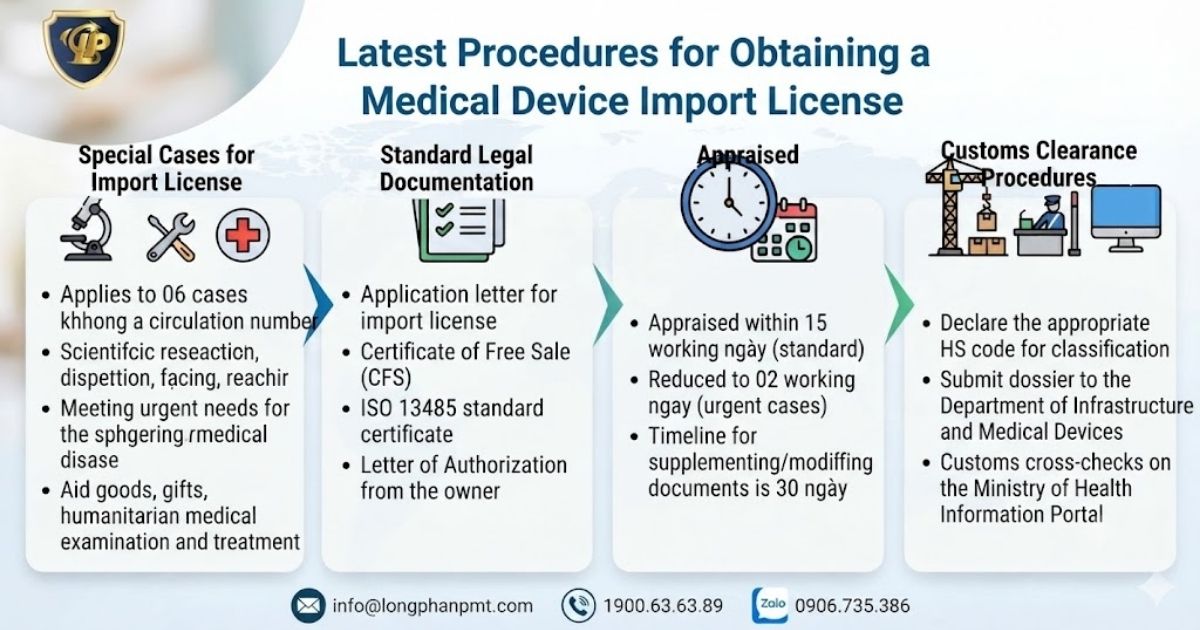
Have 6 cases Import permits must be obtained in accordance with Clause 1, Article 48 of Decree No. 98/2021/ND-CP, as amended and supplemented by Decree No. 07/2023/ND-CP:
If the import purpose does not fall into the above categories, businesses should prioritize a digital circulation strategy instead of applying for specific permits. Choosing the wrong mechanism can slow down trade plans and prolong the product-to-market cycle.
The biggest risk in 2026 is reusing old licenses or transitional customs clearance mechanisms that have expired. This is a common mistake among businesses with a portfolio of Category C and D equipment that have been imported for many years.
However, businesses can still utilize some valid old documents. Authorization letters from owners and warranty eligibility certificates signed under the old regulations are still recognized if they are still valid, as per Clause 2, Article 5 of Circular No. 44/2025/TT-BYT.
Operationally, business leaders need to review the entire import catalog before placing new orders. Products lacking valid registration numbers or import licenses may be held up at customs, resulting in warehousing costs and supply chain disruptions.
The legal requirements for obtaining a Medical Device Import License extend beyond simply submitting a complete set of application documents. Businesses must demonstrate legal responsibility for the imported products, the intended purpose of importation, and the legitimacy of the entire supply chain.
For Class C and Class D medical devices that have not yet been granted a Marketing Authorization Number, businesses should assess the following three key legal requirements in advance. These requirements determine both the likelihood of obtaining an Import License and the ability to complete customs clearance once the shipment arrives:
In practice, this means businesses are relieved of the burden of demonstrating storage capacity at the port of entry, but they remain fully responsible for the legal compliance of the imported medical devices. If documentation provided by the foreign manufacturer is inconsistent or incomplete, the consequences may extend beyond requests for additional documents and could delay the entire supply schedule.
An application for a Medical Device Import License must demonstrate three fundamental elements: the lawful status of the product, the legitimacy of the import purpose, and the importer’s legal authority to conduct the transaction. Businesses are advised to review all documents provided by the manufacturer before signing an import contract, as inconsistencies may delay the entire customs clearance process.
Pursuant to Clause 2, Article 48 of Decree No. 98/2021/ND-CP, as amended and supplemented by Point b, Clause 12, Article 1 of Decree No. 07/2023/ND-CP, a standard application dossier should include the following groups of documents:
For ODA-funded projects, the application dossier may also be required to include the investment approval decision, the goods supply contract, a valid Certificate of Free Sale (CFS), technical documentation, and a Letter of Authorization from the medical device owner, as prescribed in Point o, Clause 2, Article 48 of Decree No. 98/2021/ND-CP, as amended and supplemented by Decree No. 07/2023/ND-CP.
In summary, the greatest compliance risk does not lie in the absence of a single document, but rather in inconsistencies among the submitted documents. Before filing the application, businesses should carefully verify the trade name, model number, product owner, intended use, and scope of authorization to ensure consistency throughout the dossier.

The procedure for obtaining a Medical Device Import License should be managed as a regulatory compliance workflow, rather than merely a document submission process. Errors made during product classification or document preparation may result in requests for additional information, delaying the importation of medical devices into Vietnam.
Businesses are advised to implement the following five-step process to effectively manage both the application dossier and the approval timeline:
This workflow enables businesses to effectively manage three major compliance risks simultaneously: selecting the wrong regulatory mechanism, lacking required documentation from overseas manufacturers, and delays in customs clearance. For medical devices imported under project-based procurement or emergency circumstances, establishing a clear implementation timeline from the outset is particularly important.
Product classification is the most critical step in determining the appropriate regulatory pathway. Before deciding whether to apply for an Import License or pursue a Marketing Authorization Number, businesses must first determine whether the medical device falls under Class A, B, C, or D.
Once the classification has been completed, the legal and supply chain teams should carefully review all documentation provided by the manufacturer. Key documents include the Certificate of Free Sale (CFS), ISO 13485 Certificate, product catalogue, technical documentation, instructions for use, and the Letter of Authorization issued by the medical device owner.
Documents issued overseas should be reviewed for their validity, scope of authorization, and eligibility for consular legalization, where required. Any inconsistency in the product name, model number, or product owner may result in requests for clarification before the application can proceed to the formal assessment stage.
Businesses should submit their applications to the competent authority from the outset to avoid administrative errors caused by filing with the wrong agency.
The Department of Infrastructure and Medical Devices is the central authority responsible for receiving, reviewing, and issuing Medical Device Import Licenses, pursuant to Clause 7, Article 2 of Circular No. 44/2025/TT-BYT. Accordingly, businesses should no longer use the names of former regulatory authorities in their application dossiers or explanatory submissions.
When submitting the application through the electronic system, businesses should carefully verify the document format, digital signatures, translations, and all supporting attachments. Even a minor error in the prescribed forms may prolong the processing period and affect the overall import schedule.
The statutory review period serves as an important basis for planning procurement, transportation, and customs clearance activities.
Where the application dossier is complete and valid, the competent authority will review the application and issue the Medical Device Import License within 15 working days, in accordance with Point a, Clause 3, Article 48 of Decree No. 98/2021/ND-CP.
For medical devices imported to meet urgent needs for epidemic prevention and control or disaster recovery, the review period is shortened to 2 working days, as prescribed in Point a, Clause 3, Article 48 of Decree No. 98/2021/ND-CP.
Businesses should also allocate sufficient time for potential amendments or supplementary submissions if the application does not initially meet regulatory requirements. Planning based solely on the statutory review period, while overlooking the time required to complete or revise the dossier, may significantly disrupt the overall supply chain schedule.
Even after obtaining an import license, businesses still have to pass the final checkpoint at the customs authority. Risks often arise when the license, classification, HS code, and goods documentation are inconsistent.
Businesses should handle customs procedures according to the following control sequence:
Please note that: Customs authorities have the right to cross-check information on medical equipment on the Ministry of Health’s portal at the time of customs clearance, as stipulated in Point d, Clause 2, Article 76 of Decree No. 98/2021/ND-CP, amended and supplemented by Decree No. 04/2025/ND-CP.
In terms of operations, businesses should not view import licenses as the end point of the process, because a small discrepancy between the HS code, classification, or model name can cause goods to be held at the port, incurring storage costs and delaying delivery to healthcare facilities.
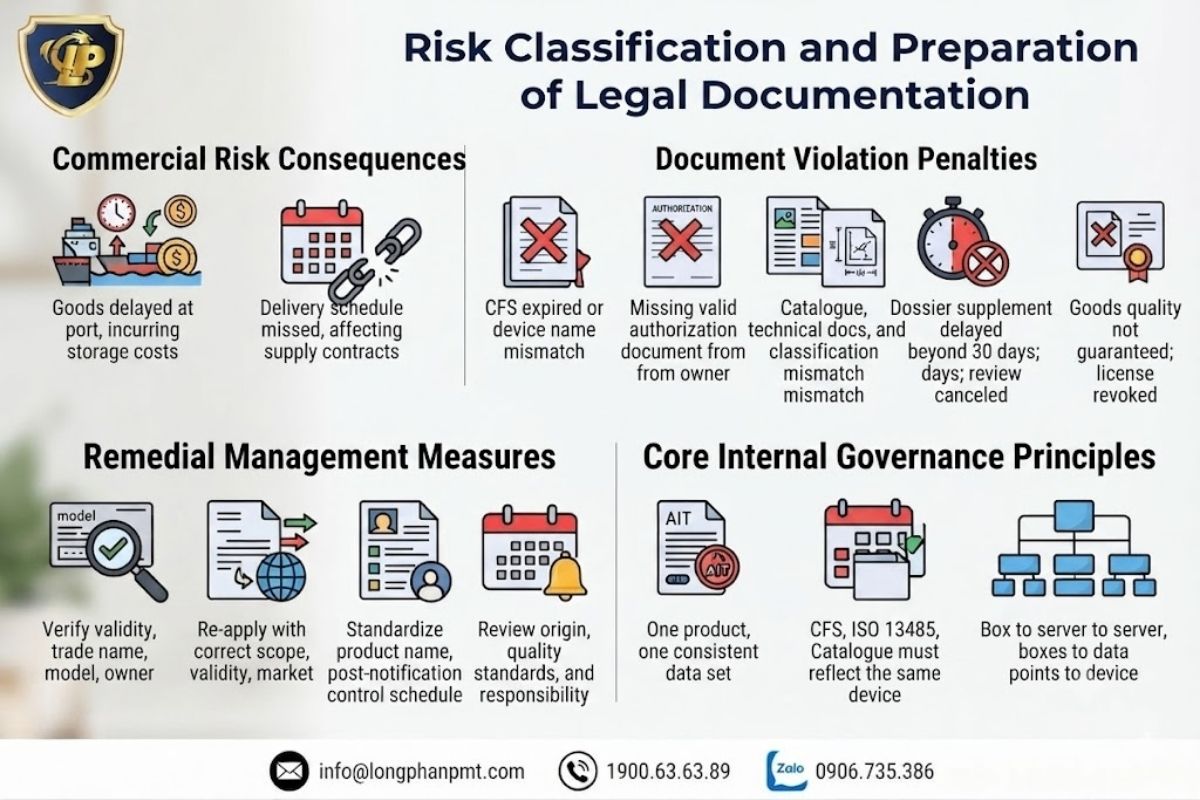
The biggest risk when applying for an import license is not just the rejection of the application. The practical consequences include delayed goods arrival at the port, increased storage costs, missed delivery deadlines, and impact on supply contracts with healthcare facilities.
During the evaluation process, if the application is not satisfactory, the business can only…30 days to amendments and additions since receiving the notification. After this deadline, The application was canceled. The review procedure is in accordance with Point d, Clause 3, Article 48 of Decree No. 98/2021/ND-CP.
| Misconduct/Deficit | Sanctions / Legal consequences | Remedial measures |
| CFS has expired or the device name does not match. | The application may be required to be amended or supplemented. | Verify validity, trade name, model, and owner before submitting. |
| Lack of legally valid authorization from the owner. | Unable to prove the right to import or distribute. | Request the license holder to reissue the license within the correct scope, timeframe, and market in Vietnam. |
| The catalog, technical documents, and classification system are inconsistent. | Increased risk of being required to explain or having the assessment process prolonged. | Standardize product names, specifications, and intended uses. |
| Too late in submitting the documents.30 days | The application process was cancelled and must be restarted from the beginning. | Set up a schedule to monitor responses immediately after receiving notifications. |
| Goods that do not meet quality or legal standards. | Import licenses may be revoked in accordance with Clause c, Point 2, Article 76 of Decree No. 98/2021/ND-CP, as amended and supplemented by Decree No. 04/2025/ND-CP. | Review the origin, quality standards, and responsibilities of the importing entity. |
In general, regarding internal governance, businesses should review records according to the following principles: “One product, one unified dataset” CFS, ISO 13485, catalog, technical documents, classification and customs documents must be included. They both reflect the same device.
Importing medical devices requires consistency across product legal documentation, technical documentation, and customs information. Long Phan Consulting assists businesses in managing regulatory risks throughout the entire process, from reviewing overseas documentation to representing clients before the competent authorities.
Our service goes beyond preparing application forms. We develop a tailored regulatory compliance strategy that aligns with the commercial objectives of each medical device portfolio. Businesses should identify at an early stage which products require a Medical Device Import License and which are better suited to a long-term strategy of obtaining a Marketing Authorization Number.
Our Key Consulting Services Include:
Businesses are welcome to send their preliminary application dossier to info@longphanpmt.com or contact us via Zalo: (+84) 906 735 386. Long Phan Consulting will conduct an initial review and provide preliminary advice on the most appropriate regulatory approach for your products.
Managing legal risks in import and export operations requires investors to have a thorough understanding of customs clearance exceptions and transitional periods. Mastering the specific regulations for obtaining a “Medical Equipment Import License” will help to effectively address administrative barriers and optimize warehousing costs. Further in-depth analysis will clarify common legal blind spots encountered in supply chain operations.
No, businesses are not required to apply for a license from the Ministry of Health for products that already have a registration number. Businesses are allowed to import these medical devices according to actual needs and are not restricted in terms of quantity for customs clearance. This free import mechanism is clearly stipulated in Clause 2, Article 46 of Decree No. 98/2021/ND-CP, amended and supplemented by Clause 11, Article 1 of Decree 07/2023/ND-CP.
No, businesses are completely exempt from the obligation to prove warehouse conditions and specialized transport vehicle capacity to customs authorities. However, the importing entity must still commit to taking full responsibility for the quality and final intended use of the medical equipment. This exemption from inspection is based on Clause 3, Article 47 of Decree No. 98/2021/ND-CP.
No, businesses cannot continue to use import licenses for medical equipment issued between January 1, 2018, and December 31, 2021, starting from the second half of 2025. The final deadline for customs clearance based on these old documents is June 30, 2025. Businesses need to urgently review their dossiers in accordance with Points a and b, Clause 2, and Point d, Clause 4, Article 76 of Decree No. 98/2021/ND-CP, as amended and supplemented by Decree No. 04/2025/ND-CP.
Applications for import licenses for medical equipment will be completely canceled if businesses fail to complete the required documents within the deadline. The maximum time limit for businesses to resubmit supplementary documents is 30 days from the date of receiving the notification requesting corrections. Strict penalties for invalidating such applications are stipulated in Point d, Clause 3, Article 48 of Decree No. 98/2021/ND-CP.
No, businesses are not required to re-apply for the authorization document from the owner of medical equipment if the old document is still valid. The state management agency continues to recognize the legality of the authorization and warranty eligibility certificates signed under the old regulations to optimize costs. The policy on recognizing legal documents from the previous period is stipulated in Clause 2, Article 5 of Circular No. 44/2025/TT-BYT.
The review and licensing period has been shortened to a maximum of only 2 working days for medical equipment used in disease prevention and control or disaster relief. This time is calculated from the moment the Department of Medical Infrastructure and Equipment receives all valid documents. The expedited review process for specialized medical equipment is based on Point a, Clause 3, Article 48 of Decree No. 98/2021/ND-CP.
Medical equipment import licenses require careful consideration from the import planning stage, as businesses must clearly distinguish between applications for specialized medical equipment import licenses and those for medical equipment registration numbers from 2026 onwards. Incorrect classification, lack of CFS (Certificate of Free Sale), ISO 13485 certification, or valid authorization documents can lead to customs delays, increased storage costs, and disruptions to supply contracts. To manage risks related to documentation and customs clearance, please contact our hotline.1900636389 to receive support from Long Phan Consulting.
📚 This article has been professionally reviewed based on the following legal documents:


