


A Billiards business license is a mandatory compliance requirement for foreign investors operating billiards facilities in Vietnam. Launching operations without the Certificate of Eligibility for Sports Business Operations may lead to immediate suspension, administrative penalties, and substantial financial losses. Business registration alone does not authorize the provision of regulated sports services under the Law on Enterprises and Businesses.
Long Phan Consulting supports investors in assessing premises, technical standards, equipment, and licensing documents to establish compliant operations and reduce approval risks from the project planning stage.

Key legal notes:
Foreign investors must understand that registering a business or household entity does not equate to a license to operate. This process merely establishes your legal personality; it does not replace the mandatory Certificate of Eligibility for Sports Business Operations.
The primary risk for investors is launching operations immediately after company formation. Under Clause 2 and Clause 4, Article 55 of the Law on Physical Training and Sports (2006, amended 2018), any enterprise conducting sports activities must possess specialized personnel and certified infrastructure. You may only commence business operations after receiving the official Certificate of Eligibility.
| Criterion | Enterprise/Household Registration | Certificate of Eligibility for Sports Business |
| Objective | Establishes legal business status | Certifies sports operational standards |
| Scope | Business lines, tax code, ownership | Facility, equipment, personnel validation |
| Authority | Business Registration Office | Provincial Sports Authority |
| Risk | Incomplete legal capacity for trade | Unauthorized sports operations |
An optimal, risk-averse approach involves establishing your legal entity first, followed by a systematic application for the industry-specific permit. Inverting this sequence can lead to delayed openings, wasted rental expenses, and regulatory non-compliance during site inspections.
Misunderstanding these procedures frequently leads to premature, unauthorized openings. For investors securing long-term lease agreements, the risk extends beyond administrative penalties to include significant cash flow disruption, failed renovation investments, and compromised human resource planning.
Under the market nomenclature, the “billiards business license” must be accurately understood as the Certificate of Eligibility for Sports Business Operations. Pursuant to Clause 1, Article 23 of Decree 36/2019/NĐ-CP, this certificate may be revoked if the enterprise terminates sports activities or has its operational rights suspended due to administrative violations.
Key operational risks requiring strict control include:
The safest approach is to treat this industry-specific permit as a foundational prerequisite for opening. While entity registration provides the “legal shell,” the Certificate of Eligibility dictates your actual right to operate a billiards facility in Vietnam.
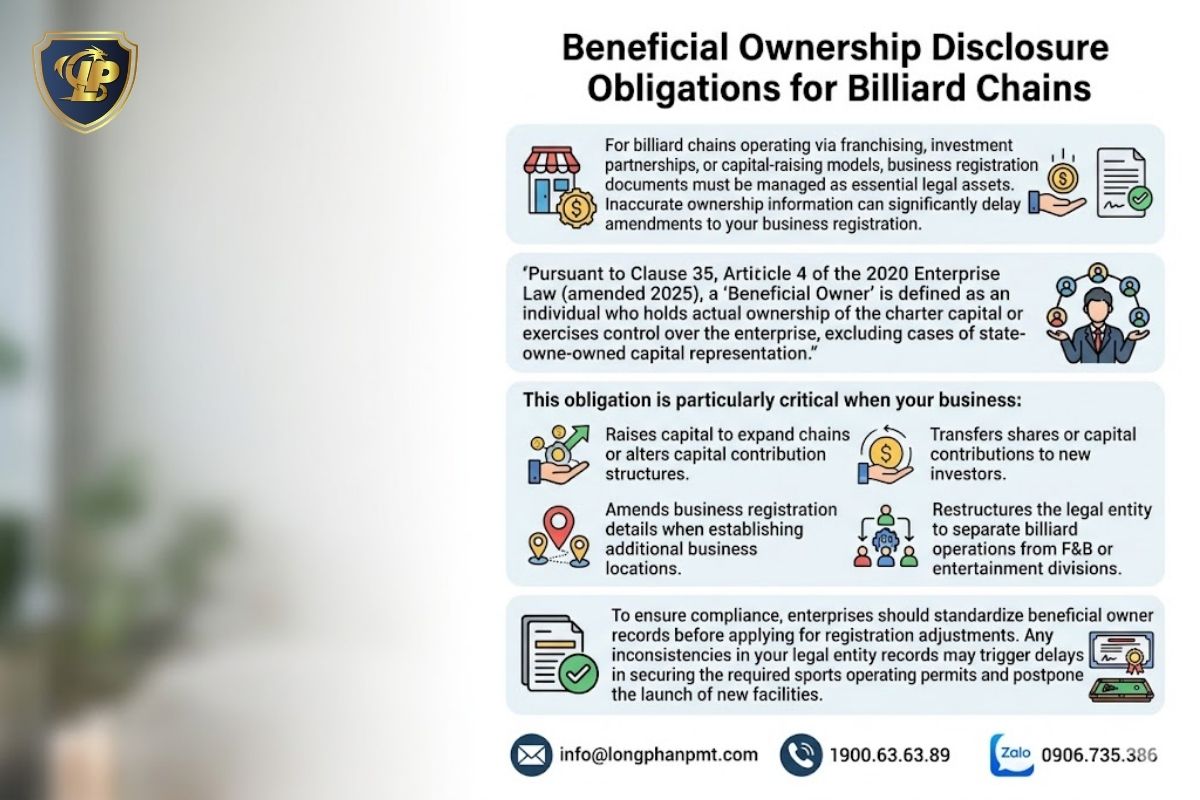
For billiard chains operating via franchising, investment partnerships, or capital-raising models, business registration documents must be managed as essential legal assets. Inaccurate ownership information can significantly delay amendments to your business registration.
Pursuant to Clause 35, Article 4 of the 2020 Enterprise Law (amended 2025), a “Beneficial Owner” is defined as an individual who holds actual ownership of the charter capital or exercises control over the enterprise, excluding cases of state-owned capital representation.
This obligation is particularly critical when your business:
To ensure compliance, enterprises should standardize beneficial owner records before applying for registration adjustments. Any inconsistencies in your legal entity records may trigger delays in securing the required sports operating permits and postpone the launch of new facilities.
Investors should assess the premises before making a deposit or signing a long-term lease. The bottleneck in billiard business license applications often lies in the ability to demonstrate the physical facilities, not just in the administrative application form.
Businesses operating in the sports sector must have facilities and equipment that meet operational requirements. The Minister of Culture, Sports and Tourism is responsible for issuing national technical standards on sports facilities and equipment applicable to businesses, as stipulated in Clause 2, Article 24 of Decree No. 36/2019/ND-CP.
Items to review before renting include:
Surveying should be done before finalizing the site plan. If the lease agreement does not allow for renovations, the business may find itself paying rent but not being eligible to complete the necessary permit application.
Businesses need to control the design of the space in a way that demonstrates safety, functionality, and suitability for sports activities. This is the foundation for ensuring that the application does not raise any doubts about the condition of the facilities.
Parameters such as the area where the table is placed, including the covered area and the distance from the outer edge of the table to the wall 1.5m and the distance between the tables 1.2m This provision was previously a reference point in the old specialized regulations. However, this provision in Circular No. 04/2018/TT-BVHTTDL has been repealed by Article 16 of Circular No. 21/2025/TT-BVHTTDL.
Therefore, businesses should not use outdated parameters as their sole legal basis. The safer approach is:
The commercial risk lies in designing the shop based on market experience but failing to meet inspection criteria. Investors should include clauses in the lease agreement granting the right to renovate, remedy, and terminate the lease if the premises do not meet licensing requirements.
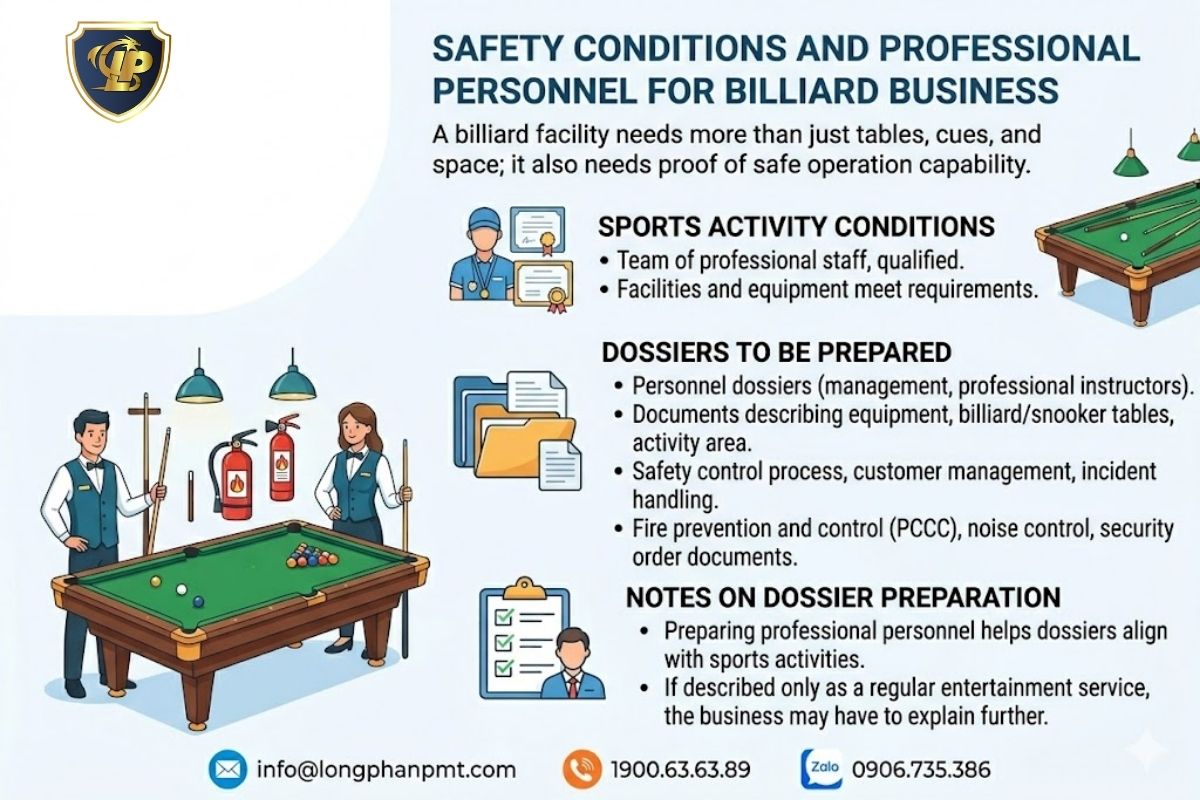
A billiards facility requires more than just tables, cues, and space. Businesses must also demonstrate their ability to operate safely, especially if they provide training, instruction, or organize regular sporting activities.
Conditions for conducting sports business activities include having a qualified team of professional staff and facilities and equipment that meet requirements. Businesses are only allowed to operate after being granted a Certificate of Eligibility to conduct business, in accordance with Clauses 2 and 4 of Article 55 of the Law on Physical Education and Sports of 2006, as amended and supplemented in 2018.
The documents that should be prepared include:
Preparing specialized personnel from the outset helps ensure the application is consistent with the nature of the sports activity. If the facility is only described as a regular entertainment service, the business is likely to be asked to provide explanations or additional documentation.
Businesses should view the procedure for applying for a Certificate of Eligibility to Conduct Sports Activities as a separate and independent process from business registration or household business registration. If the application is not properly prepared from the outset, the opening plan may be delayed due to the need for amendments and additions.
The execution sequence should be controlled according to the following steps:
Effective management involves linking the licensing process to the timeline for leasing, renovation, and hiring. If additional documents are requested, businesses need to respond quickly to avoid missing the opening deadline.
The summary of business preparation is an often overlooked but crucial document. This is where the business demonstrates that the billiards facility meets the requirements to operate as a sporting event.
The application for a certificate needs to be standardized into 01 set of documents. This includes the Application for a Certificate and a Summary of the preparation of conditions for conducting sports business activities, as stipulated in Clause 1, Article 19 of Decree No. 36/2019/ND-CP, amended and supplemented by Decree No. 31/2024/ND-CP.
The application should clearly state:
Businesses should review their applications using a logical “proof of eligibility” approach, not just filling out forms. If the summary lacks factual data, the processing agency has grounds to request revisions or further verification.
The licensing authority needs to be correctly identified from the outset to avoid submitting applications to the wrong place. For billiard halls, the processing authority is not the business registration agency but the provincial-level specialized agency for physical education and sports.
Businesses submit their applications to the specialized agency for physical education and sports under the People’s Committee of the province where the business location is registered. This is the authority that issues the Certificate of Eligibility for Sports Business Activities, according to Clause 1, Article 19 of Decree No. 36/2019/ND-CP, amended and supplemented by Decree No. 31/2024/ND-CP.
The deadlines that need to be included in the opening plan are:
In terms of operations, these milestones need to be incorporated into the lease plan, opening communications, and staff recruitment. Opening before receiving the Certificate of Registration could create risks of inspections and disrupt cash flow.
Possessing a Certificate of Eligibility for Sports Business Operations does not automatically authorize all associated services. For integrated models combining billiards with coffee, beverages, alcohol, or fee-based tournaments, the primary risk lies in your ancillary licensing ecosystem.
Enterprises should concurrently manage these document groups:
The safest management strategy is to establish an interdisciplinary checklist prior to your opening date. Neglecting any ancillary license can disrupt your business model, even if the primary sports license has been granted.
Billiards facilities often operate in enclosed, high-occupancy spaces with significant electrical infrastructure. Consequently, Fire Prevention and Fighting (PCCC) is a critical inspection point prior to launching or expanding floor area.
Pursuant to Section 14.4, Appendix I of Decree 105/2025/NĐ-CP, service businesses with a total floor area of 300 $m^2$ or more are subject to PCCC management. Investors must accurately assess the actual floor area before signing lease agreements or commencing renovations.
For existing facilities unable to meet current PCCC requirements, Clause 3, Article 43 of Decree 105/2025/NĐ-CP provides a grace period for technical improvements until July 1, 2028. If compliance remains unreachable after this deadline, a functional conversion is mandatory.
Incorporate PCCC costs into your legal budget early in the site survey stage. If the premises cannot accommodate mandatory safety exits or systems, a long-term lease may become a stranded asset.
Combining billiards with F&B services increases revenue but expands your compliance obligations. Do not assume that obtaining a sports license permits the unrestricted sale of food, beverages, or the hosting of commercial events.
Critical risk areas include:
Operate with a broad compliance roadmap. As you add services, you must explicitly separate revenue streams, licensing requirements, and management responsibilities to avoid regulatory exposure.
The application process for a billiards business license is far more than a routine administrative filing. It is a comprehensive legal audit encompassing site suitability, human resources, and ancillary permits. Long Phan Consulting Company supports enterprises in designing a licensing roadmap tailored to your specific operational model, especially for facilities integrating F&B, entertainment, or chain expansion.
Our core consulting tasks include:
The primary value of professional legal counsel is preventing costly mistakes such as securing unsuitable premises, failing renovation standards, or launching without a full legal permit. To initiate a preliminary evaluation, please send your facility documents, business registration, and proposed operational model to Email: info@longphanpmt.com or contact us via Zalo/WhatsApp: +84 906 735 386.
Establishing and operating a large-scale billiards business requires investors to overcome complex legal hurdles related to specialized sports operating conditions. Carelessly opening a facility after only completing business registration procedures without possessing the necessary “billiards business license” risks immediate suspension of operations. A thorough understanding of administrative timelines and inter-agency fire safety standards is key to optimizing premises costs and ensuring absolute compliance throughout sustainable operation.
Businesses or household businesses are not allowed to commence operations immediately after registration; they are required to obtain a Certificate of Eligibility for Sports Business Activities issued by a competent state agency. The establishment is only permitted to operate after obtaining a Certificate of Eligibility for Sports Business Activities from a competent state agency, as stipulated in Clauses 2 and 4 of Article 55 of the 2006 Law on Physical Education and Sports (amended and supplemented by the 2018 Law).
The specialized agency for physical education and sports under the Provincial People’s Committee will conduct on-site inspections of business conditions and issue a Certificate to the enterprise within 7 working days from the date of receiving a complete and valid application as stipulated in Clause 2, Article 20 of Decree No. 36/2019/NĐ-CP.
Businesses are required to prepare and submit one set of documents including an application for a Certificate and a summary of the preparation of business conditions for sports activities as prescribed in Clause 1, Article 19 of Decree No. 36/2019/ND-CP (amended and supplemented by Decree No. 31/2024/ND-CP).
The issuing authority is responsible for notifying the enterprise in writing, either directly or electronically, of the necessary amendments or additions within 3 working days from the date of receiving the application, as stipulated in Clause 2, Article 20 of Decree No. 36/2019/NĐ-CP.
Billiard service establishments with a total floor area of 300 m2 or more are required to establish management records, equip technical systems, and undergo periodic or unscheduled fire safety inspections, as they fall under the category of establishments managed by the Public Security agency regarding fire prevention and control, as stipulated in Section 14.4, Appendix I of Decree No. 105/2025/ND-CP.
Businesses are required to return the Certificate of Eligibility to the licensing authority within 3 working days from the date of cessation of sports business activities as stipulated in Point b, Clause 2, Article 23 of Decree No. 36/2019/NĐ-CP.
Facilities that do not meet fire safety requirements and were put into operation before the effective date of the Law on Fire Prevention and Fighting will not be immediately closed but will be granted an extension to complete the technical remediation until July 1, 2028 at the latest; if after this date the corresponding technical solutions cannot be applied according to the new regulations, they will be required to convert their operational function as stipulated in Clause 3, Article 43 of Decree No. 105/2025/ND-CP.
Securing a billiards business license in Vietnam demands meticulous alignment of your corporate entity, facility infrastructure, specialized personnel, and ancillary permits. Prematurely launching operations based solely on general business registration exposes your investment to severe regulatory sanctions, operational suspension, and substantial financial risk. To ensure long-term compliance and safeguard your capital, verify all PCCC standards and specialized sports requirements before finalizing your operational strategy.
For comprehensive legal support in navigating these complex Vietnamese administrative procedures and to optimize your facility’s compliance roadmap, contact the senior legal team at Long Phan Consulting Company via our direct hotline at 1900636389 for immediate professional assistance.
📚 This article is provided with professional consultation based on the following legal framework:


